

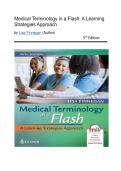
Medical Terminology in a Flash: A Learning
Strategies Approach
by Lisa Finnegan (Author)
5th Edition
,TABLE OF CONTENTS
Chapter 1: Learning Preferences and Strategies
Chapter 2: Medical Word Elements
Chapter 3: Levels of Organization
Chapter 4: Integumentary System
Chapter 5: Nervous System
Chapter 6: Cardiovascular System
Chapter 7: Lymphatic and Immune System
Chapter 8: Respiratory System
Chapter 9: Digestive System
Chapter 10: Urinary System
Chapter 11: Reproductive System
Chapter 12: Endocrine System
Chapter 13: Skeletal and Muscular Systems
Chapter 14: Special Senses: Eyes and Ears
,Test Bank: Medical Terminology in a Flash
A Learning Strategies Approach, 5th Edition (Finnegan, 2024)
MULTIPLE CHOICE
CHAPTER 1: Learning Preferences and Strategies
1. Which learning style is best described as preferring to learn through listening to lectures, recordings,
and verbal explanations?
A) Visual
B) Kinesthetic
C) Auditory
D) Read/Write
Answer: C) Auditory
2. A student who prefers to learn by handling models, practicing procedures, and participating in lab
activities is best classified as which type of learner?
A) Visual
B) Auditory
C) Read/Write
D) Kinesthetic
Answer: D) Kinesthetic
3. Which of the following is an example of a visual learning strategy for medical terminology?
A) Reading the textbook aloud
B) Creating color-coded flashcards with diagrams
, C) Listening to recorded lectures repeatedly
D) Writing out definitions multiple times
Answer: B) Creating color-coded flashcards with diagrams
4. The VARK model of learning styles includes which of the following components?
A) Visual, Auditory, Reading, Kinesthetic
B) Visual, Auditory, Read/Write, Kinesthetic
C) Verbal, Auditory, Rhythmic, Kinesthetic
D) Visual, Analytical, Read/Write, Kinesthetic
Answer: B) Visual, Auditory, Read/Write, Kinesthetic
5. Which learning strategy involves breaking medical terms into smaller parts (prefixes, roots, and
suffixes) to understand their meaning?
A) Rote memorization
B) Word dissection
C) Auditory repetition
D) Contextual mapping
Answer: B) Word dissection
6. A student who prefers taking detailed notes, reading textbooks, and making lists is best described as
which type of learner?
A) Kinesthetic
B) Visual
Strategies Approach
by Lisa Finnegan (Author)
5th Edition
,TABLE OF CONTENTS
Chapter 1: Learning Preferences and Strategies
Chapter 2: Medical Word Elements
Chapter 3: Levels of Organization
Chapter 4: Integumentary System
Chapter 5: Nervous System
Chapter 6: Cardiovascular System
Chapter 7: Lymphatic and Immune System
Chapter 8: Respiratory System
Chapter 9: Digestive System
Chapter 10: Urinary System
Chapter 11: Reproductive System
Chapter 12: Endocrine System
Chapter 13: Skeletal and Muscular Systems
Chapter 14: Special Senses: Eyes and Ears
,Test Bank: Medical Terminology in a Flash
A Learning Strategies Approach, 5th Edition (Finnegan, 2024)
MULTIPLE CHOICE
CHAPTER 1: Learning Preferences and Strategies
1. Which learning style is best described as preferring to learn through listening to lectures, recordings,
and verbal explanations?
A) Visual
B) Kinesthetic
C) Auditory
D) Read/Write
Answer: C) Auditory
2. A student who prefers to learn by handling models, practicing procedures, and participating in lab
activities is best classified as which type of learner?
A) Visual
B) Auditory
C) Read/Write
D) Kinesthetic
Answer: D) Kinesthetic
3. Which of the following is an example of a visual learning strategy for medical terminology?
A) Reading the textbook aloud
B) Creating color-coded flashcards with diagrams
, C) Listening to recorded lectures repeatedly
D) Writing out definitions multiple times
Answer: B) Creating color-coded flashcards with diagrams
4. The VARK model of learning styles includes which of the following components?
A) Visual, Auditory, Reading, Kinesthetic
B) Visual, Auditory, Read/Write, Kinesthetic
C) Verbal, Auditory, Rhythmic, Kinesthetic
D) Visual, Analytical, Read/Write, Kinesthetic
Answer: B) Visual, Auditory, Read/Write, Kinesthetic
5. Which learning strategy involves breaking medical terms into smaller parts (prefixes, roots, and
suffixes) to understand their meaning?
A) Rote memorization
B) Word dissection
C) Auditory repetition
D) Contextual mapping
Answer: B) Word dissection
6. A student who prefers taking detailed notes, reading textbooks, and making lists is best described as
which type of learner?
A) Kinesthetic
B) Visual


