

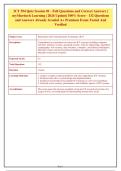
ICT 394 Quiz Session 01 - Full Questions and Correct Answers |
myMurdoch Learning | 2026 Update| 100% Score - 132 Questions
and Answers Already Graded A+ Premium Exam Tested And
Verified
Subject Area Information and Communication Technology (ICT)
Description Comprehensive examination covering core ICT concepts including computer
networks, database systems, operating systems, software engineering, algorithms,
cryptography, web security, data structures, compilers, and artificial intelligence.
Questions require advanced analytical thinking and application of theoretical
principles to practical scenarios.
Expected Grade A+
Total Questions 132
Duration 3 hours
Learning Outcomes 1. Analyze complex technical problems and select appropriate ICT solutions
2. Evaluate trade-offs in system design and implementation
3. Synthesize knowledge from multiple ICT domains to solve novel problems
4. Critically assess security, performance, and reliability aspects of ICT systems
Accreditation This exam meets the rigorous standards of top-tier US research universities (Ivy
League & R1), assessing depth of understanding beyond mere recall.
Page 1
,Question 1 of 132
In TCP Reno, after a packet loss is detected via triple duplicate ACKs, the congestion window is
halved. If the congestion window before loss is 16 segments and the slow start threshold is 20, what
will be the congestion window after the congestion avoidance phase begins following the loss?
A. 8 segments, and slow start threshold set to 10
B. 8 segments, and slow start threshold set to 8
C. 4 segments, and slow start threshold set to 16
D. 16 segments, and slow start threshold set to 8
The correct answer is:
Correct Action: 8 segments, and slow start threshold set to 8
Rationales
• 8 segments, and slow start threshold set to 8 (Correct):
This is the correct action. In TCP Reno's fast recovery, on triple duplicate ACKs, the congestion window is halved (from 16
to 8) and the slow start threshold is set to half the current window before loss (i.e., 8). Option A incorrectly uses the
pre-loss threshold; C halves again; D keeps window unchanged.
• 8 segments, and slow start threshold set to 10 (Incorrect):
This option is not appropriate. e., 8)
• 4 segments, and slow start threshold set to 16 (Incorrect):
This option is not appropriate. e., 8)
• 16 segments, and slow start threshold set to 8 (Incorrect):
This option is not appropriate. e., 8)
Page 2
,Question 2 of 132
A relation R(A, B, C, D, E) has functional dependencies: AB -> C, C -> D, D -> B, and B -> E. Is R in
Boyce-Codd Normal Form (BCNF)? If not, which dependency violates BCNF?
A. Yes, R is in BCNF
B. No, AB -> C violates BCNF
C. No, C -> D violates BCNF
D. No, D -> B violates BCNF
The correct answer is:
Correct Action: No, C -> D violates BCNF
Rationales
• No, C -> D violates BCNF (Correct):
This is the correct action. For BCNF, every determinant must be a superkey. Candidate keys: AB (since AB->C->D->B->E)
and also AD? Actually compute: AB is a key. Also, from D->B, we have AD->AB, so AD is also a key. Check each FD:
AB->C (AB superkey, ok). C->D: C is not a superkey (C not in {AB, AD}), violates. D->B: D is not a superkey (needs D+
• Yes, R is in BCNF (Incorrect):
This option is not appropriate. Candidate keys: AB (since AB->C->D->B->E) and also AD? Actually compute: AB is a
key. Also, from D->B, we have AD->AB, so AD is also a key
• No, AB -> C violates BCNF (Incorrect):
This option is not appropriate. Candidate keys: AB (since AB->C->D->B->E) and also AD? Actually compute: AB is a
key. Also, from D->B, we have AD->AB, so AD is also a key
• No, D -> B violates BCNF (Incorrect):
This option is not appropriate. Candidate keys: AB (since AB->C->D->B->E) and also AD? Actually compute: AB is a
key. Also, from D->B, we have AD->AB, so AD is also a key
Page 3
, Question 3 of 132
In RSA, given p=11, q=13, and e=7, what is the private exponent d?
A. 103
B. 11
C. 37
D. 23
The correct answer is:
Correct Action: 103
Rationales
• 103 (Correct):
This is the correct action. n = p*q = 143. (n) = (p-1)(q-1) = 10*12 = 120. d is the modular inverse of e mod (n): e*d 1 mod
120. 7*d 1 mod 120 => d = 7^{-1} mod 120. 7*103 = 721 = 6*120+1 = 721 mod 120 = 1. So d=103. Other options are
incorrect inverses or random.
• 11 (Incorrect):
This option is not appropriate. (n) = (p-1)(q-1) = 10*12 = 120. d is the modular inverse of e mod (n): e*d 1 mod 120
• 37 (Incorrect):
This option is not appropriate. (n) = (p-1)(q-1) = 10*12 = 120. d is the modular inverse of e mod (n): e*d 1 mod 120
• 23 (Incorrect):
This option is not appropriate. (n) = (p-1)(q-1) = 10*12 = 120. d is the modular inverse of e mod (n): e*d 1 mod 120
Page 4
myMurdoch Learning | 2026 Update| 100% Score - 132 Questions
and Answers Already Graded A+ Premium Exam Tested And
Verified
Subject Area Information and Communication Technology (ICT)
Description Comprehensive examination covering core ICT concepts including computer
networks, database systems, operating systems, software engineering, algorithms,
cryptography, web security, data structures, compilers, and artificial intelligence.
Questions require advanced analytical thinking and application of theoretical
principles to practical scenarios.
Expected Grade A+
Total Questions 132
Duration 3 hours
Learning Outcomes 1. Analyze complex technical problems and select appropriate ICT solutions
2. Evaluate trade-offs in system design and implementation
3. Synthesize knowledge from multiple ICT domains to solve novel problems
4. Critically assess security, performance, and reliability aspects of ICT systems
Accreditation This exam meets the rigorous standards of top-tier US research universities (Ivy
League & R1), assessing depth of understanding beyond mere recall.
Page 1
,Question 1 of 132
In TCP Reno, after a packet loss is detected via triple duplicate ACKs, the congestion window is
halved. If the congestion window before loss is 16 segments and the slow start threshold is 20, what
will be the congestion window after the congestion avoidance phase begins following the loss?
A. 8 segments, and slow start threshold set to 10
B. 8 segments, and slow start threshold set to 8
C. 4 segments, and slow start threshold set to 16
D. 16 segments, and slow start threshold set to 8
The correct answer is:
Correct Action: 8 segments, and slow start threshold set to 8
Rationales
• 8 segments, and slow start threshold set to 8 (Correct):
This is the correct action. In TCP Reno's fast recovery, on triple duplicate ACKs, the congestion window is halved (from 16
to 8) and the slow start threshold is set to half the current window before loss (i.e., 8). Option A incorrectly uses the
pre-loss threshold; C halves again; D keeps window unchanged.
• 8 segments, and slow start threshold set to 10 (Incorrect):
This option is not appropriate. e., 8)
• 4 segments, and slow start threshold set to 16 (Incorrect):
This option is not appropriate. e., 8)
• 16 segments, and slow start threshold set to 8 (Incorrect):
This option is not appropriate. e., 8)
Page 2
,Question 2 of 132
A relation R(A, B, C, D, E) has functional dependencies: AB -> C, C -> D, D -> B, and B -> E. Is R in
Boyce-Codd Normal Form (BCNF)? If not, which dependency violates BCNF?
A. Yes, R is in BCNF
B. No, AB -> C violates BCNF
C. No, C -> D violates BCNF
D. No, D -> B violates BCNF
The correct answer is:
Correct Action: No, C -> D violates BCNF
Rationales
• No, C -> D violates BCNF (Correct):
This is the correct action. For BCNF, every determinant must be a superkey. Candidate keys: AB (since AB->C->D->B->E)
and also AD? Actually compute: AB is a key. Also, from D->B, we have AD->AB, so AD is also a key. Check each FD:
AB->C (AB superkey, ok). C->D: C is not a superkey (C not in {AB, AD}), violates. D->B: D is not a superkey (needs D+
• Yes, R is in BCNF (Incorrect):
This option is not appropriate. Candidate keys: AB (since AB->C->D->B->E) and also AD? Actually compute: AB is a
key. Also, from D->B, we have AD->AB, so AD is also a key
• No, AB -> C violates BCNF (Incorrect):
This option is not appropriate. Candidate keys: AB (since AB->C->D->B->E) and also AD? Actually compute: AB is a
key. Also, from D->B, we have AD->AB, so AD is also a key
• No, D -> B violates BCNF (Incorrect):
This option is not appropriate. Candidate keys: AB (since AB->C->D->B->E) and also AD? Actually compute: AB is a
key. Also, from D->B, we have AD->AB, so AD is also a key
Page 3
, Question 3 of 132
In RSA, given p=11, q=13, and e=7, what is the private exponent d?
A. 103
B. 11
C. 37
D. 23
The correct answer is:
Correct Action: 103
Rationales
• 103 (Correct):
This is the correct action. n = p*q = 143. (n) = (p-1)(q-1) = 10*12 = 120. d is the modular inverse of e mod (n): e*d 1 mod
120. 7*d 1 mod 120 => d = 7^{-1} mod 120. 7*103 = 721 = 6*120+1 = 721 mod 120 = 1. So d=103. Other options are
incorrect inverses or random.
• 11 (Incorrect):
This option is not appropriate. (n) = (p-1)(q-1) = 10*12 = 120. d is the modular inverse of e mod (n): e*d 1 mod 120
• 37 (Incorrect):
This option is not appropriate. (n) = (p-1)(q-1) = 10*12 = 120. d is the modular inverse of e mod (n): e*d 1 mod 120
• 23 (Incorrect):
This option is not appropriate. (n) = (p-1)(q-1) = 10*12 = 120. d is the modular inverse of e mod (n): e*d 1 mod 120
Page 4


