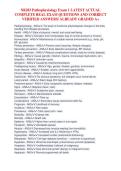
NR283 Pathophysiology Exam 1 LATEST ACTUAL
COMPLETE REAL EXAM QUESTIONS AND CORRECT
VERIFIED ANSWERS/ ALREADY GRADED A+
Pathophysiology - ANS✔✔-The study of functional (physiological) changes in the body
resulting from disease processes.
Health - ANS✔✔-State of physical, mental, and social well-being.
Disease - ANS✔✔-Deviation from homeostasis; loss of normal structure or function.
Homeostasis - ANS✔✔-Maintenance of a stable internal environment (e.g., temp, pH,
BP, glucose).
Primary prevention - ANS✔✔-Prevent onset (vaccines, lifestyle changes).
Secondary prevention - ANS✔✔-Early detection (screenings, BP checks).
Tertiary prevention - ANS✔✔-Reduce complications (rehab, meds for chronic disease).
Etiology - ANS✔✔-Cause (genetic, infection, trauma, immunologic dysfunction, etc.).
Idiopathic - ANS✔✔-Unknown cause.
Iatrogenic - ANS✔✔-Caused by treatment/procedure.
Predisposing factors - ANS✔✔-Age, gender, lifestyle, genetics, environment.
Acute disease - ANS✔✔-Sudden, severe, short-term (appendicitis).
Chronic disease - ANS✔✔-Gradual, long-term (COPD, HTN).
Subclinical - ANS✔✔-No obvious symptoms, but changes occur (renal failure).
Latent period - ANS✔✔-Silent stage (HIV latency).
Prodromal period - ANS✔✔-Early nonspecific symptoms (fatigue, malaise).
Signs - ANS✔✔-Objective (fever, rash).
Symptoms - ANS✔✔-Subjective (pain, nausea).
Remission - ANS✔✔-Manifestations subside.
Exacerbation - ANS✔✔-Flare-up.
Complications - ANS✔✔-Secondary issues (pneumonia after flu).
Prognosis - ANS✔✔-Likelihood of recovery.
Incidence - ANS✔✔-New cases.
Prevalence - ANS✔✔-Total cases (old + new).
Morbidity - ANS✔✔-Disease rate.
Mortality - ANS✔✔-Death rate.
Epidemic - ANS✔✔-Higher than normal cases in one region.
Pandemic - ANS✔✔-Worldwide spread.
Atrophy - ANS✔✔-Decreased size (muscle wasting from immobility).
Hypertrophy - ANS✔✔-Increased size (LV thickening in HTN).
Hyperplasia - ANS✔✔-Increased number (endometrial thickening).
Metaplasia - ANS✔✔-Cell type replaced (smoking → columnar to squamous).
Dysplasia - ANS✔✔-Abnormal size/shape; precancerous (cervical dysplasia).
Anaplasia - ANS✔✔-Undifferentiated; hallmark of malignancy.
Neoplasia - ANS✔✔-New abnormal growth (benign or malignant tumor).
Apoptosis - ANS✔✔-Normal programmed cell death.
, NR283 Pathophysiology Exam 1 LATEST ACTUAL
COMPLETE REAL EXAM QUESTIONS AND CORRECT
VERIFIED ANSWERS/ ALREADY GRADED A+
Ischemia - ANS✔✔-Lack of blood flow.
Hypoxia - ANS✔✔-Reduced oxygen in tissues.
Necrosis - ANS✔✔-Pathologic cell death.
Liquefaction - ANS✔✔-Cells liquefy (brain infarct).
Coagulative - ANS✔✔-Cells retain shape (myocardial infarction).
Caseous - ANS✔✔-Cheese-like debris (TB).
Fat necrosis - ANS✔✔-Fat breakdown (pancreatitis).
Gangrene - ANS✔✔-Dead tissue invaded by bacteria.
General Adaptation Syndrome (GAS) - ANS✔✔-A three-stage response to stress:
Alarm, Resistance, Exhaustion.
Short-Term Stress Responses - ANS✔✔-↑ BP, HR, RR; Pupils dilate.
Exhaustion - ANS✔✔-Depletion of resources → disease.
Long-Term Stress Effects - ANS✔✔-HTN, heart disease. Ulcers, infections. Fatigue,
depression. Impaired wound healing.
Technostress - ANS✔✔-Stress caused by overreliance on technology.
Chemical hazards - ANS✔✔-Lead, mercury, pesticides, asbestos.
Physical hazards - ANS✔✔-Radiation, heat/cold extremes, noise.
Biological hazards - ANS✔✔-Bites, rabies, malaria, Lyme disease.
Food/Waterborne hazards - ANS✔✔-E. coli, Salmonella, Staphylococcus, botulism.
Lead Poisoning Signs - ANS✔✔-Irritability, headache, abdominal pain, anemia,
developmental delays in children.
Lead Poisoning Complications - ANS✔✔-Neurologic damage, kidney dysfunction.
Benign Tumors - ANS✔✔-Growth is slow, well-differentiated, localized, rare systemic
effects, and rare life-threatening.
Malignant Tumors - ANS✔✔-Growth is rapid, undifferentiated, invasive, common
systemic effects (fatigue, weight loss), and often life-threatening.
Hallmarks of Cancer - ANS✔✔-No apoptosis, no contact inhibition, invasion of tissues,
angiogenesis (new blood vessels).
Warning Signs of Cancer (CAUTION) - ANS✔✔-Change in bowel/bladder habits, a sore
that doesn't heal, unusual bleeding/discharge, thickening/lump, indigestion/difficulty
swallowing, obvious mole change, nagging cough/hoarseness.
Systemic Effects of Cancer - ANS✔✔-Weight loss, cachexia, fatigue, anemia,
infections, bleeding, paraneoplastic syndromes (hormone-like secretions).
Cancer Staging (TNM) - ANS✔✔-T: Tumor size, N: Node involvement, M: Metastasis.
Example: T2N1M0 = medium tumor, 1 node, no metastasis.
Carcinogenesis Stages - ANS✔✔-Initiation (DNA mutation), Promotion (exposure to
promoters, hormones), Progression (malignant tumor growth).
Malnutrition in Cancer - ANS✔✔-Tumors compete for nutrients; treatments cause
anorexia, mouth sores, nausea/vomiting.
COMPLETE REAL EXAM QUESTIONS AND CORRECT
VERIFIED ANSWERS/ ALREADY GRADED A+
Pathophysiology - ANS✔✔-The study of functional (physiological) changes in the body
resulting from disease processes.
Health - ANS✔✔-State of physical, mental, and social well-being.
Disease - ANS✔✔-Deviation from homeostasis; loss of normal structure or function.
Homeostasis - ANS✔✔-Maintenance of a stable internal environment (e.g., temp, pH,
BP, glucose).
Primary prevention - ANS✔✔-Prevent onset (vaccines, lifestyle changes).
Secondary prevention - ANS✔✔-Early detection (screenings, BP checks).
Tertiary prevention - ANS✔✔-Reduce complications (rehab, meds for chronic disease).
Etiology - ANS✔✔-Cause (genetic, infection, trauma, immunologic dysfunction, etc.).
Idiopathic - ANS✔✔-Unknown cause.
Iatrogenic - ANS✔✔-Caused by treatment/procedure.
Predisposing factors - ANS✔✔-Age, gender, lifestyle, genetics, environment.
Acute disease - ANS✔✔-Sudden, severe, short-term (appendicitis).
Chronic disease - ANS✔✔-Gradual, long-term (COPD, HTN).
Subclinical - ANS✔✔-No obvious symptoms, but changes occur (renal failure).
Latent period - ANS✔✔-Silent stage (HIV latency).
Prodromal period - ANS✔✔-Early nonspecific symptoms (fatigue, malaise).
Signs - ANS✔✔-Objective (fever, rash).
Symptoms - ANS✔✔-Subjective (pain, nausea).
Remission - ANS✔✔-Manifestations subside.
Exacerbation - ANS✔✔-Flare-up.
Complications - ANS✔✔-Secondary issues (pneumonia after flu).
Prognosis - ANS✔✔-Likelihood of recovery.
Incidence - ANS✔✔-New cases.
Prevalence - ANS✔✔-Total cases (old + new).
Morbidity - ANS✔✔-Disease rate.
Mortality - ANS✔✔-Death rate.
Epidemic - ANS✔✔-Higher than normal cases in one region.
Pandemic - ANS✔✔-Worldwide spread.
Atrophy - ANS✔✔-Decreased size (muscle wasting from immobility).
Hypertrophy - ANS✔✔-Increased size (LV thickening in HTN).
Hyperplasia - ANS✔✔-Increased number (endometrial thickening).
Metaplasia - ANS✔✔-Cell type replaced (smoking → columnar to squamous).
Dysplasia - ANS✔✔-Abnormal size/shape; precancerous (cervical dysplasia).
Anaplasia - ANS✔✔-Undifferentiated; hallmark of malignancy.
Neoplasia - ANS✔✔-New abnormal growth (benign or malignant tumor).
Apoptosis - ANS✔✔-Normal programmed cell death.
, NR283 Pathophysiology Exam 1 LATEST ACTUAL
COMPLETE REAL EXAM QUESTIONS AND CORRECT
VERIFIED ANSWERS/ ALREADY GRADED A+
Ischemia - ANS✔✔-Lack of blood flow.
Hypoxia - ANS✔✔-Reduced oxygen in tissues.
Necrosis - ANS✔✔-Pathologic cell death.
Liquefaction - ANS✔✔-Cells liquefy (brain infarct).
Coagulative - ANS✔✔-Cells retain shape (myocardial infarction).
Caseous - ANS✔✔-Cheese-like debris (TB).
Fat necrosis - ANS✔✔-Fat breakdown (pancreatitis).
Gangrene - ANS✔✔-Dead tissue invaded by bacteria.
General Adaptation Syndrome (GAS) - ANS✔✔-A three-stage response to stress:
Alarm, Resistance, Exhaustion.
Short-Term Stress Responses - ANS✔✔-↑ BP, HR, RR; Pupils dilate.
Exhaustion - ANS✔✔-Depletion of resources → disease.
Long-Term Stress Effects - ANS✔✔-HTN, heart disease. Ulcers, infections. Fatigue,
depression. Impaired wound healing.
Technostress - ANS✔✔-Stress caused by overreliance on technology.
Chemical hazards - ANS✔✔-Lead, mercury, pesticides, asbestos.
Physical hazards - ANS✔✔-Radiation, heat/cold extremes, noise.
Biological hazards - ANS✔✔-Bites, rabies, malaria, Lyme disease.
Food/Waterborne hazards - ANS✔✔-E. coli, Salmonella, Staphylococcus, botulism.
Lead Poisoning Signs - ANS✔✔-Irritability, headache, abdominal pain, anemia,
developmental delays in children.
Lead Poisoning Complications - ANS✔✔-Neurologic damage, kidney dysfunction.
Benign Tumors - ANS✔✔-Growth is slow, well-differentiated, localized, rare systemic
effects, and rare life-threatening.
Malignant Tumors - ANS✔✔-Growth is rapid, undifferentiated, invasive, common
systemic effects (fatigue, weight loss), and often life-threatening.
Hallmarks of Cancer - ANS✔✔-No apoptosis, no contact inhibition, invasion of tissues,
angiogenesis (new blood vessels).
Warning Signs of Cancer (CAUTION) - ANS✔✔-Change in bowel/bladder habits, a sore
that doesn't heal, unusual bleeding/discharge, thickening/lump, indigestion/difficulty
swallowing, obvious mole change, nagging cough/hoarseness.
Systemic Effects of Cancer - ANS✔✔-Weight loss, cachexia, fatigue, anemia,
infections, bleeding, paraneoplastic syndromes (hormone-like secretions).
Cancer Staging (TNM) - ANS✔✔-T: Tumor size, N: Node involvement, M: Metastasis.
Example: T2N1M0 = medium tumor, 1 node, no metastasis.
Carcinogenesis Stages - ANS✔✔-Initiation (DNA mutation), Promotion (exposure to
promoters, hormones), Progression (malignant tumor growth).
Malnutrition in Cancer - ANS✔✔-Tumors compete for nutrients; treatments cause
anorexia, mouth sores, nausea/vomiting.