

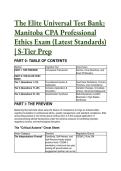
The Elite Universal Test Bank:
Manitoba CPA Professional
Ethics Exam (Latest Standards)
| S-Tier Prep
PART 0: TABLE OF CONTENTS
Section Cognitive Tier Core Focus
PART I: THE PREVIEW Conceptual Framework Axioms, Core Directives, and
Exam Philosophy
PART II: THE ELITE TEST
BANK
Tier 1 (Questions 1–10) Foundational Syntax & Hard Deck Definitions, Primary
Application Theories, Core Compliance
Tier 2 (Questions 11–20) Complex Application & Variable Changes, Immediate
Simulation Actions, Structural Safeguards
Tier 3 (Questions 21–30) Grandmaster Synthesis Multi-Disciplinary Conflict
Resolution, High-Stakes
Syntheses
PART I: THE PREVIEW
Mastering this test bank strips away the illusion of competence to forge an indestructible,
cognitive foundation in professional ethics, quality management, and standard compliance. Elite
accounting practice is not merely about reciting rules; it is the surgical application of
uncompromising ethical frameworks under the extreme pressure of conflicting interests,
regulatory scrutiny, and technological disruption.
The "Critical Axioms" Cheat Sheet
Axiom Category Directive Regulatory Source
The Independence Firewall Familiarity, Self-Interest, and CSQM 2, Rule 204
Self-Review threats dictate
practice limits. CSQM 2
mandates a minimum two-year
cooling-off period before an
engagement partner can act as
,Axiom Category Directive Regulatory Source
an Engagement Quality
Reviewer (EQR).
Fee Dependency (PIE vs. Public Interest Entities (PIEs) IESBA/Rule 204.4
Non-PIE) breaching a 15% fee
dependency threshold for two
consecutive years require a
pre-issuance external review.
Non-PIEs breaching a 30%
threshold for five consecutive
years require similar
intervention.
The AML / FINTRAC Paradox Registrants must fiercely PCMLTFA, Rule 208
protect client data, yet
immediately report triggering
activities to FINTRAC via a
Suspicious Transaction Report
(STR). Alerting the client
constitutes criminal Tipping Off.
The Trust Account Doctrine Client funds are inviolable. Rule 212, Trust Rules
They must be deposited by the
next banking day. Registrants
are strictly prohibited from
accepting cash exceeding a
$7,500 aggregate limit per
client matter to prevent money
laundering.
The Joint Submission Under the Anthony-Cook Case Law: R v. Anthony-Cook
Imperative principle, a disciplinary panel
must accept a joint penalty
submission from the Crown and
defense unless it fails the
Public Interest Test (i.e., it
brings the administration of
justice into disrepute).
The Digital & Tax Ethos Automation bias is an explicit IESBA 2024/2026 Revisions
ethical threat; professional
skepticism cannot be delegated
to AI. Furthermore, tax planning
services require a credible
basis grounded in current law,
considering broader economic
consequences.
PART II: THE ELITE TEST BANK
, Tier 1 - Foundational Syntax & Application
Q1: A newly designated CPA in Manitoba is establishing their Continuing Professional
Development (CPD) tracking framework. Over a rolling three-year calendar cycle, the member is
calculating their verifiable and unverifiable hours. To remain in flawless compliance with CPA
Manitoba bylaws, what is the MINIMUM verifiable CPD requirement specifically dedicated to
professional ethics? A) 20 hours annually, with at least 10 hours being verifiable ethics training
based on a structured course. B) 120 hours over a 3-year rolling period, with 60 hours of
verifiable ethics training directly applicable to the member's professional role. C) 4 hours of
verifiable learning in professional ethics over a 3-year rolling period, which excludes informal
self-study. D) 4 hours of self-study ethics reading annually, logged with a corresponding date
and publication title.
● Answer: C (4 hours of verifiable learning in professional ethics over a 3-year rolling
period, which excludes informal self-study.)
● Distractor Analysis:
○ A is incorrect: While 20 hours (10 verifiable) is the absolute minimum for general
annual CPD, the ethics-specific requirement spans the 3-year cycle, not annually.
○ B is incorrect: 120 total hours and 60 verifiable hours are the broad 3-year
requirements for overall CPD. Demanding all 60 verifiable hours be strictly ethics is
an excessive hallucination of the standard.
○ D is incorrect: Self-study explicitly does not qualify as verifiable professional ethics
CPD unless it is tied to an assessment or structured program.
The Mentor's Analysis: The regulatory mandate is absolute: 120 total hours, 60 verifiable, with
exactly 4 verifiable ethics hours per 3-year rolling cycle. By isolating verifiable ethics, regulatory
bodies ensure members are subjected to objective, documented ethical recalibration.
Professional/Academic Intuition: Self-study without an objective assessment mechanism
is forever classified as unverifiable.
Q2: An ambitious CPA decides to leave a mid-sized firm to start a sole proprietorship. They
secure office space, build a website, and immediately begin marketing their tax preparation and
compilation services to the public. However, they have submitted their application but have not
yet received approval from the CPA Manitoba Registration Committee. Which consequence is
the MOST LIKELY result of this action? A) The CPA is fully compliant, as tax preparation does
not require firm registration unless assurance services such as audits or reviews are offered. B)
The CPA has breached the bylaws; they are strictly prohibited from providing public accounting
or regulated services until the effective date on their Consent and Authorization for Firm
Registration letter. C) The CPA may offer services on a contingent fee basis until the firm
registration is officially finalized, at which point standard billing applies. D) The CPA is compliant
provided they hold sufficient Professional Liability Insurance (PLI) and display the certificate
prior to taking on their first client.
● Answer: B (The CPA has breached the bylaws; they are strictly prohibited from providing
public accounting or regulated services until the effective date on their Consent and
Authorization for Firm Registration letter.)
● Distractor Analysis:
○ A is incorrect: Tax preparation for individuals outside one's immediate household
constitutes a regulated service and strictly requires firm registration.
○ C is incorrect: Contingent fees are irrelevant to the authorization to practice and are
outright banned for compilation/tax preparation under objectivity rules.
Manitoba CPA Professional
Ethics Exam (Latest Standards)
| S-Tier Prep
PART 0: TABLE OF CONTENTS
Section Cognitive Tier Core Focus
PART I: THE PREVIEW Conceptual Framework Axioms, Core Directives, and
Exam Philosophy
PART II: THE ELITE TEST
BANK
Tier 1 (Questions 1–10) Foundational Syntax & Hard Deck Definitions, Primary
Application Theories, Core Compliance
Tier 2 (Questions 11–20) Complex Application & Variable Changes, Immediate
Simulation Actions, Structural Safeguards
Tier 3 (Questions 21–30) Grandmaster Synthesis Multi-Disciplinary Conflict
Resolution, High-Stakes
Syntheses
PART I: THE PREVIEW
Mastering this test bank strips away the illusion of competence to forge an indestructible,
cognitive foundation in professional ethics, quality management, and standard compliance. Elite
accounting practice is not merely about reciting rules; it is the surgical application of
uncompromising ethical frameworks under the extreme pressure of conflicting interests,
regulatory scrutiny, and technological disruption.
The "Critical Axioms" Cheat Sheet
Axiom Category Directive Regulatory Source
The Independence Firewall Familiarity, Self-Interest, and CSQM 2, Rule 204
Self-Review threats dictate
practice limits. CSQM 2
mandates a minimum two-year
cooling-off period before an
engagement partner can act as
,Axiom Category Directive Regulatory Source
an Engagement Quality
Reviewer (EQR).
Fee Dependency (PIE vs. Public Interest Entities (PIEs) IESBA/Rule 204.4
Non-PIE) breaching a 15% fee
dependency threshold for two
consecutive years require a
pre-issuance external review.
Non-PIEs breaching a 30%
threshold for five consecutive
years require similar
intervention.
The AML / FINTRAC Paradox Registrants must fiercely PCMLTFA, Rule 208
protect client data, yet
immediately report triggering
activities to FINTRAC via a
Suspicious Transaction Report
(STR). Alerting the client
constitutes criminal Tipping Off.
The Trust Account Doctrine Client funds are inviolable. Rule 212, Trust Rules
They must be deposited by the
next banking day. Registrants
are strictly prohibited from
accepting cash exceeding a
$7,500 aggregate limit per
client matter to prevent money
laundering.
The Joint Submission Under the Anthony-Cook Case Law: R v. Anthony-Cook
Imperative principle, a disciplinary panel
must accept a joint penalty
submission from the Crown and
defense unless it fails the
Public Interest Test (i.e., it
brings the administration of
justice into disrepute).
The Digital & Tax Ethos Automation bias is an explicit IESBA 2024/2026 Revisions
ethical threat; professional
skepticism cannot be delegated
to AI. Furthermore, tax planning
services require a credible
basis grounded in current law,
considering broader economic
consequences.
PART II: THE ELITE TEST BANK
, Tier 1 - Foundational Syntax & Application
Q1: A newly designated CPA in Manitoba is establishing their Continuing Professional
Development (CPD) tracking framework. Over a rolling three-year calendar cycle, the member is
calculating their verifiable and unverifiable hours. To remain in flawless compliance with CPA
Manitoba bylaws, what is the MINIMUM verifiable CPD requirement specifically dedicated to
professional ethics? A) 20 hours annually, with at least 10 hours being verifiable ethics training
based on a structured course. B) 120 hours over a 3-year rolling period, with 60 hours of
verifiable ethics training directly applicable to the member's professional role. C) 4 hours of
verifiable learning in professional ethics over a 3-year rolling period, which excludes informal
self-study. D) 4 hours of self-study ethics reading annually, logged with a corresponding date
and publication title.
● Answer: C (4 hours of verifiable learning in professional ethics over a 3-year rolling
period, which excludes informal self-study.)
● Distractor Analysis:
○ A is incorrect: While 20 hours (10 verifiable) is the absolute minimum for general
annual CPD, the ethics-specific requirement spans the 3-year cycle, not annually.
○ B is incorrect: 120 total hours and 60 verifiable hours are the broad 3-year
requirements for overall CPD. Demanding all 60 verifiable hours be strictly ethics is
an excessive hallucination of the standard.
○ D is incorrect: Self-study explicitly does not qualify as verifiable professional ethics
CPD unless it is tied to an assessment or structured program.
The Mentor's Analysis: The regulatory mandate is absolute: 120 total hours, 60 verifiable, with
exactly 4 verifiable ethics hours per 3-year rolling cycle. By isolating verifiable ethics, regulatory
bodies ensure members are subjected to objective, documented ethical recalibration.
Professional/Academic Intuition: Self-study without an objective assessment mechanism
is forever classified as unverifiable.
Q2: An ambitious CPA decides to leave a mid-sized firm to start a sole proprietorship. They
secure office space, build a website, and immediately begin marketing their tax preparation and
compilation services to the public. However, they have submitted their application but have not
yet received approval from the CPA Manitoba Registration Committee. Which consequence is
the MOST LIKELY result of this action? A) The CPA is fully compliant, as tax preparation does
not require firm registration unless assurance services such as audits or reviews are offered. B)
The CPA has breached the bylaws; they are strictly prohibited from providing public accounting
or regulated services until the effective date on their Consent and Authorization for Firm
Registration letter. C) The CPA may offer services on a contingent fee basis until the firm
registration is officially finalized, at which point standard billing applies. D) The CPA is compliant
provided they hold sufficient Professional Liability Insurance (PLI) and display the certificate
prior to taking on their first client.
● Answer: B (The CPA has breached the bylaws; they are strictly prohibited from providing
public accounting or regulated services until the effective date on their Consent and
Authorization for Firm Registration letter.)
● Distractor Analysis:
○ A is incorrect: Tax preparation for individuals outside one's immediate household
constitutes a regulated service and strictly requires firm registration.
○ C is incorrect: Contingent fees are irrelevant to the authorization to practice and are
outright banned for compilation/tax preparation under objectivity rules.


