

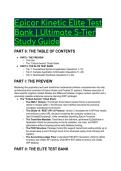
Epicor Kinetic Elite Test
Bank | Ultimate S-Tier
Study Guide
PART 0: THE TABLE OF CONTENTS
● PART I: THE PREVIEW
○ The Intro
○ The "Critical Axioms" Cheat Sheet
● PART II: THE ELITE TEST BANK
○ Tier 1: Foundational Syntax & Application (Questions 1–10)
○ Tier 2: Complex Application & Simulation (Questions 11–20)
○ Tier 3: Grandmaster Synthesis (Questions 21–30)
PART I: THE PREVIEW
Mastering this proprietary test bank transforms fundamental software comprehension into elite,
architectural-level command of Epicor Kinetic and Prophet 21 systems. Flawless execution of
these specific cognitive models dictates the difference between a legacy system operator and a
universally capable enterprise resource planning (ERP) strategist.
● The "Critical Axioms" Cheat Sheet:
○ The 2026.1 Horizon: The Kinetic Smart Client (classic forms) is permanently
retired in release 2026.1; the Browser User Interface becomes the exclusive,
mandatory operational environment.
○ The OData v4 / REST API v2 Protocol: Version 2 mandates the X-API-Key header
and enforces a strict URL structure containing the company context (e.g.,
/api/v2/odata/[Company]/), while completely absorbing Epicor Functions.
○ The TransView Mandate: TransView is the definitive, ephemeral EpDataView in
Application Studio for processing on-the-fly variables, row rules, and REST
parameters without requiring server-side database binding.
○ The PCID Structure: Package Control IDs support hierarchical nesting strictly up to
five levels deep (Level 0 through Level 4) for advanced supply chain tracking and
logistics.
○ The Accounting Ledger Flow: A standard PUR-STK transaction uniformly debits
Inventory and credits AP Clearing, while MFG-STK debits Inventory and credits
WIP Material.
PART II: THE ELITE TEST BANK
,Tier 1: Foundational Syntax & Application
The foundational tier establishes the absolute baseline of systemic comprehension required to
navigate the Epicor Kinetic framework. The analysis indicates that failures at the enterprise level
frequently originate not from complex algorithmic errors, but from a fundamental
misunderstanding of core architecture. The transition from legacy versions to the Kinetic 2025.2
and 2026.1 environments introduces paradigm shifts in user interface deployment, application
programming interfaces (APIs), and fundamental inventory ledger routing.
To provide structural context for the ensuing operational scenarios, the following architectural
demarcations define the modern Epicor ecosystem:
Architectural Legacy ERP 10 Kinetic 2026..2 Operational Implication
Component Paradigm Paradigm
Client Interface Smart Client (Classic Browser UI Exclusively All client-side
Forms) customizations must be
migrated to Application
Studio.
Integration Layer REST API v1 (OData REST API v2 (OData Enforced X-API-Key
v3) v4) usage and
tenant-specific URL
routing.
UI Data Binding Direct SQL/C# Stateless Metadata Reliance on TransView
Scripting and localized event
triggers (e.g., OnBlur).
The subsequent questions test the practitioner's ability to apply these hard-deck definitions
within realistic operational environments.
Q1: An enterprise manufacturer currently relies heavily on localized, highly modified classic
forms for order entry. The executive steering committee mandates a system upgrade to Epicor
Kinetic next year. Based on the release architecture of Kinetic 2026.1, which migration outcome
is the MOST ACCURATE? A) Classic forms will remain accessible via a localized Smart Client
bridge, though rendering performance will degrade significantly. B) The system will automatically
translate all client-side C# customizations into the Browser User Interface without developer
intervention. C) The Kinetic Smart Client is fully retired, mandating all users access the system
exclusively via the Browser User Interface. D) Classic forms are preserved exclusively for
on-premises deployments, while cloud tenants are forced onto the Browser UI.
● Answer: C (The Kinetic Smart Client is fully retired, mandating all users access the
system exclusively via the Browser User Interface.)
● Distractor Analysis:
○ A is incorrect: The reliance on legacy localized Smart Client bridges represents a
fundamental misunderstanding of the Epicor Kinetic 2026.1 architecture. The
product roadmap dictates a hard termination of this client, meaning any attempt to
bridge classic forms will result in immediate system inoperability, not mere
performance degradation.
○ B is incorrect: Client-side customizations require manual rework and translation into
Application Studio metadata logic. The system does not possess an
auto-translation engine capable of converting rigid C# into stateless web
frameworks.
○ D is incorrect: The retirement of the Smart Client applies universally across both
, multi-tenant cloud and on-premises architectures, representing a total platform shift.
The Mentor's Analysis: Kinetic 2026.1 represents the final severing of legacy client
architectures, requiring organizations to fully adopt web-based operational paradigms. When
facing the deprecation of legacy interfaces, the immediate priority is rebuilding customizations
strictly within Application Studio. By utilizing Native Browser UI Frameworks, the practitioner
bypasses the common trap of relying on unsupported legacy client workarounds that guarantee
deployment failure. Professional/Academic Intuition: Never defer technical debt; rebuilding
classic customizations in Application Studio prior to the 2025.2 cutoff is a mandatory
survival protocol.
Q2: A third-party logistics platform must query a massive list of part numbers from Epicor to
synchronize inventory statuses. The integration developer utilizes the REST API v2 using
OData v4 syntax but encounters a 404 URL length limitation error when passing a long list of
parameters in a single GET request. Which architectural adjustment is MOST APPROPRIATE?
A) Downgrade the integration endpoint to REST API v1 to bypass the OData v4 URL character
string limits. B) Modify the Epicor web.config file to infinitely expand the HTTP GET character
allowance on the application server. C) Abandon standard GET endpoints and utilize custom
POST service methods to pass the lengthy query parameters securely within the request body.
D) Wrap the GET request within a $batch operation, which OData v4 natively supports in Epicor
Kinetic for unlimited payload sizes.
● Answer: C (Abandon standard GET endpoints and utilize custom POST service methods
to pass the lengthy query parameters securely within the request body.)
● Distractor Analysis:
○ A is incorrect: REST API v1 shares the exact same systemic HTTP URL string
limitations governed by standard web protocols, and is deprecated for modern
integrations.
○ B is incorrect: Modifying core server configuration files to breach standardized
HTTP protocol limits introduces severe security vulnerabilities (e.g., buffer
overflows) and platform instability.
○ D is incorrect: Epicor's specific REST API implementation currently lacks full,
unrestricted support for OData $batch and $query operations as a mechanism for
bypassing standard URL limits.
The Mentor's Analysis: HTTP GET requests are inherently limited by URL string character
caps across modern network routing infrastructure. When facing URL length limitations during
bulk data retrieval, the immediate priority is shifting the parameterized payload from the URI
string into the HTTP body. By utilizing Custom POST Methods, the system architect bypasses
the common trap of generating highly inefficient, segmented micro-requests that artificially spike
server latency. Professional/Academic Intuition: Data retrieval requiring exhaustive,
complex parameterization must always be executed via POST payloads rather than
URI-bound GET filters.
Q3: A developer is constructing a custom landing page in Application Studio that filters data
based on ephemeral session criteria. They require a data view to temporarily store variables,
manipulate row rules, and map REST parameters without triggering a server-side database
commit. Which core component is MOST ACCURATE for this requirement? A) The
CallContextBpmData view. B) The KeyFields system data view. C) The TransView data view. D)
A custom EpDataView bound directly to a User Defined (UD) SQL table.
● Answer: C (The TransView data view.)
● Distractor Analysis:
○ A is incorrect: While occasionally utilized for BPM routing payloads,
Bank | Ultimate S-Tier
Study Guide
PART 0: THE TABLE OF CONTENTS
● PART I: THE PREVIEW
○ The Intro
○ The "Critical Axioms" Cheat Sheet
● PART II: THE ELITE TEST BANK
○ Tier 1: Foundational Syntax & Application (Questions 1–10)
○ Tier 2: Complex Application & Simulation (Questions 11–20)
○ Tier 3: Grandmaster Synthesis (Questions 21–30)
PART I: THE PREVIEW
Mastering this proprietary test bank transforms fundamental software comprehension into elite,
architectural-level command of Epicor Kinetic and Prophet 21 systems. Flawless execution of
these specific cognitive models dictates the difference between a legacy system operator and a
universally capable enterprise resource planning (ERP) strategist.
● The "Critical Axioms" Cheat Sheet:
○ The 2026.1 Horizon: The Kinetic Smart Client (classic forms) is permanently
retired in release 2026.1; the Browser User Interface becomes the exclusive,
mandatory operational environment.
○ The OData v4 / REST API v2 Protocol: Version 2 mandates the X-API-Key header
and enforces a strict URL structure containing the company context (e.g.,
/api/v2/odata/[Company]/), while completely absorbing Epicor Functions.
○ The TransView Mandate: TransView is the definitive, ephemeral EpDataView in
Application Studio for processing on-the-fly variables, row rules, and REST
parameters without requiring server-side database binding.
○ The PCID Structure: Package Control IDs support hierarchical nesting strictly up to
five levels deep (Level 0 through Level 4) for advanced supply chain tracking and
logistics.
○ The Accounting Ledger Flow: A standard PUR-STK transaction uniformly debits
Inventory and credits AP Clearing, while MFG-STK debits Inventory and credits
WIP Material.
PART II: THE ELITE TEST BANK
,Tier 1: Foundational Syntax & Application
The foundational tier establishes the absolute baseline of systemic comprehension required to
navigate the Epicor Kinetic framework. The analysis indicates that failures at the enterprise level
frequently originate not from complex algorithmic errors, but from a fundamental
misunderstanding of core architecture. The transition from legacy versions to the Kinetic 2025.2
and 2026.1 environments introduces paradigm shifts in user interface deployment, application
programming interfaces (APIs), and fundamental inventory ledger routing.
To provide structural context for the ensuing operational scenarios, the following architectural
demarcations define the modern Epicor ecosystem:
Architectural Legacy ERP 10 Kinetic 2026..2 Operational Implication
Component Paradigm Paradigm
Client Interface Smart Client (Classic Browser UI Exclusively All client-side
Forms) customizations must be
migrated to Application
Studio.
Integration Layer REST API v1 (OData REST API v2 (OData Enforced X-API-Key
v3) v4) usage and
tenant-specific URL
routing.
UI Data Binding Direct SQL/C# Stateless Metadata Reliance on TransView
Scripting and localized event
triggers (e.g., OnBlur).
The subsequent questions test the practitioner's ability to apply these hard-deck definitions
within realistic operational environments.
Q1: An enterprise manufacturer currently relies heavily on localized, highly modified classic
forms for order entry. The executive steering committee mandates a system upgrade to Epicor
Kinetic next year. Based on the release architecture of Kinetic 2026.1, which migration outcome
is the MOST ACCURATE? A) Classic forms will remain accessible via a localized Smart Client
bridge, though rendering performance will degrade significantly. B) The system will automatically
translate all client-side C# customizations into the Browser User Interface without developer
intervention. C) The Kinetic Smart Client is fully retired, mandating all users access the system
exclusively via the Browser User Interface. D) Classic forms are preserved exclusively for
on-premises deployments, while cloud tenants are forced onto the Browser UI.
● Answer: C (The Kinetic Smart Client is fully retired, mandating all users access the
system exclusively via the Browser User Interface.)
● Distractor Analysis:
○ A is incorrect: The reliance on legacy localized Smart Client bridges represents a
fundamental misunderstanding of the Epicor Kinetic 2026.1 architecture. The
product roadmap dictates a hard termination of this client, meaning any attempt to
bridge classic forms will result in immediate system inoperability, not mere
performance degradation.
○ B is incorrect: Client-side customizations require manual rework and translation into
Application Studio metadata logic. The system does not possess an
auto-translation engine capable of converting rigid C# into stateless web
frameworks.
○ D is incorrect: The retirement of the Smart Client applies universally across both
, multi-tenant cloud and on-premises architectures, representing a total platform shift.
The Mentor's Analysis: Kinetic 2026.1 represents the final severing of legacy client
architectures, requiring organizations to fully adopt web-based operational paradigms. When
facing the deprecation of legacy interfaces, the immediate priority is rebuilding customizations
strictly within Application Studio. By utilizing Native Browser UI Frameworks, the practitioner
bypasses the common trap of relying on unsupported legacy client workarounds that guarantee
deployment failure. Professional/Academic Intuition: Never defer technical debt; rebuilding
classic customizations in Application Studio prior to the 2025.2 cutoff is a mandatory
survival protocol.
Q2: A third-party logistics platform must query a massive list of part numbers from Epicor to
synchronize inventory statuses. The integration developer utilizes the REST API v2 using
OData v4 syntax but encounters a 404 URL length limitation error when passing a long list of
parameters in a single GET request. Which architectural adjustment is MOST APPROPRIATE?
A) Downgrade the integration endpoint to REST API v1 to bypass the OData v4 URL character
string limits. B) Modify the Epicor web.config file to infinitely expand the HTTP GET character
allowance on the application server. C) Abandon standard GET endpoints and utilize custom
POST service methods to pass the lengthy query parameters securely within the request body.
D) Wrap the GET request within a $batch operation, which OData v4 natively supports in Epicor
Kinetic for unlimited payload sizes.
● Answer: C (Abandon standard GET endpoints and utilize custom POST service methods
to pass the lengthy query parameters securely within the request body.)
● Distractor Analysis:
○ A is incorrect: REST API v1 shares the exact same systemic HTTP URL string
limitations governed by standard web protocols, and is deprecated for modern
integrations.
○ B is incorrect: Modifying core server configuration files to breach standardized
HTTP protocol limits introduces severe security vulnerabilities (e.g., buffer
overflows) and platform instability.
○ D is incorrect: Epicor's specific REST API implementation currently lacks full,
unrestricted support for OData $batch and $query operations as a mechanism for
bypassing standard URL limits.
The Mentor's Analysis: HTTP GET requests are inherently limited by URL string character
caps across modern network routing infrastructure. When facing URL length limitations during
bulk data retrieval, the immediate priority is shifting the parameterized payload from the URI
string into the HTTP body. By utilizing Custom POST Methods, the system architect bypasses
the common trap of generating highly inefficient, segmented micro-requests that artificially spike
server latency. Professional/Academic Intuition: Data retrieval requiring exhaustive,
complex parameterization must always be executed via POST payloads rather than
URI-bound GET filters.
Q3: A developer is constructing a custom landing page in Application Studio that filters data
based on ephemeral session criteria. They require a data view to temporarily store variables,
manipulate row rules, and map REST parameters without triggering a server-side database
commit. Which core component is MOST ACCURATE for this requirement? A) The
CallContextBpmData view. B) The KeyFields system data view. C) The TransView data view. D)
A custom EpDataView bound directly to a User Defined (UD) SQL table.
● Answer: C (The TransView data view.)
● Distractor Analysis:
○ A is incorrect: While occasionally utilized for BPM routing payloads,


