

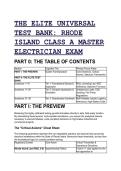
THE ELITE UNIVERSAL
TEST BANK: RHODE
ISLAND CLASS A MASTER
ELECTRICIAN EXAM
PART 0: THE TABLE OF CONTENTS
Section Cognitive Tier Primary Focus Areas
PART I: THE PREVIEW System Familiarization Core Directives, Critical
Axioms, Statutory Frameworks
PART II: THE ELITE TEST
BANK
Questions 1–10 Tier 1: Foundational Syntax & RIGL Licensing Law, NEC
Application Definitions, Baseline Formulas
Questions 11–20 Tier 2: Complex Application & Unbalanced Loads, EGC
Simulation Upsizing, Fire Pump
Regulations
Questions 21–30 Tier 3: Grandmaster Synthesis Multi-Variable Jobsite Logistics,
Harmonics, High-Stakes Code
PART I: THE PREVIEW
Mastering this highly calibrated testing gauntlet translates directly to elite, field-ready intuition.
By internalizing these layered, multi-variable simulations, you acquire the analytical stamina
necessary to execute flawless, code-compliant decisions on high-stakes industrial and
commercial projects.
The "Critical Axioms" Cheat Sheet
The following parameters represent the non-negotiable statutory and physical laws governing
electrical installations within the State of Rhode Island. Memorize these thresholds, as they form
the foundational logic for complex problem-solving.
Regulatory Domain Core Axiom Critical Thresholds &
Operational Directives
Rhode Island Law (RIGL 5-6) Apprenticeship Ratios A strict 1:1 ratio applies for the
first apprentice to
,Regulatory Domain Core Axiom Critical Thresholds &
Operational Directives
journeyworker, followed by a
1:3 ratio for all subsequent
journeyworkers on a job site.
Rhode Island Law (RIGL 5-6) Continuing Education Master (Class A) and
Journeyperson (Class B)
licensees must complete 15
clock hours of mandatory CE
per renewal cycle, exclusively
covering the currently adopted
NEC.
Neutral Sizing (NEC 220.61) Unbalanced Demand The first 200A of a neutral
linear load is calculated at
100%. Any linear portion
exceeding 200A is reduced to
70%. Non-linear loads receive
zero reduction.
Grounding (NEC 250.122(B)) EGC Proportional Upsizing If phase conductors are
increased in size for voltage
drop, the Equipment Grounding
Conductor (EGC) must be
proportionally increased based
on the circular mil (CM) area
ratio.
Life Safety (NEC 695) Fire Pump Supremacy Fire pump circuits operate to
destruction to save the facility.
Overcurrent protective devices
(OCPDs) must carry
locked-rotor current indefinitely
for short-circuit protection only.
Transformers (NEC 450.3(B)) Primary Protection Limits For transformers ≤ 600V with
primary-only protection (>9A),
the OCPD is capped at 125%
of the primary full-load current
(the next standard size is
permitted).
PART II: THE ELITE TEST BANK
Tier 1: Foundational Syntax & Application
Q1: A newly established electrical contracting firm in Providence is structuring its workforce for a
major commercial build. The firm currently employs three licensed Class B Journeypersons.
Based on the principles of Rhode Island General Laws (RIGL 5-6) regarding apprenticeship
ratios, which workforce configuration represents the MAXIMUM legal deployment for this
specific crew? A) 3 registered apprentices B) 7 registered apprentices C) 9 registered
, apprentices D) 1 registered apprentice
● Answer: B (7 registered apprentices)
● Distractor Analysis:
○ A is incorrect: This calculation assumes a strict 1:1 ratio across the board, which
ignores the secondary tiered allowance designed to scale larger workforces
efficiently.
○ C is incorrect: This analytical error occurs when a novice incorrectly applies the
secondary 1:3 ratio to all journeyworkers simultaneously (3 journeyworkers × 3 = 9),
bypassing the initial safety anchor.
○ D is incorrect: This represents an outdated or hyper-conservative misinterpretation
that limits an entire commercial job site to a single apprentice regardless of the total
journeyworker count.
The Mentor's Analysis: Rhode Island enforces a strict, tiered safety and supervision standard
on job sites to prevent hazardous oversights. The law mandates a specific "1:1 then 1:3" scale.
The first journeyworker supervises one apprentice (1:1). Every subsequent journeyworker
added to the site is trusted to supervise up to three apprentices. Therefore, Journeyworker 1
yields 1 apprentice, Journeyworker 2 yields 3 apprentices, and Journeyworker 3 yields 3
apprentices, netting a total of 7. Professional/Academic Intuition: Always isolate the first
journeyworker before calculating the bulk workforce; the "1:1 then 1:3" rule acts as an
unyielding safety anchor for site supervision.
Q2: A licensed Class A Master Electrician in Rhode Island is preparing to renew their license.
Over the past two years, they have completed 10 hours of OSHA safety training and 5 hours of
project management seminars. Based on the principles of the Rhode Island Board of Examiners
of Electricians (RIGL 5-6-20.1), which outcome is the MOST ACCURATE regarding their
renewal status? A) The license will be successfully renewed because the quantitative 15-hour
continuing education requirement has been satisfied. B) The license will be suspended
indefinitely because project management hours are statutorily capped at 3 hours per renewal
cycle. C) The license will not be renewed because the mandatory 15 hours of continuing
education must focus entirely on the currently adopted National Electrical Code. D) The license
will be renewed on a probationary status until an approved NFPA 70E electrical safety course is
formally completed.
● Answer: C (The license will not be renewed because the mandatory 15 hours of
continuing education must focus entirely on the currently adopted National Electrical
Code.)
● Distractor Analysis:
○ A is incorrect: While the quantitative 15-hour mark was reached, the qualitative
subject matter strictly fails state requirements, rendering the hours legally void for
renewal purposes.
○ B is incorrect: Rhode Island does not have a specific "project management" hour
cap for this license; it demands absolute code-centric education, making any
management hours irrelevant for CE credit.
○ D is incorrect: While NFPA 70E (work practices) is highly recommended for
corporate safety compliance, it is not explicitly mandated for the 15-hour license
renewal, which strictly covers the NEC installation code.
The Mentor's Analysis: Continuing Education (CE) is not a loose suggestion of general
professional development; it is a rigid statutory requirement ensuring ongoing public safety.
Rhode Island unequivocally mandates 15 clock hours per renewal cycle for Class A and Class B
licensees, built entirely on the currently adopted National Electrical Code (NEC).
TEST BANK: RHODE
ISLAND CLASS A MASTER
ELECTRICIAN EXAM
PART 0: THE TABLE OF CONTENTS
Section Cognitive Tier Primary Focus Areas
PART I: THE PREVIEW System Familiarization Core Directives, Critical
Axioms, Statutory Frameworks
PART II: THE ELITE TEST
BANK
Questions 1–10 Tier 1: Foundational Syntax & RIGL Licensing Law, NEC
Application Definitions, Baseline Formulas
Questions 11–20 Tier 2: Complex Application & Unbalanced Loads, EGC
Simulation Upsizing, Fire Pump
Regulations
Questions 21–30 Tier 3: Grandmaster Synthesis Multi-Variable Jobsite Logistics,
Harmonics, High-Stakes Code
PART I: THE PREVIEW
Mastering this highly calibrated testing gauntlet translates directly to elite, field-ready intuition.
By internalizing these layered, multi-variable simulations, you acquire the analytical stamina
necessary to execute flawless, code-compliant decisions on high-stakes industrial and
commercial projects.
The "Critical Axioms" Cheat Sheet
The following parameters represent the non-negotiable statutory and physical laws governing
electrical installations within the State of Rhode Island. Memorize these thresholds, as they form
the foundational logic for complex problem-solving.
Regulatory Domain Core Axiom Critical Thresholds &
Operational Directives
Rhode Island Law (RIGL 5-6) Apprenticeship Ratios A strict 1:1 ratio applies for the
first apprentice to
,Regulatory Domain Core Axiom Critical Thresholds &
Operational Directives
journeyworker, followed by a
1:3 ratio for all subsequent
journeyworkers on a job site.
Rhode Island Law (RIGL 5-6) Continuing Education Master (Class A) and
Journeyperson (Class B)
licensees must complete 15
clock hours of mandatory CE
per renewal cycle, exclusively
covering the currently adopted
NEC.
Neutral Sizing (NEC 220.61) Unbalanced Demand The first 200A of a neutral
linear load is calculated at
100%. Any linear portion
exceeding 200A is reduced to
70%. Non-linear loads receive
zero reduction.
Grounding (NEC 250.122(B)) EGC Proportional Upsizing If phase conductors are
increased in size for voltage
drop, the Equipment Grounding
Conductor (EGC) must be
proportionally increased based
on the circular mil (CM) area
ratio.
Life Safety (NEC 695) Fire Pump Supremacy Fire pump circuits operate to
destruction to save the facility.
Overcurrent protective devices
(OCPDs) must carry
locked-rotor current indefinitely
for short-circuit protection only.
Transformers (NEC 450.3(B)) Primary Protection Limits For transformers ≤ 600V with
primary-only protection (>9A),
the OCPD is capped at 125%
of the primary full-load current
(the next standard size is
permitted).
PART II: THE ELITE TEST BANK
Tier 1: Foundational Syntax & Application
Q1: A newly established electrical contracting firm in Providence is structuring its workforce for a
major commercial build. The firm currently employs three licensed Class B Journeypersons.
Based on the principles of Rhode Island General Laws (RIGL 5-6) regarding apprenticeship
ratios, which workforce configuration represents the MAXIMUM legal deployment for this
specific crew? A) 3 registered apprentices B) 7 registered apprentices C) 9 registered
, apprentices D) 1 registered apprentice
● Answer: B (7 registered apprentices)
● Distractor Analysis:
○ A is incorrect: This calculation assumes a strict 1:1 ratio across the board, which
ignores the secondary tiered allowance designed to scale larger workforces
efficiently.
○ C is incorrect: This analytical error occurs when a novice incorrectly applies the
secondary 1:3 ratio to all journeyworkers simultaneously (3 journeyworkers × 3 = 9),
bypassing the initial safety anchor.
○ D is incorrect: This represents an outdated or hyper-conservative misinterpretation
that limits an entire commercial job site to a single apprentice regardless of the total
journeyworker count.
The Mentor's Analysis: Rhode Island enforces a strict, tiered safety and supervision standard
on job sites to prevent hazardous oversights. The law mandates a specific "1:1 then 1:3" scale.
The first journeyworker supervises one apprentice (1:1). Every subsequent journeyworker
added to the site is trusted to supervise up to three apprentices. Therefore, Journeyworker 1
yields 1 apprentice, Journeyworker 2 yields 3 apprentices, and Journeyworker 3 yields 3
apprentices, netting a total of 7. Professional/Academic Intuition: Always isolate the first
journeyworker before calculating the bulk workforce; the "1:1 then 1:3" rule acts as an
unyielding safety anchor for site supervision.
Q2: A licensed Class A Master Electrician in Rhode Island is preparing to renew their license.
Over the past two years, they have completed 10 hours of OSHA safety training and 5 hours of
project management seminars. Based on the principles of the Rhode Island Board of Examiners
of Electricians (RIGL 5-6-20.1), which outcome is the MOST ACCURATE regarding their
renewal status? A) The license will be successfully renewed because the quantitative 15-hour
continuing education requirement has been satisfied. B) The license will be suspended
indefinitely because project management hours are statutorily capped at 3 hours per renewal
cycle. C) The license will not be renewed because the mandatory 15 hours of continuing
education must focus entirely on the currently adopted National Electrical Code. D) The license
will be renewed on a probationary status until an approved NFPA 70E electrical safety course is
formally completed.
● Answer: C (The license will not be renewed because the mandatory 15 hours of
continuing education must focus entirely on the currently adopted National Electrical
Code.)
● Distractor Analysis:
○ A is incorrect: While the quantitative 15-hour mark was reached, the qualitative
subject matter strictly fails state requirements, rendering the hours legally void for
renewal purposes.
○ B is incorrect: Rhode Island does not have a specific "project management" hour
cap for this license; it demands absolute code-centric education, making any
management hours irrelevant for CE credit.
○ D is incorrect: While NFPA 70E (work practices) is highly recommended for
corporate safety compliance, it is not explicitly mandated for the 15-hour license
renewal, which strictly covers the NEC installation code.
The Mentor's Analysis: Continuing Education (CE) is not a loose suggestion of general
professional development; it is a rigid statutory requirement ensuring ongoing public safety.
Rhode Island unequivocally mandates 15 clock hours per renewal cycle for Class A and Class B
licensees, built entirely on the currently adopted National Electrical Code (NEC).


