
Page 1 of 147
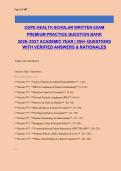
TABLE OF CONTENTS
| Section | Topic | Questions |
|---------|-------|-----------|
| **Section 1** | **Scope of Practice & Scholar Responsibilities** | 1–20 |
| **Section 2** | **HIPAA Compliance & Patient Confidentiality** | 21–40 |
| **Section 3** | **Infection Control & Prevention** | 41–65 |
| **Section 4** | **Personal Protective Equipment (PPE)** | 66–85 |
| **Section 5** | **Patient Care Skills & Mobility** | 86–110 |
| **Section 6** | **Body Mechanics & Injury Prevention** | 111–130 |
| **Section 7** | **Vital Signs & Patient Assessment** | 131–150 |
| **Section 8** | **Medical Terminology & Abbreviations** | 151–175 |
| **Section 9** | **Emergency Codes & Hospital Safety** | 176–200 |
| **Section 10** | **Communication & Patient Interaction (AIDET/SKAHI)** | 201–220 |
| **Section 11** | **Program Policies: Shifts, Attendance & Leave** | 221–240 |
| **Section 12** | **Ethics, Patient Rights & Cultural Competence** | 241–260 |
---
,Page 2 of 147
SECTION 1: SCOPE OF PRACTICE & SCHOLAR RESPONSIBILITIES
**Question 1**
As a COPE Health Scholar, your primary role in the healthcare setting is to:
A) Perform medical procedures independently, including starting IVs and administering
medications
B) Provide non-clinical support, assist with patient mobility, and help nursing staff under
supervision
C) Diagnose medical conditions and prescribe treatment plans
D) Manage hospital finances and administrative operations
**Correct Answer: B**
**Rationale:** Health Scholars are volunteers or trainees who assist with patient comfort,
ambulation, feeding, and other tasks delegated by licensed staff. They do not perform clinical
procedures independently, diagnose patients, or manage hospital finances. The role is specifically
designed to provide supportive, non-clinical care under the supervision of licensed healthcare
professionals.
---
**Question 2**
Which of the following tasks is within the scope of practice for a COPE Health Scholar?
A) Administering intravenous (IV) medications
B) Taking vital signs after appropriate training and supervision
C) Interpreting laboratory results
D) Writing orders in the patient's medical chart
,Page 3 of 147
**Correct Answer: B**
**Rationale:** Scholars may be trained to measure vital signs (temperature, pulse, respiration,
blood pressure) under the supervision of a nurse. Medication administration, interpreting lab
results, and writing chart orders are reserved for licensed professionals such as nurses and
physicians.
---
**Question 3**
A patient asks you for medical advice about their new diagnosis. What should you do?
A) Give your best opinion based on what you've learned in training
B) Tell the patient you are not a licensed provider and refer them to the nurse or doctor
C) Look up the information on your phone to help the patient
D) Ask the patient to wait while you consult with another scholar
**Correct Answer: B**
**Rationale:** Health Scholars are not licensed healthcare providers and are not qualified to
give medical advice. The appropriate response is to inform the patient of this limitation and refer
them to a licensed professional such as a nurse or physician. Providing medical advice exceeds
the scholar's scope of practice.
---
**Question 4**
If a patient refuses to have a Health Scholar assist them, the scholar should:
, Page 4 of 147
A) Insist that the patient accept help for their own good
B) Respect the patient's refusal and notify the supervising nurse
C) Leave the patient alone without telling anyone
D) Ask the patient's family to convince the patient to accept help
**Correct Answer: B**
**Rationale:** Patients have the right to refuse care. The scholar must respect patient autonomy
and inform the supervising nurse of the refusal. Attempting to coerce a patient or involving
family members inappropriately violates patient rights and professional boundaries.
---
**Question 5**
What is the Scope of Practice for a Health Scholar?
A) A document listing all medications scholars can administer
B) The duties or services that a particular practitioner is authorized to perform
C) A list of hospital departments where scholars can work
D) The schedule of shifts assigned to each scholar
**Correct Answer: B**
**Rationale:** Scope of practice defines the duties or services that a particular healthcare
practitioner is authorized to perform, which is limited based on education, clinical experiences,
and verification of competency. For Health Scholars, this includes non-clinical support tasks
delegated by licensed staff.
---
TABLE OF CONTENTS
| Section | Topic | Questions |
|---------|-------|-----------|
| **Section 1** | **Scope of Practice & Scholar Responsibilities** | 1–20 |
| **Section 2** | **HIPAA Compliance & Patient Confidentiality** | 21–40 |
| **Section 3** | **Infection Control & Prevention** | 41–65 |
| **Section 4** | **Personal Protective Equipment (PPE)** | 66–85 |
| **Section 5** | **Patient Care Skills & Mobility** | 86–110 |
| **Section 6** | **Body Mechanics & Injury Prevention** | 111–130 |
| **Section 7** | **Vital Signs & Patient Assessment** | 131–150 |
| **Section 8** | **Medical Terminology & Abbreviations** | 151–175 |
| **Section 9** | **Emergency Codes & Hospital Safety** | 176–200 |
| **Section 10** | **Communication & Patient Interaction (AIDET/SKAHI)** | 201–220 |
| **Section 11** | **Program Policies: Shifts, Attendance & Leave** | 221–240 |
| **Section 12** | **Ethics, Patient Rights & Cultural Competence** | 241–260 |
---
,Page 2 of 147
SECTION 1: SCOPE OF PRACTICE & SCHOLAR RESPONSIBILITIES
**Question 1**
As a COPE Health Scholar, your primary role in the healthcare setting is to:
A) Perform medical procedures independently, including starting IVs and administering
medications
B) Provide non-clinical support, assist with patient mobility, and help nursing staff under
supervision
C) Diagnose medical conditions and prescribe treatment plans
D) Manage hospital finances and administrative operations
**Correct Answer: B**
**Rationale:** Health Scholars are volunteers or trainees who assist with patient comfort,
ambulation, feeding, and other tasks delegated by licensed staff. They do not perform clinical
procedures independently, diagnose patients, or manage hospital finances. The role is specifically
designed to provide supportive, non-clinical care under the supervision of licensed healthcare
professionals.
---
**Question 2**
Which of the following tasks is within the scope of practice for a COPE Health Scholar?
A) Administering intravenous (IV) medications
B) Taking vital signs after appropriate training and supervision
C) Interpreting laboratory results
D) Writing orders in the patient's medical chart
,Page 3 of 147
**Correct Answer: B**
**Rationale:** Scholars may be trained to measure vital signs (temperature, pulse, respiration,
blood pressure) under the supervision of a nurse. Medication administration, interpreting lab
results, and writing chart orders are reserved for licensed professionals such as nurses and
physicians.
---
**Question 3**
A patient asks you for medical advice about their new diagnosis. What should you do?
A) Give your best opinion based on what you've learned in training
B) Tell the patient you are not a licensed provider and refer them to the nurse or doctor
C) Look up the information on your phone to help the patient
D) Ask the patient to wait while you consult with another scholar
**Correct Answer: B**
**Rationale:** Health Scholars are not licensed healthcare providers and are not qualified to
give medical advice. The appropriate response is to inform the patient of this limitation and refer
them to a licensed professional such as a nurse or physician. Providing medical advice exceeds
the scholar's scope of practice.
---
**Question 4**
If a patient refuses to have a Health Scholar assist them, the scholar should:
, Page 4 of 147
A) Insist that the patient accept help for their own good
B) Respect the patient's refusal and notify the supervising nurse
C) Leave the patient alone without telling anyone
D) Ask the patient's family to convince the patient to accept help
**Correct Answer: B**
**Rationale:** Patients have the right to refuse care. The scholar must respect patient autonomy
and inform the supervising nurse of the refusal. Attempting to coerce a patient or involving
family members inappropriately violates patient rights and professional boundaries.
---
**Question 5**
What is the Scope of Practice for a Health Scholar?
A) A document listing all medications scholars can administer
B) The duties or services that a particular practitioner is authorized to perform
C) A list of hospital departments where scholars can work
D) The schedule of shifts assigned to each scholar
**Correct Answer: B**
**Rationale:** Scope of practice defines the duties or services that a particular healthcare
practitioner is authorized to perform, which is limited based on education, clinical experiences,
and verification of competency. For Health Scholars, this includes non-clinical support tasks
delegated by licensed staff.
---


