

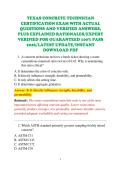
TEXAS CONCRETE TECHNICIAN
CERTIFICATION EXAM WITH ACTUAL
QUESTIONS AND VERIFIED ANSWERS,
PLUS EXPLAINED RATIONALES/EXPERT
VERIFIED FOR GUARANTEED 100% PASS
2026/LATEST UPDATE/INSTANT
DOWNLOAD PDF
1. A concrete technician receives a batch ticket showing a water-
cementitious materials ratio (w/cm) of 0.42. Why is maintaining
this ratio critical?
A. It determines the color of concrete only.
B. It directly influences strength, durability, and permeability.
C. It only affects the setting time.
D. It determines aggregate gradation.
Answer: B. It directly influences strength, durability, and
permeability.
Rationale: The water-cementitious materials ratio is one of the most
important factors affecting concrete quality. Lower w/cm ratios
generally produce stronger, less permeable, and more durable concrete
provided adequate workability and curing are maintained.
2. Which ASTM standard primarily governs sampling freshly mixed
concrete?
A. ASTM C31
B. ASTM C143
C. ASTM C172
D. ASTM C39
1
,Answer: C. ASTM C172
Rationale: ASTM C172 establishes procedures for obtaining
representative samples of freshly mixed concrete from mixers and
transporting equipment before performing acceptance tests.
3. During a slump test, the technician measures a slump of 5 inches
when the specification requires 4 ±1 inches. What should be
concluded?
A. Concrete automatically fails.
B. Concrete is acceptable.
C. Water must immediately be added.
D. Cement must be added.
Answer: B. Concrete is acceptable.
Rationale: A required slump of 4 ±1 inches permits results between 3
and 5 inches. Therefore, a measured slump of 5 inches complies with the
specification.
4. What is the primary purpose of air entrainment in concrete exposed
to freezing and thawing?
A. Increase density.
B. Improve freeze-thaw durability.
C. Reduce cement content only.
D. Increase slump permanently.
Answer: B. Improve freeze-thaw durability.
Rationale: Microscopic entrained air bubbles provide space for freezing
water to expand, reducing internal stresses and minimizing scaling and
cracking.
2
, 5. Which aggregate property most significantly affects concrete
workability?
A. Specific gravity only
B. Particle shape and grading
C. Chemical composition only
D. Color
Answer: B. Particle shape and grading
Rationale: Rounded, well-graded aggregates require less paste for
lubrication, improving workability while reducing segregation.
6. What is the primary function of cement in concrete?
A. Provide reinforcement.
B. Bind aggregates together through hydration.
C. Reduce shrinkage only.
D. Replace aggregates.
Answer: B. Bind aggregates together through hydration.
Rationale: Portland cement reacts chemically with water to form
hydration products that bond aggregates into a solid mass.
7. Which test determines the compressive strength of hardened
concrete?
A. ASTM C39
B. ASTM C143
C. ASTM C231
D. ASTM C1064
Answer: A. ASTM C39
3
, Rationale: ASTM C39 establishes procedures for testing concrete
cylinders under compression to determine compressive strength.
8. Excessive water added at the jobsite primarily causes:
A. Increased strength.
B. Lower permeability.
C. Reduced strength and increased shrinkage.
D. Improved durability only.
Answer: C. Reduced strength and increased shrinkage.
Rationale: Additional water increases porosity, reducing strength while
increasing drying shrinkage and permeability.
9. Which admixture primarily accelerates early strength gain?
A. Air-entraining admixture
B. Accelerator
C. Retarder
D. Shrinkage reducer
Answer: B. Accelerator
Rationale: Accelerating admixtures shorten setting time and promote
faster early-age strength development, particularly in cold weather.
10. What is the recommended method for consolidating normal
structural concrete?
A. Shoveling only
B. Internal vibration
C. Spraying water
D. Mechanical brooming
4
CERTIFICATION EXAM WITH ACTUAL
QUESTIONS AND VERIFIED ANSWERS,
PLUS EXPLAINED RATIONALES/EXPERT
VERIFIED FOR GUARANTEED 100% PASS
2026/LATEST UPDATE/INSTANT
DOWNLOAD PDF
1. A concrete technician receives a batch ticket showing a water-
cementitious materials ratio (w/cm) of 0.42. Why is maintaining
this ratio critical?
A. It determines the color of concrete only.
B. It directly influences strength, durability, and permeability.
C. It only affects the setting time.
D. It determines aggregate gradation.
Answer: B. It directly influences strength, durability, and
permeability.
Rationale: The water-cementitious materials ratio is one of the most
important factors affecting concrete quality. Lower w/cm ratios
generally produce stronger, less permeable, and more durable concrete
provided adequate workability and curing are maintained.
2. Which ASTM standard primarily governs sampling freshly mixed
concrete?
A. ASTM C31
B. ASTM C143
C. ASTM C172
D. ASTM C39
1
,Answer: C. ASTM C172
Rationale: ASTM C172 establishes procedures for obtaining
representative samples of freshly mixed concrete from mixers and
transporting equipment before performing acceptance tests.
3. During a slump test, the technician measures a slump of 5 inches
when the specification requires 4 ±1 inches. What should be
concluded?
A. Concrete automatically fails.
B. Concrete is acceptable.
C. Water must immediately be added.
D. Cement must be added.
Answer: B. Concrete is acceptable.
Rationale: A required slump of 4 ±1 inches permits results between 3
and 5 inches. Therefore, a measured slump of 5 inches complies with the
specification.
4. What is the primary purpose of air entrainment in concrete exposed
to freezing and thawing?
A. Increase density.
B. Improve freeze-thaw durability.
C. Reduce cement content only.
D. Increase slump permanently.
Answer: B. Improve freeze-thaw durability.
Rationale: Microscopic entrained air bubbles provide space for freezing
water to expand, reducing internal stresses and minimizing scaling and
cracking.
2
, 5. Which aggregate property most significantly affects concrete
workability?
A. Specific gravity only
B. Particle shape and grading
C. Chemical composition only
D. Color
Answer: B. Particle shape and grading
Rationale: Rounded, well-graded aggregates require less paste for
lubrication, improving workability while reducing segregation.
6. What is the primary function of cement in concrete?
A. Provide reinforcement.
B. Bind aggregates together through hydration.
C. Reduce shrinkage only.
D. Replace aggregates.
Answer: B. Bind aggregates together through hydration.
Rationale: Portland cement reacts chemically with water to form
hydration products that bond aggregates into a solid mass.
7. Which test determines the compressive strength of hardened
concrete?
A. ASTM C39
B. ASTM C143
C. ASTM C231
D. ASTM C1064
Answer: A. ASTM C39
3
, Rationale: ASTM C39 establishes procedures for testing concrete
cylinders under compression to determine compressive strength.
8. Excessive water added at the jobsite primarily causes:
A. Increased strength.
B. Lower permeability.
C. Reduced strength and increased shrinkage.
D. Improved durability only.
Answer: C. Reduced strength and increased shrinkage.
Rationale: Additional water increases porosity, reducing strength while
increasing drying shrinkage and permeability.
9. Which admixture primarily accelerates early strength gain?
A. Air-entraining admixture
B. Accelerator
C. Retarder
D. Shrinkage reducer
Answer: B. Accelerator
Rationale: Accelerating admixtures shorten setting time and promote
faster early-age strength development, particularly in cold weather.
10. What is the recommended method for consolidating normal
structural concrete?
A. Shoveling only
B. Internal vibration
C. Spraying water
D. Mechanical brooming
4


