
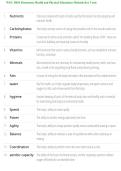
WGU D694 Elementary Health and Physical Educations Methods Key Term
WGU D694 Elementary Health and Physical Educations Methods Key Term
Study online at https://quizlet.com/_h8ium8
1. Nutrients Chemical compounds found in foods used by the body to function properly and
maintain health.
2. Carbohydrates The body's primary source of energy that provides fuel for the muscles and brain.
3. Proteins Comprised of amino acids and often called "the building blocks of life", these are
crucial for building and repairing tissues in the body
4. Vitamins Micronutrients that assist in various bodily functions, such as metabolism, immune
function, and vision.
5. Minerals Micronutrients that are necessary for maintaining healthy bones, teeth, and mus-
cles, as well as for regulating body fluids and producing energy.
6. Fats A source of energy for the body that helps in the absorption of fat-soluble vitamins
7. water Vital for health, as it helps regulate body temperature, transport nutrients and
oxygen to cells, and remove waste from the body.
8. hygiene Involves keeping all parts of the external body clean and healthy and is essential
for maintaining both physical and mental health.
9. Speed The body's ability to move rapidly.
10. Power The ability to transfer energy explosively into force.
11. Agility The body's ability to change position rapidly and accurately while moving in space.
12. Balance The body's ability to maintain a state of equilibrium while either stationary or
moving.
13. Coordination The body's ability to perform more than one motor task at a time.
14. aerobic capacity The ability of the heart, the blood vessels, and the respiratory system to deliver
oxygen efficiently for an extended time.
1/5
, WGU D694 Elementary Health and Physical Educations Methods Key Term
WGU D694 Elementary Health and Physical Educations Methods Key Term
Study online at https://quizlet.com/_h8ium8
15. muscular The ability to exert maximum force over a short period of time.
strength
16. muscular en- The ability to exert force over an extended period.
durance
17. Flexibility The range of movement through which a joint or sequence of joints can move.
18. body composi- The proportion of body fat to lean body mass.
tion
19. MVPA Refers to physical activities that require moderate to high levels of effort and sig-
nificantly increase heart rate, such as brisk walking, running, swimming, dancing,
and playing sports.
20. Locomotor Skills used to move the body from one place to another or to project the body
upward.
21. Non-Locomotor Movements that do not require the body to move from one place to another or
Movements change direction.
22. Manipulative Actions that involve the handling or control of objects using the hands or other
Movements body parts.
23. Wellness The state of being in good health.
24. decision making Learning skills that are a part of behaving responsibly. The decision-making
process involves learning the consequences of our decisions and the effect they
have on others.
25. sportsmanship Playing within the rules and understanding and using sports etiquette.
26. cooperative Students actively engaging with one another while working towards a common
learning goal or task.
2/5
WGU D694 Elementary Health and Physical Educations Methods Key Term
Study online at https://quizlet.com/_h8ium8
1. Nutrients Chemical compounds found in foods used by the body to function properly and
maintain health.
2. Carbohydrates The body's primary source of energy that provides fuel for the muscles and brain.
3. Proteins Comprised of amino acids and often called "the building blocks of life", these are
crucial for building and repairing tissues in the body
4. Vitamins Micronutrients that assist in various bodily functions, such as metabolism, immune
function, and vision.
5. Minerals Micronutrients that are necessary for maintaining healthy bones, teeth, and mus-
cles, as well as for regulating body fluids and producing energy.
6. Fats A source of energy for the body that helps in the absorption of fat-soluble vitamins
7. water Vital for health, as it helps regulate body temperature, transport nutrients and
oxygen to cells, and remove waste from the body.
8. hygiene Involves keeping all parts of the external body clean and healthy and is essential
for maintaining both physical and mental health.
9. Speed The body's ability to move rapidly.
10. Power The ability to transfer energy explosively into force.
11. Agility The body's ability to change position rapidly and accurately while moving in space.
12. Balance The body's ability to maintain a state of equilibrium while either stationary or
moving.
13. Coordination The body's ability to perform more than one motor task at a time.
14. aerobic capacity The ability of the heart, the blood vessels, and the respiratory system to deliver
oxygen efficiently for an extended time.
1/5
, WGU D694 Elementary Health and Physical Educations Methods Key Term
WGU D694 Elementary Health and Physical Educations Methods Key Term
Study online at https://quizlet.com/_h8ium8
15. muscular The ability to exert maximum force over a short period of time.
strength
16. muscular en- The ability to exert force over an extended period.
durance
17. Flexibility The range of movement through which a joint or sequence of joints can move.
18. body composi- The proportion of body fat to lean body mass.
tion
19. MVPA Refers to physical activities that require moderate to high levels of effort and sig-
nificantly increase heart rate, such as brisk walking, running, swimming, dancing,
and playing sports.
20. Locomotor Skills used to move the body from one place to another or to project the body
upward.
21. Non-Locomotor Movements that do not require the body to move from one place to another or
Movements change direction.
22. Manipulative Actions that involve the handling or control of objects using the hands or other
Movements body parts.
23. Wellness The state of being in good health.
24. decision making Learning skills that are a part of behaving responsibly. The decision-making
process involves learning the consequences of our decisions and the effect they
have on others.
25. sportsmanship Playing within the rules and understanding and using sports etiquette.
26. cooperative Students actively engaging with one another while working towards a common
learning goal or task.
2/5


