

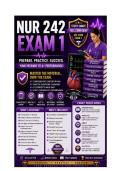
,NUR 242 Exam 1 Study Guide: 300
Practice Questions & Answers +
Rationales | Perioperative, Anemias,
Transfusions, Pressure Injuries, Infection
Control 2026
NUR 242 Exam 1 - Multiple Choice Questions (1-300)
Questions 1-50: Health, Safety, Tissue Integrity, and
Prevention
1. A nurse is assessing a patient who is immobile. Which finding indicates a Stage
1 pressure injury?
A. Full-thickness skin loss with exposed bone
B. Partial-thickness skin loss with exposed dermis
C. Nonblanchable erythema over a bony prominence
D. Open ulceration with visible subcutaneous fat
,Rationale: Stage 1 pressure injuries are characterized by intact skin with nonblanchable
redness, typically over a bony prominence. Option A describes Stage 4, Option B describes
Stage 2, and Option D describes Stage 3.
2. A patient asks the nurse about ways to prevent skin cancer. Which response by
the nurse is most appropriate?
A. "Avoid sun exposure between 2 PM and 6 PM only"
B. "Use tanning beds instead of outdoor sun exposure"
C. "Apply broad-spectrum sunscreen with SPF 30 or higher and reapply every 2
hours"
D. "Only worry about skin cancer if you have a family history"
Rationale: Sunscreen with SPF 30 or higher, reapplied every 2 hours, is a key primary
prevention measure. UV exposure is most intense between 10 AM and 4 PM, not 2-6 PM.
Tanning beds increase skin cancer risk, and everyone should practice sun safety regardless
of family history.
3. A nurse is caring for an older adult patient with limited mobility. Which
intervention is most effective for preventing pressure injuries?
A. Massaging bony prominences twice daily
B. Repositioning the patient every 2 hours
C. Keeping the head of the bed elevated at 45 degrees
D. Using a donut-shaped cushion for the sacrum
Rationale: Repositioning every 2 hours relieves pressure on bony prominences and is the
most effective preventive measure. Massaging can damage capillaries, donut cushions can
create pressure points, and prolonged head elevation increases shearing forces.
4. The nurse is teaching a patient about the ABCDE method for skin self-
assessment. What does the "E" stand for?
, A. Evolving
B. Excision
C. Erythema
D. Elevation
Rationale: "E" in the ABCDE method stands for Evolving, meaning the mole or lesion is
changing in size, shape, color, or symptoms. Asymmetry, Border irregularity, Color
variation, and Diameter >6mm are the other components.
5. A patient with cellulitis of the lower extremity asks the nurse what caused the
infection. Which response is most accurate?
A. "Cellulitis is caused by a virus that enters through broken skin"
B. "Cellulitis is most commonly caused by bacteria, such as Staphylococcus or
Streptococcus, entering through a break in the skin"
C. "Cellulitis is caused by a fungal infection that spreads from the feet"
D. "Cellulitis is an allergic reaction to insect bites"
Rationale: Cellulitis is a bacterial infection of the dermis and subcutaneous tissue, most
commonly caused by Staphylococcus aureus and Group B streptococci. It is not viral,
fungal, or allergic in nature.
6. A nurse is providing education about primary prevention of pressure injuries.
Which statement by the patient indicates understanding?
A. "I should use a heating pad to increase circulation to my skin"
B. "I will check my skin daily for any red or broken areas"
C. "I should sit in a chair for no more than 4 hours at a time"
D. "I only need to worry about pressure injuries if I have diabetes"
Rationale: Daily skin inspection is a key primary prevention strategy. Heating pads can
cause burns. Sitting should be limited to 2 hours or less. All immobile patients are at risk,
not just those with diabetes.
Practice Questions & Answers +
Rationales | Perioperative, Anemias,
Transfusions, Pressure Injuries, Infection
Control 2026
NUR 242 Exam 1 - Multiple Choice Questions (1-300)
Questions 1-50: Health, Safety, Tissue Integrity, and
Prevention
1. A nurse is assessing a patient who is immobile. Which finding indicates a Stage
1 pressure injury?
A. Full-thickness skin loss with exposed bone
B. Partial-thickness skin loss with exposed dermis
C. Nonblanchable erythema over a bony prominence
D. Open ulceration with visible subcutaneous fat
,Rationale: Stage 1 pressure injuries are characterized by intact skin with nonblanchable
redness, typically over a bony prominence. Option A describes Stage 4, Option B describes
Stage 2, and Option D describes Stage 3.
2. A patient asks the nurse about ways to prevent skin cancer. Which response by
the nurse is most appropriate?
A. "Avoid sun exposure between 2 PM and 6 PM only"
B. "Use tanning beds instead of outdoor sun exposure"
C. "Apply broad-spectrum sunscreen with SPF 30 or higher and reapply every 2
hours"
D. "Only worry about skin cancer if you have a family history"
Rationale: Sunscreen with SPF 30 or higher, reapplied every 2 hours, is a key primary
prevention measure. UV exposure is most intense between 10 AM and 4 PM, not 2-6 PM.
Tanning beds increase skin cancer risk, and everyone should practice sun safety regardless
of family history.
3. A nurse is caring for an older adult patient with limited mobility. Which
intervention is most effective for preventing pressure injuries?
A. Massaging bony prominences twice daily
B. Repositioning the patient every 2 hours
C. Keeping the head of the bed elevated at 45 degrees
D. Using a donut-shaped cushion for the sacrum
Rationale: Repositioning every 2 hours relieves pressure on bony prominences and is the
most effective preventive measure. Massaging can damage capillaries, donut cushions can
create pressure points, and prolonged head elevation increases shearing forces.
4. The nurse is teaching a patient about the ABCDE method for skin self-
assessment. What does the "E" stand for?
, A. Evolving
B. Excision
C. Erythema
D. Elevation
Rationale: "E" in the ABCDE method stands for Evolving, meaning the mole or lesion is
changing in size, shape, color, or symptoms. Asymmetry, Border irregularity, Color
variation, and Diameter >6mm are the other components.
5. A patient with cellulitis of the lower extremity asks the nurse what caused the
infection. Which response is most accurate?
A. "Cellulitis is caused by a virus that enters through broken skin"
B. "Cellulitis is most commonly caused by bacteria, such as Staphylococcus or
Streptococcus, entering through a break in the skin"
C. "Cellulitis is caused by a fungal infection that spreads from the feet"
D. "Cellulitis is an allergic reaction to insect bites"
Rationale: Cellulitis is a bacterial infection of the dermis and subcutaneous tissue, most
commonly caused by Staphylococcus aureus and Group B streptococci. It is not viral,
fungal, or allergic in nature.
6. A nurse is providing education about primary prevention of pressure injuries.
Which statement by the patient indicates understanding?
A. "I should use a heating pad to increase circulation to my skin"
B. "I will check my skin daily for any red or broken areas"
C. "I should sit in a chair for no more than 4 hours at a time"
D. "I only need to worry about pressure injuries if I have diabetes"
Rationale: Daily skin inspection is a key primary prevention strategy. Heating pads can
cause burns. Sitting should be limited to 2 hours or less. All immobile patients are at risk,
not just those with diabetes.


