

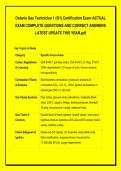
Ontario Gas Technician 1 (G1) Certification Exam ACTUAL
EXAM COMPLETE QUESTIONS AND CORRECT ANSWERS
LATEST UPDATE THIS YEAR.pdf
Key Topics to Study
Category Specific Focus Areas
Codes, Regulations CSA B149.1 (primary code), CSA B149.3, O. Reg. 215/01,
& Licensing TSSA requirements, G1 scope of work, licence renewal,
red tag authority
Combustion Theory Stoichiometric combustion, excess air, products of
& Analysis combustion (CO₂, CO, O₂, NOx), ignition temperature of
natural gas (540°C), LEL/UEL
Gas Piping Systems Pipe sizing, pressure drop calculations, materials (black
steel, CSST, copper), fittings, testing pressures (strength:
15 psig, low pressure: 6 psig), sediment traps
Gas Trains & Double block & bleed systems, shutoff valves, vent valves,
Controls high/low pressure switches (25% above/50% below), bleed
valves, butterfly valves
Flame Safeguard & Flame rod (DC signal), UV scanners, lead sulfide cells,
Ignition flame rectification, response times (4 seconds for
>1,000,000 BTU/h), purge requirements
, Venting & Air Supply Venting categories (I, II, III, IV), draft hoods, combustion
air, vent connector clearance, backdrafting prevention
Troubleshooting Delayed ignition, flame failure, short cycling, lockout
conditions, false flame signals, CO production causes
SECTION 1: CODES, REGULATIONS & LICENSING (Questions 1-45)
1. What is the minimum passing score required on the TSSA Gas Technician 1 Exam
to qualify for a G1 licence?
A) 65%
B) 75%
C) 80%
D) 85%
Answer: B. The TSSA requires candidates to achieve a score of 75% or higher on the EX
03 Gas Technician 1 Exam to qualify for the G1 licence .
2. A G1 licence holder may work on equipment with which BTU input capacity?
A) Up to 400,000 BTU/h only
B) Any BTU/h capacity (unrestricted)
C) Up to 1,000,000 BTU/h only
D) Only appliances under 200,000 BTU/h
Answer: B. G1 is the highest level of gas technician licensing in Ontario, allowing
technicians to work on natural gas and propane equipment of any BTU/h capacity without
restriction .
,3. Which of the following codes is the primary governing document for gas
installations in Ontario?
A) CSA B149.3
B) CSA B149.1
C) NFPA 54
D) ASME Section IX
Answer: B. CSA B149.1, the Natural Gas and Propane Installation Code, is the primary
code governing gas installations in Ontario .
4. Which regulation under the Technical Standards and Safety Act, 2000, governs the
licensing and certification of Gas Technicians in Ontario?
A) O. Reg. 211/01
B) O. Reg. 212/01
C) O. Reg. 213/01
D) O. Reg. 215/01
Answer: D. Ontario Regulation 215/01 under the Technical Standards and Safety Act,
2000, governs the licensing and certification of Gas Technicians in Ontario .
5. Which regulation establishes the Gaseous Fuels Code Adoption Document (CAD)
in Ontario?
A) O. Reg. 211/01
B) O. Reg. 212/01
C) O. Reg. 213/01
, D) O. Reg. 215/01
Answer: B. O. Reg. 212/01: Gaseous Fuels establishes the Code Adoption Document
(CAD) for gaseous fuels .
6. Under CSA B149.1, what is the minimum clearance required between a natural-gas
furnace and a combustible wall?
A) 1 inch
B) 3 inches
C) 6 inches
D) 12 inches
Answer: B. Clause 8.1.3 of CSA B149.1 generally requires a minimum clearance of 3
inches from combustible materials for gas appliances, unless the appliance is listed for a
lesser clearance .
7. What is the prerequisite work experience required to qualify for the G1 exam?
A) 2,000 hours as a G3 technician
B) 4,000 hours of field experience as a G2 technician with 500 supervised hours on
equipment over 400,000 BTU/h
C) 5,000 hours of any gas-related work
D) No work experience is required
Answer: B. Applicants must have 4,000 hours of field experience as a G2 technician, which
includes 500 hours on systems over 400,000 BTU/h under direct G1 supervision .
8. How often must a G1 gas technician renew their licence in Ontario?
A) 1 year
EXAM COMPLETE QUESTIONS AND CORRECT ANSWERS
LATEST UPDATE THIS YEAR.pdf
Key Topics to Study
Category Specific Focus Areas
Codes, Regulations CSA B149.1 (primary code), CSA B149.3, O. Reg. 215/01,
& Licensing TSSA requirements, G1 scope of work, licence renewal,
red tag authority
Combustion Theory Stoichiometric combustion, excess air, products of
& Analysis combustion (CO₂, CO, O₂, NOx), ignition temperature of
natural gas (540°C), LEL/UEL
Gas Piping Systems Pipe sizing, pressure drop calculations, materials (black
steel, CSST, copper), fittings, testing pressures (strength:
15 psig, low pressure: 6 psig), sediment traps
Gas Trains & Double block & bleed systems, shutoff valves, vent valves,
Controls high/low pressure switches (25% above/50% below), bleed
valves, butterfly valves
Flame Safeguard & Flame rod (DC signal), UV scanners, lead sulfide cells,
Ignition flame rectification, response times (4 seconds for
>1,000,000 BTU/h), purge requirements
, Venting & Air Supply Venting categories (I, II, III, IV), draft hoods, combustion
air, vent connector clearance, backdrafting prevention
Troubleshooting Delayed ignition, flame failure, short cycling, lockout
conditions, false flame signals, CO production causes
SECTION 1: CODES, REGULATIONS & LICENSING (Questions 1-45)
1. What is the minimum passing score required on the TSSA Gas Technician 1 Exam
to qualify for a G1 licence?
A) 65%
B) 75%
C) 80%
D) 85%
Answer: B. The TSSA requires candidates to achieve a score of 75% or higher on the EX
03 Gas Technician 1 Exam to qualify for the G1 licence .
2. A G1 licence holder may work on equipment with which BTU input capacity?
A) Up to 400,000 BTU/h only
B) Any BTU/h capacity (unrestricted)
C) Up to 1,000,000 BTU/h only
D) Only appliances under 200,000 BTU/h
Answer: B. G1 is the highest level of gas technician licensing in Ontario, allowing
technicians to work on natural gas and propane equipment of any BTU/h capacity without
restriction .
,3. Which of the following codes is the primary governing document for gas
installations in Ontario?
A) CSA B149.3
B) CSA B149.1
C) NFPA 54
D) ASME Section IX
Answer: B. CSA B149.1, the Natural Gas and Propane Installation Code, is the primary
code governing gas installations in Ontario .
4. Which regulation under the Technical Standards and Safety Act, 2000, governs the
licensing and certification of Gas Technicians in Ontario?
A) O. Reg. 211/01
B) O. Reg. 212/01
C) O. Reg. 213/01
D) O. Reg. 215/01
Answer: D. Ontario Regulation 215/01 under the Technical Standards and Safety Act,
2000, governs the licensing and certification of Gas Technicians in Ontario .
5. Which regulation establishes the Gaseous Fuels Code Adoption Document (CAD)
in Ontario?
A) O. Reg. 211/01
B) O. Reg. 212/01
C) O. Reg. 213/01
, D) O. Reg. 215/01
Answer: B. O. Reg. 212/01: Gaseous Fuels establishes the Code Adoption Document
(CAD) for gaseous fuels .
6. Under CSA B149.1, what is the minimum clearance required between a natural-gas
furnace and a combustible wall?
A) 1 inch
B) 3 inches
C) 6 inches
D) 12 inches
Answer: B. Clause 8.1.3 of CSA B149.1 generally requires a minimum clearance of 3
inches from combustible materials for gas appliances, unless the appliance is listed for a
lesser clearance .
7. What is the prerequisite work experience required to qualify for the G1 exam?
A) 2,000 hours as a G3 technician
B) 4,000 hours of field experience as a G2 technician with 500 supervised hours on
equipment over 400,000 BTU/h
C) 5,000 hours of any gas-related work
D) No work experience is required
Answer: B. Applicants must have 4,000 hours of field experience as a G2 technician, which
includes 500 hours on systems over 400,000 BTU/h under direct G1 supervision .
8. How often must a G1 gas technician renew their licence in Ontario?
A) 1 year


