
WGU D755 Assessment in Special Education Objective Assessment (OA) Study Guide, Practice Questions, Answers & Exam Review
WGU D755|D003 Assessment in Special Education Objective Assessment |
OA 45 Questions and Answers | 2026 Update | 100% Correct
Study online at https://quizlet.com/_j05y9u
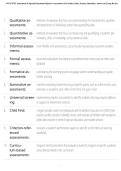
1. Qualitative as- methods of evaluation that focus on understanding the characteristics, qualities,
sessments: and experiences of individuals rather than quantifying data
2. Quantitative as- methods of evaluation that focus on measuring and quantifying a student's per-
sessments: formance, skills, or knowledge using numerical data
3. Informal assess- more flexible and spontaneous, occurring during everyday classroom activities
ments:
4. Formal assess- structured evaluations that adhere to predetermined criteria and are often stan-
ments: dardized
5. Formative as- used during the learning process to gauge student understanding and guide
sessments: further learning
6. Summative as- a tool for evaluating student learning at specific points, such as at the end of a unit,
sessments: semester, or academic year; often in the form of a quiz or test
7. Universal screen- implementing regular assessments to identify students who may require addition-
ing: al support or intervention early on
8. Child Find: a legal mandate under the Individuals with Disabilities Education Act (IDEA) that
requires public schools to identify, locate, and evaluate all children with exception-
alities who may be in need of special education and related services
9. Criterion-refer- measure a student's performance against a specific set of criteria or learning
enced standards
assessments:
10. Curricu- frequent, brief assessments that evaluate a student's progress in specific academic
lum-based areas directly linked to the curriculum
assessments:
1/9
, WGU D755 Assessment in Special Education Objective Assessment (OA) Study Guide, Practice Questions, Answers & Exam Review
WGU D755|D003 Assessment in Special Education Objective Assessment |
OA 45 Questions and Answers | 2026 Update | 100% Correct
Study online at https://quizlet.com/_j05y9u
11. Direct observa- allows educators to record specific behaviors in real-time, focusing on particular
tion: times, activities, or settings where issues are most likely to arise
12. Behavioral check- quantify the frequency, intensity, and duration of behaviors, offering a measurable
lists and rating way to track changes over time and assess intervention success
scales:
13. Functional be- a systematic process used to identify the underlying causes and functions of
havior assess- specific behaviors in students
ment (FBA):
14. Student self-as- encourages students to reflect on their behavior and the effectiveness of inter-
sessment: ventions, promoting self-awareness and aligning their perspectives with teacher
observations
15. Anecdotal document specific behavioral incidents in a narrative form, providing detailed
records: qualitative data that can reveal patterns and guide intervention adjustments
16. 4-point method: allows educators to plot data points from assessments on a graph, connecting four
key points—such as the start, midpoint, and endpoints of a given period
17. Goal line: represents the expected trajectory of student progress based on set goals
18. Trend line analy- helps in visualizing the trajectory of a student's performance or behavior and can
sis: be used to predict future outcomes
19. Pre-referral a systematic approach used to address and support students who are struggling
process: academically or behaviorally prior to a formal special education referral
20. Intervention as- A team that meets during the pre-referral process, usually including general
sistance team education and special education teachers, school psychologists, administrators,
(IAT): and other professionals who have a vested interest in the student
2/9
WGU D755|D003 Assessment in Special Education Objective Assessment |
OA 45 Questions and Answers | 2026 Update | 100% Correct
Study online at https://quizlet.com/_j05y9u
1. Qualitative as- methods of evaluation that focus on understanding the characteristics, qualities,
sessments: and experiences of individuals rather than quantifying data
2. Quantitative as- methods of evaluation that focus on measuring and quantifying a student's per-
sessments: formance, skills, or knowledge using numerical data
3. Informal assess- more flexible and spontaneous, occurring during everyday classroom activities
ments:
4. Formal assess- structured evaluations that adhere to predetermined criteria and are often stan-
ments: dardized
5. Formative as- used during the learning process to gauge student understanding and guide
sessments: further learning
6. Summative as- a tool for evaluating student learning at specific points, such as at the end of a unit,
sessments: semester, or academic year; often in the form of a quiz or test
7. Universal screen- implementing regular assessments to identify students who may require addition-
ing: al support or intervention early on
8. Child Find: a legal mandate under the Individuals with Disabilities Education Act (IDEA) that
requires public schools to identify, locate, and evaluate all children with exception-
alities who may be in need of special education and related services
9. Criterion-refer- measure a student's performance against a specific set of criteria or learning
enced standards
assessments:
10. Curricu- frequent, brief assessments that evaluate a student's progress in specific academic
lum-based areas directly linked to the curriculum
assessments:
1/9
, WGU D755 Assessment in Special Education Objective Assessment (OA) Study Guide, Practice Questions, Answers & Exam Review
WGU D755|D003 Assessment in Special Education Objective Assessment |
OA 45 Questions and Answers | 2026 Update | 100% Correct
Study online at https://quizlet.com/_j05y9u
11. Direct observa- allows educators to record specific behaviors in real-time, focusing on particular
tion: times, activities, or settings where issues are most likely to arise
12. Behavioral check- quantify the frequency, intensity, and duration of behaviors, offering a measurable
lists and rating way to track changes over time and assess intervention success
scales:
13. Functional be- a systematic process used to identify the underlying causes and functions of
havior assess- specific behaviors in students
ment (FBA):
14. Student self-as- encourages students to reflect on their behavior and the effectiveness of inter-
sessment: ventions, promoting self-awareness and aligning their perspectives with teacher
observations
15. Anecdotal document specific behavioral incidents in a narrative form, providing detailed
records: qualitative data that can reveal patterns and guide intervention adjustments
16. 4-point method: allows educators to plot data points from assessments on a graph, connecting four
key points—such as the start, midpoint, and endpoints of a given period
17. Goal line: represents the expected trajectory of student progress based on set goals
18. Trend line analy- helps in visualizing the trajectory of a student's performance or behavior and can
sis: be used to predict future outcomes
19. Pre-referral a systematic approach used to address and support students who are struggling
process: academically or behaviorally prior to a formal special education referral
20. Intervention as- A team that meets during the pre-referral process, usually including general
sistance team education and special education teachers, school psychologists, administrators,
(IAT): and other professionals who have a vested interest in the student
2/9


