D775 WGU Section 1
D775 WGU Section 1
Study online at https://quizlet.com/_gy4zah
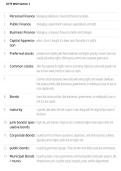
1. Personal Finance Managing individual or household financial activities
2. Public Finance Managing a government's revenues, expenditures, and debt
3. Business Finance Managing a company's financial activities and strategies
4. Capital Apprecia- when a stock is bought at a lower price than what it is sold at.
tion
5. Preferred stocks provide more stability with fixed dividends and higher priority in asset claims but
usually lack voting rights, offering less control over corporate governance.
6. Common stocks offer the potential for higher returns and voting rights but come with greater risk
due to their lower priority in claims on assets.
7. Common stock represents ownership with voting rights and variable dividloans
that various entities (like businesses, governments, or individuals) issue, or sell, to
raise capital.ends,
8. Bonds loans that various entities (like businesses, governments, or individuals) issue, or
sell, to raise capital.
9. maturity a specific date when the last coupon is due along with the original face value of
the bond
10. junk bonds/ spec- high-risk, and investors hope to earn a relatively higher return due to that risk.
ulative bonds
11. Corporate Bonds Issued by firms to finance operations, expansions, and other business activities.
Typically carries higher yields due to higher risk
12. public bonds: Issued by government groups. There are two main kinds municipal and treasury.
13. Municipal Bonds Issued by states or local governments and municipalities fund public projects, like
/ munis infrastructure such as public roads, hospitals, parks, and fire departments.
1/7
, D775 WGU Section 1
D775 WGU Section 1
Study online at https://quizlet.com/_gy4zah
14. Treasury bonds / When firms have extra cash sitting in their account- short-term, non-risky invest-
treasuries ments for the cash.
15. How do compa- Companies can issue bonds (debt financing), which must be repaid with interest,
nies raise capital or sell stock (equity financing), which gives ownership to investors but does not
through debt and require repayment.
equity financing?
16. Financial deriva- They derive their value from the performance of underlying assets, indexes, or
tives rates.
17. Options financial contracts that give the buyer the right, but not the obligation, to buy or sell
an asset at a predetermined price, known as the "strike price," before a specified
date
18. Futures standardized contracts obligating the buyer to purchase or the seller to sell an
asset at a predetermined price on a specified future date.
19. Mutual Funds typically open-end investment companies that issue shares to the public and are
priced daily based on their net asset value (NAV
20. Exchange-traded trade on stock exchanges like individual stocks and can be bought and sold
funds throughout the trading day
21. Hedge Funds private investment partnerships for accredited investors that employ diverse strate-
gies to generate high returns, often with higher risk
22. Pension Funds large pools of capital collected from employees for retirement savings, managed
to ensure growth and sustainability of the fund.
23. Public Markets buying and selling of securities, such as stocks and bonds, on organized exchanges
where the general public can participate
2/7
D775 WGU Section 1
Study online at https://quizlet.com/_gy4zah
1. Personal Finance Managing individual or household financial activities
2. Public Finance Managing a government's revenues, expenditures, and debt
3. Business Finance Managing a company's financial activities and strategies
4. Capital Apprecia- when a stock is bought at a lower price than what it is sold at.
tion
5. Preferred stocks provide more stability with fixed dividends and higher priority in asset claims but
usually lack voting rights, offering less control over corporate governance.
6. Common stocks offer the potential for higher returns and voting rights but come with greater risk
due to their lower priority in claims on assets.
7. Common stock represents ownership with voting rights and variable dividloans
that various entities (like businesses, governments, or individuals) issue, or sell, to
raise capital.ends,
8. Bonds loans that various entities (like businesses, governments, or individuals) issue, or
sell, to raise capital.
9. maturity a specific date when the last coupon is due along with the original face value of
the bond
10. junk bonds/ spec- high-risk, and investors hope to earn a relatively higher return due to that risk.
ulative bonds
11. Corporate Bonds Issued by firms to finance operations, expansions, and other business activities.
Typically carries higher yields due to higher risk
12. public bonds: Issued by government groups. There are two main kinds municipal and treasury.
13. Municipal Bonds Issued by states or local governments and municipalities fund public projects, like
/ munis infrastructure such as public roads, hospitals, parks, and fire departments.
1/7
, D775 WGU Section 1
D775 WGU Section 1
Study online at https://quizlet.com/_gy4zah
14. Treasury bonds / When firms have extra cash sitting in their account- short-term, non-risky invest-
treasuries ments for the cash.
15. How do compa- Companies can issue bonds (debt financing), which must be repaid with interest,
nies raise capital or sell stock (equity financing), which gives ownership to investors but does not
through debt and require repayment.
equity financing?
16. Financial deriva- They derive their value from the performance of underlying assets, indexes, or
tives rates.
17. Options financial contracts that give the buyer the right, but not the obligation, to buy or sell
an asset at a predetermined price, known as the "strike price," before a specified
date
18. Futures standardized contracts obligating the buyer to purchase or the seller to sell an
asset at a predetermined price on a specified future date.
19. Mutual Funds typically open-end investment companies that issue shares to the public and are
priced daily based on their net asset value (NAV
20. Exchange-traded trade on stock exchanges like individual stocks and can be bought and sold
funds throughout the trading day
21. Hedge Funds private investment partnerships for accredited investors that employ diverse strate-
gies to generate high returns, often with higher risk
22. Pension Funds large pools of capital collected from employees for retirement savings, managed
to ensure growth and sustainability of the fund.
23. Public Markets buying and selling of securities, such as stocks and bonds, on organized exchanges
where the general public can participate
2/7