WGU D186 Q&A
WGU D186
Study online at https://quizlet.com/_jp8hhs
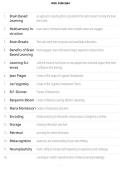
1. Brain Based an approach to teaching that is grounded in the latest research on how the brain
Learning learns best.
2. Multisensory In- brain retains information better when multiple senses are engaged
struction
3. Brain Breaks The brain needs time to process and consolidate information
4. Benefits of Brain more engaged, retain information longer, experience reduced stress
Based Learning
5. Learning Sci- a field of research that focuses on how people learn and what support they need
ences to influence their learning
6. Jean Piaget Creator of the Stages of Cognitive Development
7. Lev Vygotsky Creator of the Cognitive Development Theory
8. B.F. Skinner Pioneer of Behaviorism
9. Benjamin Bloom Creator of Mastery Learning (Bloom's Taxonomy)
10. Maria Montessori Creator of Exploratory Education
11. Encoding Initial processing of information, sensory input is changed to a schema
12. Storage retaining information over time
13. Retrieval accessing the stored information
14. Metacognition awareness and understanding of your own thinking
15. Neuroplasticity brain's ability to reshape itself depending on experiences and challenges
16. a technique in which new information is linked to existing knowledge
1/5
, WGU D186 Q&A
WGU D186
Study online at https://quizlet.com/_jp8hhs
Elaborative Re-
hearsal
17. Feedback provide information on performance and guides future actions
18. Dual Coding the process of combining verbal materials with visual materials for the purpose of
improving comprehension
19. Deep Learning development of complex understanding and meaning, incorporates critical-think-
ing skills so students can develop understandings between concepts and solve
problems
20. Elaborative Inter- Learners are asked to ask themselves questions that invite deep reasoning - why,
rogation how, what if, what if not
21. Self-Explanation learners produce explanations of material or of their thought processes while they
are reading, answering questions, or solving problems
22. Elaboration explaining and describing ideas with many details
23. Open Ended encourage discussion and exploration, allowing students to express their thoughts
Questions without a single correct answer
24. Socratic Ques- involves asking a series of questions that challenge assumptions and stimulate
tioning critical thinking.
25. Think-Pair-Share Students first think about a question individually, then discuss their thoughts with
a partner before sharing with the class, fostering collaborative learning.
26. Problem-Based Presenting a real-world problem encourages students to analyze, evaluate, and
Questions create solutions
27. Reflective Ques- These questions encourage students to reflect on their learning experiences and
tions connect them to real-world contexts.
2/5
WGU D186
Study online at https://quizlet.com/_jp8hhs
1. Brain Based an approach to teaching that is grounded in the latest research on how the brain
Learning learns best.
2. Multisensory In- brain retains information better when multiple senses are engaged
struction
3. Brain Breaks The brain needs time to process and consolidate information
4. Benefits of Brain more engaged, retain information longer, experience reduced stress
Based Learning
5. Learning Sci- a field of research that focuses on how people learn and what support they need
ences to influence their learning
6. Jean Piaget Creator of the Stages of Cognitive Development
7. Lev Vygotsky Creator of the Cognitive Development Theory
8. B.F. Skinner Pioneer of Behaviorism
9. Benjamin Bloom Creator of Mastery Learning (Bloom's Taxonomy)
10. Maria Montessori Creator of Exploratory Education
11. Encoding Initial processing of information, sensory input is changed to a schema
12. Storage retaining information over time
13. Retrieval accessing the stored information
14. Metacognition awareness and understanding of your own thinking
15. Neuroplasticity brain's ability to reshape itself depending on experiences and challenges
16. a technique in which new information is linked to existing knowledge
1/5
, WGU D186 Q&A
WGU D186
Study online at https://quizlet.com/_jp8hhs
Elaborative Re-
hearsal
17. Feedback provide information on performance and guides future actions
18. Dual Coding the process of combining verbal materials with visual materials for the purpose of
improving comprehension
19. Deep Learning development of complex understanding and meaning, incorporates critical-think-
ing skills so students can develop understandings between concepts and solve
problems
20. Elaborative Inter- Learners are asked to ask themselves questions that invite deep reasoning - why,
rogation how, what if, what if not
21. Self-Explanation learners produce explanations of material or of their thought processes while they
are reading, answering questions, or solving problems
22. Elaboration explaining and describing ideas with many details
23. Open Ended encourage discussion and exploration, allowing students to express their thoughts
Questions without a single correct answer
24. Socratic Ques- involves asking a series of questions that challenge assumptions and stimulate
tioning critical thinking.
25. Think-Pair-Share Students first think about a question individually, then discuss their thoughts with
a partner before sharing with the class, fostering collaborative learning.
26. Problem-Based Presenting a real-world problem encourages students to analyze, evaluate, and
Questions create solutions
27. Reflective Ques- These questions encourage students to reflect on their learning experiences and
tions connect them to real-world contexts.
2/5