

Written by students who passed Immediately available after payment Read online or as PDF Wrong document? Swap it for free 4.6 TrustPilot
logo-home
Document preview thumbnail
Preview 4 out of 58 pages
Exam (elaborations)

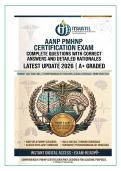
AANP PMHNP Certification Exam Study Guide | Comprehensive Practice Questions with Detailed Explanations | Latest 2026 Edition

Document preview thumbnail
Preview 4 out of 58 pages

Prepare confidently for the AANP Psychiatric-Mental Health Nurse Practitioner (PMHNP) Certification Examination with the most comprehensive and up-to-date study guide developed for the 2026 certification blueprint. Designed specifically for PMHNP students, recent graduates, and board certification candidates, this complete review resource features hundreds of original, certification-style practice questions carefully written to strengthen clinical reasoning, diagnostic accuracy, psychopharmacology knowledge, and evidence-based psychiatric care across the lifespan. Every practice question includes a correct answer followed by a detailed, exam-style explanation that explains not only why the correct option is appropriate, but also why the alternative responses are less appropriate in clinical practice. Rather than focusing on memorization alone, this guide develops the clinical judgment and decision-making skills expected of entry-level Psychiatric-Mental Health Nurse Practitioners. Built around the current AANP PMHNP certification content outline, this comprehensive study guide emphasizes the major competency domains of assessment, diagnosis, treatment planning, and evaluation across patients from infancy through older adulthood. Comprehensive coverage includes: Comprehensive Psychiatric Assessment: Psychiatric interviews, mental status examination (MSE), psychiatric history, psychosocial assessment, family history, developmental milestones, substance use screening, suicide and homicide risk assessment, violence assessment, trauma screening, cultural formulation, physical assessment, laboratory interpretation, differential diagnosis, and evidence-based diagnostic decision-making. DSM-5-TR Psychiatric Disorders: Major depressive disorder, persistent depressive disorder, bipolar I and II disorders, generalized anxiety disorder, panic disorder, obsessive-compulsive disorder, PTSD, acute stress disorder, schizophrenia spectrum disorders, schizoaffective disorder, personality disorders, ADHD, autism spectrum disorder, eating disorders, sleep-wake disorders, neurocognitive disorders, substance use disorders, and psychiatric emergencies. Advanced Psychopharmacology: Antidepressants (SSRIs, SNRIs, TCAs, MAOIs, atypical antidepressants), antipsychotics, mood stabilizers, anxiolytics, stimulants, medications for ADHD, sleep medications, medications for substance use disorders, pharmacokinetics, pharmacodynamics, CYP450 interactions, adverse effects, contraindications, therapeutic drug monitoring, medication selection, augmentation strategies, treatment-resistant psychiatric disorders, and safe prescribing principles. Psychotherapy & Therapeutic Modalities: Cognitive Behavioral Therapy (CBT), Dialectical Behavior Therapy (DBT), Motivational Interviewing, Acceptance and Commitment Therapy (ACT), supportive psychotherapy, psychodynamic therapy, interpersonal therapy, family therapy, couples therapy, group therapy, crisis intervention, trauma-informed care, and integrating psychotherapy with medication management. Care Across the Lifespan: Infant and early childhood development, pediatric behavioral disorders, adolescent psychiatric conditions, adult mental health, perinatal psychiatry, women's mental health, geriatric psychiatry, age-specific prescribing considerations, developmental disorders, and lifespan mental health promotion. Psychiatric Emergencies & Crisis Management: Suicide prevention, self-harm assessment, homicidal ideation, acute psychosis, mania, delirium, intoxication and withdrawal syndromes, serotonin syndrome, neuroleptic malignant syndrome, psychiatric hospitalization criteria, involuntary commitment principles, de-escalation techniques, safety planning, and emergency psychiatric interventions. Medical & Psychiatric Comorbidities: Chronic medical illnesses affecting mental health, endocrine disorders, neurological conditions, cardiovascular disease, chronic pain, sleep disorders, substance-related complications, medication-induced psychiatric symptoms, and integrated behavioral healthcare approaches. Substance Use & Addiction Medicine: Screening tools, diagnosis of substance use disorders, alcohol withdrawal, opioid use disorder, stimulant misuse, cannabis-related disorders, nicotine dependence, medication-assisted treatment (MAT), relapse prevention, motivational enhancement strategies, harm reduction, and recovery-oriented care. Professional Practice, Ethics & Legal Issues: Scope of PMHNP practice, informed consent, confidentiality, HIPAA, ethical decision-making, professional boundaries, documentation, mandatory reporting, telepsychiatry, evidence-based practice, quality improvement, cultural humility, social determinants of health, collaborative care models, and legal responsibilities of advanced practice psychiatric providers. Health Promotion & Prevention: Screening recommendations, preventive mental healthcare, resilience building, patient education, lifestyle interventions, psychoeducation, relapse prevention, chronic disease management, and population-focused psychiatric care. Clinical Case Studies & Board-Style Scenarios: Realistic patient encounters requiring candidates to prioritize assessment findings, interpret diagnostic information, select first-line treatments, modify medication regimens, recognize adverse drug reactions, evaluate therapeutic response, manage psychiatric crises, and apply evidence-based clinical guidelines in complex patient presentations. Exam Readiness & Clinical Reasoning: This study guide emphasizes competency-based learning through realistic clinical scenarios, helping candidates develop diagnostic confidence, prescribing accuracy, therapeutic communication skills, and sound clinical judgment expected of newly certified PMHNPs. The official AANP PMHNP exam is designed to assess entry-level competency across assessment, diagnosis, planning, and evaluation domains throughout the lifespan. Whether you are preparing for your first certification attempt, completing a final comprehensive review, or strengthening weak content areas before test day, this resource provides the structured practice, detailed explanations, and comprehensive content review needed to build confidence and prepare effectively for the AANP PMHNP Certification Examination.

Content preview

,AANP PMHNP CERTIFICATION EXAM
COMPLETE QUESTIONS WITH CORRECT ANSWERS AND DETAILED
RATIONALES
LATEST UPDATE 2026 | A+ GRADED


EXAM OVERVIEW & BLUEPRINT
The PMHNP certification examination is an entry-level competency-
based exam that tests clinical knowledge of psychiatric mental health
across the lifespan. Administered by the American Academy of Nurse
Practitioners Certification Board (AANPCB), the exam consists of 150
multiple-choice questions with a 3-hour time limit.
Content Domain Breakdown

Domain Number of Items Percentage

Domain I – Assess 45 33%

Domain II – Diagnose 28 21%

Domain III – Plan 35 26%

Domain IV – Evaluate 27 20%

Total 135 100%

Patient Age Category Distribution

,Age Category Number of Items Percentage

Infant & Child 8 6%

Pre-Adolescent 11 8%

Adolescent 22 16%

Adult 67 50%

Older Adult 27 20%

Key Knowledge Areas
The exam covers Scientific Foundations (anatomy, neuroanatomy,
pathophysiology, epidemiology), Pharmacology (psychopharmacology,
pharmacodynamics, drug interactions, pharmacogenetic
testing), Psychotherapies (individual, group, and family therapy
theories), Assessment & Diagnosis (clinical interviewing, DSM-5
diagnostic criteria, screening instruments), Care Practices (risk
assessment, crisis management, trauma-informed care, cultural
humility), and Professional Role (ethics, scope of practice, telehealth,
quality improvement).


SECTION 1: SCIENTIFIC FOUNDATIONS & NEUROBIOLOGY (Questions
1-30)
Question 1
Where is norepinephrine primarily synthesized in the central nervous
system?

, • A) Raphe nuclei
• B) Locus coeruleus
• C) Substantia nigra
• D) Nucleus accumbens
Correct Answer: B) Locus coeruleus
Rationale: The locus coeruleus, located in the pons, is the primary site
for norepinephrine synthesis in the brain. This pathway is crucial for
arousal, attention, and the stress response. The raphe nuclei synthesize
serotonin, the substantia nigra synthesizes dopamine, and the nucleus
accumbens is primarily involved in reward processing.


Question 2
Which dopamine pathway is primarily associated with the positive
symptoms of schizophrenia (hallucinations, delusions)?
• A) Mesocortical pathway
• B) Nigrostriatal pathway
• C) Tuberoinfundibular pathway
• D) Mesolimbic pathway
Correct Answer: D) Mesolimbic pathway
Rationale: The mesolimbic pathway projects from the Ventral
Tegmental Area (VTA) to the nucleus accumbens. Excess dopamine
activity in this pathway is linked to positive symptoms of schizophrenia
including hallucinations and delusions. Hypoactivity in the mesocortical
pathway is associated with negative symptoms. The nigrostriatal

Document information

Uploaded on
August 2, 2026
Number of pages
58
Written in
2026/2027
Type
Exam (elaborations)
Contains
Questions & answers
$22.99

Wrong document? Swap it for free Within 14 days of purchase and before downloading, you can choose a different document. You can simply spend the amount again.
Written by students who passed
Immediately available after payment
Read online or as PDF

Seller avatar
Reputation scores are based on the amount of documents a seller has sold for a fee and the reviews they have received for those documents. There are three levels: Bronze, Silver and Gold. The better the reputation, the more your can rely on the quality of the sellers work.
itsjustel
4.5
(2)
Sold
18
Followers
1
Items
801
Last sold
1 day ago


Why students choose Stuvia

Created by fellow students, verified by reviews

Quality you can trust: written by students who passed their tests and reviewed by others who've used these notes.

Didn't get what you expected? Choose another document

No worries! You can instantly pick a different document that better fits what you're looking for.

Pay as you like, start learning right away

No subscription, no commitments. Pay the way you're used to via credit card and download your PDF document instantly.

Student with book image

“Bought, downloaded, and aced it. It really can be that simple.”

Alisha Student

Working on your references?

Create accurate citations in APA, MLA and Harvard with our free citation generator.

Working on your references?

Frequently asked questions
