

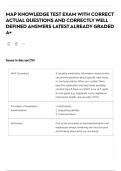
MAP KNOWLEDGE TEST EXAM WITH CORRECT
ACTUAL QUESTIONS AND CORRECTLY WELL
DEFINED ANSWERS LATEST ALREADY GRADED
A+
Terms in this set (79)
MAP Consultant A valuable medication information resource who
can answer questions about specific med issues
or med procedures. When you contact them,
have the medication and med sheet available;
contact them if there is a STAFF error or 5 rights
do not agree. E.g. registered nurse, registered
pharmacist, health care provider (HCP).
Principles of Medication 1. Mindfulness
Administration 2. Supporting abilities
3. Communication
Minfulness One of the principles of med administration that
emphasizes always remaining alert and focused
and thinking about what you are doing.
,Supporting Abiliites One of the principles of med administration that
emphasizes helping the pt function as
independently as possible and encouraging them
to participate fully in the med admin process.
Communication One of the principles of med administration that
emphasizes reading the HCP order, pharmacy
label, and med sheet, checking 5 rights, and
talking + listening to the pt while you are
administering their medication; also includes:
listening, documenting, body language, facial
expression, tone of voice, speaking clearly,
asking questions when needed.
Respecting Rights Pts have right to:
1. Confidentiality
2. Know what their meds are and the reasons they
are taken
3. Know the risks associated with taking med
4. Know the benefits of the med
5. Refuse med
6. Be given med only as ordered by HCP
Observation The process of watching someone carefully in
order to obtain information.
Objective Observation Factual information you see, hear, feel, smell, or
measure.
Subjective Observation Observations that come from working with a
person who communicates how they are feeling.
, Reporting Giving spoken or written information of
something observed or told. I am responsible for
making note of any physical or behavioral
changes in pt.
Immediate Reporting Reporting without delay as soon as possible after
a change is observed; may prevent a small
change observed from becoming a major health
issue and allows the appropriate treatment to be
ordered ASAP.
911 The person to call when:
-Pt falls and can't get up
-Pt complains of chest pain, has difficulty
breathing, or is choking
-Pt is unresponsive
-MAP Con. recommends you hang up and call
Poison Controll The person to call when:
-Pt ingests a foreign substance such as detergent
-MAP Con. recommends you hang up and call
ACTUAL QUESTIONS AND CORRECTLY WELL
DEFINED ANSWERS LATEST ALREADY GRADED
A+
Terms in this set (79)
MAP Consultant A valuable medication information resource who
can answer questions about specific med issues
or med procedures. When you contact them,
have the medication and med sheet available;
contact them if there is a STAFF error or 5 rights
do not agree. E.g. registered nurse, registered
pharmacist, health care provider (HCP).
Principles of Medication 1. Mindfulness
Administration 2. Supporting abilities
3. Communication
Minfulness One of the principles of med administration that
emphasizes always remaining alert and focused
and thinking about what you are doing.
,Supporting Abiliites One of the principles of med administration that
emphasizes helping the pt function as
independently as possible and encouraging them
to participate fully in the med admin process.
Communication One of the principles of med administration that
emphasizes reading the HCP order, pharmacy
label, and med sheet, checking 5 rights, and
talking + listening to the pt while you are
administering their medication; also includes:
listening, documenting, body language, facial
expression, tone of voice, speaking clearly,
asking questions when needed.
Respecting Rights Pts have right to:
1. Confidentiality
2. Know what their meds are and the reasons they
are taken
3. Know the risks associated with taking med
4. Know the benefits of the med
5. Refuse med
6. Be given med only as ordered by HCP
Observation The process of watching someone carefully in
order to obtain information.
Objective Observation Factual information you see, hear, feel, smell, or
measure.
Subjective Observation Observations that come from working with a
person who communicates how they are feeling.
, Reporting Giving spoken or written information of
something observed or told. I am responsible for
making note of any physical or behavioral
changes in pt.
Immediate Reporting Reporting without delay as soon as possible after
a change is observed; may prevent a small
change observed from becoming a major health
issue and allows the appropriate treatment to be
ordered ASAP.
911 The person to call when:
-Pt falls and can't get up
-Pt complains of chest pain, has difficulty
breathing, or is choking
-Pt is unresponsive
-MAP Con. recommends you hang up and call
Poison Controll The person to call when:
-Pt ingests a foreign substance such as detergent
-MAP Con. recommends you hang up and call


