

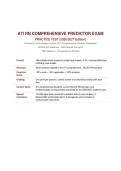
ATI RN COMPREHENSIVE PREDICTOR EXAM
PRACTICE TEST (2026/2027 Edition)
Assessment Technologies Institute (ATI) Comprehensive Predictor Preparation
NCLEX-RN Readiness • NGN-Aligned Scenarios
180 Questions • Comprehensive Practice
Format: 180 multiple-choice questions (single best answer, A–D), including NGN-style
unfolding case studies.
Structure: Seven sections aligned to the ATI comprehensive / NCLEX-RN test plan.
Cognitive ~30% recall • ~50% application • ~20% analysis.
levels:
Grading: One point per question; correct answer and rationale provided after each
item.
Content basis: ATI comprehensive blueprint, current NCLEX-RN test plan, and
evidence-based nursing practice standards for the 2026/2027 academic year.
Special 10 NGN-style items (acute MI & pediatric asthma case studies); 5
inclusions: Maslow/ABC prioritization items; 3 therapeutic-communication &
mental-health-crisis items.
, Section 1: Management of Care – Safety, Delegation, Legal/Ethical, Case
Management (30 questions)
Q1: A nurse is caring for four clients. Which client should the nurse assess first?
A. A client reporting chest pressure with diaphoresis [CORRECT]
B. A client with a scheduled dressing change
C. A client requesting pain medication for a surgical incision
D. A client ready for discharge teaching
Correct Answer: A
Rationale: A is correct: the ABCs and acuity guide prioritization; chest pressure with diaphoresis suggests a
possible cardiac event and is the highest priority. B, C, and D are important but lower priority than a potential
MI.
Q2: The nurse is delegating tasks to assistive personnel (AP). Which task is appropriate to
delegate?
A. Administering IV push medication
B. Measuring a stable client's routine vital signs [CORRECT]
C. Performing the initial assessment of a new admission
D. Providing teaching about a new medication
Correct Answer: B
Rationale: A is correct: measuring vital signs of a stable client is within the AP's scope. B, C, and D require
the registered nurse's assessment, medication administration, or teaching skills.
Q3: Which task should the nurse NOT delegate to unlicensed assistive personnel (UAP)?
A. Assisting a client to the bathroom
B. Measuring and recording intake and output
C. Assessing a client's lung sounds [CORRECT]
D. Changing a client's bed linens
Correct Answer: C
Rationale: A is correct: assessment (auscultating lung sounds) requires nursing judgment and cannot be
delegated. B, C, and D are routine tasks within the UAP scope.
Q4: A nurse discovers a medication error was made. What is the first action the nurse should take?
A. Document the error and do nothing else
B. Hide the error from the charge nurse
C. Administer the correct dose without telling anyone
D. Assess the client for adverse effects and notify the provider [CORRECT]
Correct Answer: D
Rationale: A is correct: after a medication error, the nurse first assesses the client for harm and notifies the
provider. B, C, and D are unsafe and unethical.
Q5: A client who is confused and attempting to remove their IV line is placed in a wrist restraint.
Which is the most important nursing action?
A. Assess the restraint, neurovascular status, and skin, and document regularly with provider
notification and a release schedule [CORRECT]
B. Keep the restraint on continuously for 24 hours
C. Never release the restraint
D. Tie the restraint tightly to the bed frame
Correct Answer: A
Rationale: A is correct: restraints require frequent assessment, release, documentation, and provider orders.
B, C, and D are unsafe and contrary to restraint standards.
ATI RN Comprehensive Predictor Exam (2026/2027 Edition) Page 2
, Q6: A nurse is preparing to administer a blood transfusion. Which action is most important to verify
before starting?
A. Warm the blood to body temperature
B. Confirm the client's identity and blood compatibility with another licensed
professional [CORRECT]
C. Give it rapidly
D. Skip the baseline vital signs
Correct Answer: B
Rationale: A is correct: verifying identity and compatibility with a second licensed professional prevents
transfusion reactions. B, C, and D are incorrect practices.
Q7: Which action demonstrates adherence to standard precautions?
A. Wearing gloves for every patient contact regardless of risk
B. Reusing gloves between clients
C. Wearing gloves for potential contact with blood or body fluids and performing hand
hygiene [CORRECT]
D. Skipping hand hygiene between clients
Correct Answer: C
Rationale: A is correct: standard precautions include hand hygiene and gloves when contact with blood/body
fluids is likely. B overuses gloves; C and D spread infection.
Q8: A client with a communicable infection transmitted by droplet requires which precautions?
A. Contact precautions only
B. N95 respirator for all infections
C. No precautions
D. Droplet precautions, including a surgical mask within 3 feet and standard
precautions [CORRECT]
Correct Answer: D
Rationale: A is correct: droplet precautions require a surgical mask for close contact. B is wrong (contact
precautions differ); C is for airborne; D is incorrect.
Q9: Which client is at highest risk for falls?
A. An older adult with impaired mobility, confusion, and a history of falls [CORRECT]
B. A young adult with a sprained ankle
C. A client with stable vital signs
D. A client who is fully oriented and independent
Correct Answer: A
Rationale: A is correct: advanced age, impaired mobility, confusion, and fall history increase fall risk. B, C,
and D are lower risk.
Q10: A nurse needs to obtain informed consent for a procedure. Which person is responsible for
obtaining informed consent?
A. The nurse
B. The health care provider performing the procedure [CORRECT]
C. The unit clerk
D. A family member
Correct Answer: B
Rationale: A is correct: the provider performing the procedure obtains informed consent. The nurse's role is
to witness, confirm understanding, and clarify but not obtain the consent.
ATI RN Comprehensive Predictor Exam (2026/2027 Edition) Page 3
, Q11: A client with do-not-resuscitate (DNR) status stops breathing. Which action is appropriate?
A. Begin CPR regardless of the order
B. Call a code and begin resuscitation
C. Provide comfort measures and follow the DNR order, not initiating CPR [CORRECT]
D. Intubate immediately
Correct Answer: C
Rationale: A is correct: for a client with valid DNR status, resuscitation is not initiated; comfort measures are
provided. B, C, and D violate the DNR order.
Q12: Which situation is an example of a violation of client confidentiality?
A. Documenting care in the medical record
B. Reporting abuse to authorities as required
C. Sharing information with the treatment team caring for the client
D. Discussing a client's condition with a colleague in the hospital cafeteria [CORRECT]
Correct Answer: D
Rationale: A is correct: discussing PHI with a non-involved person in a public place violates confidentiality. B,
C, and D are appropriate disclosures.
Q13: A nurse is prioritizing care for four clients. Which client should the nurse see first?
A. A client with a new oxygen saturation of 88% [CORRECT]
B. A client requesting a meal tray
C. A client asking for a blanket
D. A client ready for discharge
Correct Answer: A
Rationale: A is correct: an oxygen saturation of 88% indicates hypoxemia and requires immediate
assessment (airway/breathing). B, C, and D are lower priority.
Q14: The nurse is using Maslow's hierarchy to prioritize care. Which client need is highest priority?
A. Safety and security
B. Airway and breathing (physiologic need) [CORRECT]
C. Love and belonging
D. Self-esteem
Correct Answer: B
Rationale: A is correct: physiologic needs such as airway and breathing are at the base of Maslow's
hierarchy and take priority. B, C, and D are higher on the hierarchy.
Q15: A charge nurse is assigning care for a group of clients. Which assignment is most appropriate
for a licensed practical nurse (LPN)?
A. A newly admitted client requiring comprehensive assessment
B. A client receiving a blood transfusion with unstable vital signs
C. A client with stable vital signs needing routine medication administration [CORRECT]
D. A client needing complex teaching about insulin
Correct Answer: C
Rationale: A is correct: an LPN can administer medications and provide care to stable clients.
Comprehensive assessment, unstable clients, and complex teaching are RN responsibilities.
ATI RN Comprehensive Predictor Exam (2026/2027 Edition) Page 4
PRACTICE TEST (2026/2027 Edition)
Assessment Technologies Institute (ATI) Comprehensive Predictor Preparation
NCLEX-RN Readiness • NGN-Aligned Scenarios
180 Questions • Comprehensive Practice
Format: 180 multiple-choice questions (single best answer, A–D), including NGN-style
unfolding case studies.
Structure: Seven sections aligned to the ATI comprehensive / NCLEX-RN test plan.
Cognitive ~30% recall • ~50% application • ~20% analysis.
levels:
Grading: One point per question; correct answer and rationale provided after each
item.
Content basis: ATI comprehensive blueprint, current NCLEX-RN test plan, and
evidence-based nursing practice standards for the 2026/2027 academic year.
Special 10 NGN-style items (acute MI & pediatric asthma case studies); 5
inclusions: Maslow/ABC prioritization items; 3 therapeutic-communication &
mental-health-crisis items.
, Section 1: Management of Care – Safety, Delegation, Legal/Ethical, Case
Management (30 questions)
Q1: A nurse is caring for four clients. Which client should the nurse assess first?
A. A client reporting chest pressure with diaphoresis [CORRECT]
B. A client with a scheduled dressing change
C. A client requesting pain medication for a surgical incision
D. A client ready for discharge teaching
Correct Answer: A
Rationale: A is correct: the ABCs and acuity guide prioritization; chest pressure with diaphoresis suggests a
possible cardiac event and is the highest priority. B, C, and D are important but lower priority than a potential
MI.
Q2: The nurse is delegating tasks to assistive personnel (AP). Which task is appropriate to
delegate?
A. Administering IV push medication
B. Measuring a stable client's routine vital signs [CORRECT]
C. Performing the initial assessment of a new admission
D. Providing teaching about a new medication
Correct Answer: B
Rationale: A is correct: measuring vital signs of a stable client is within the AP's scope. B, C, and D require
the registered nurse's assessment, medication administration, or teaching skills.
Q3: Which task should the nurse NOT delegate to unlicensed assistive personnel (UAP)?
A. Assisting a client to the bathroom
B. Measuring and recording intake and output
C. Assessing a client's lung sounds [CORRECT]
D. Changing a client's bed linens
Correct Answer: C
Rationale: A is correct: assessment (auscultating lung sounds) requires nursing judgment and cannot be
delegated. B, C, and D are routine tasks within the UAP scope.
Q4: A nurse discovers a medication error was made. What is the first action the nurse should take?
A. Document the error and do nothing else
B. Hide the error from the charge nurse
C. Administer the correct dose without telling anyone
D. Assess the client for adverse effects and notify the provider [CORRECT]
Correct Answer: D
Rationale: A is correct: after a medication error, the nurse first assesses the client for harm and notifies the
provider. B, C, and D are unsafe and unethical.
Q5: A client who is confused and attempting to remove their IV line is placed in a wrist restraint.
Which is the most important nursing action?
A. Assess the restraint, neurovascular status, and skin, and document regularly with provider
notification and a release schedule [CORRECT]
B. Keep the restraint on continuously for 24 hours
C. Never release the restraint
D. Tie the restraint tightly to the bed frame
Correct Answer: A
Rationale: A is correct: restraints require frequent assessment, release, documentation, and provider orders.
B, C, and D are unsafe and contrary to restraint standards.
ATI RN Comprehensive Predictor Exam (2026/2027 Edition) Page 2
, Q6: A nurse is preparing to administer a blood transfusion. Which action is most important to verify
before starting?
A. Warm the blood to body temperature
B. Confirm the client's identity and blood compatibility with another licensed
professional [CORRECT]
C. Give it rapidly
D. Skip the baseline vital signs
Correct Answer: B
Rationale: A is correct: verifying identity and compatibility with a second licensed professional prevents
transfusion reactions. B, C, and D are incorrect practices.
Q7: Which action demonstrates adherence to standard precautions?
A. Wearing gloves for every patient contact regardless of risk
B. Reusing gloves between clients
C. Wearing gloves for potential contact with blood or body fluids and performing hand
hygiene [CORRECT]
D. Skipping hand hygiene between clients
Correct Answer: C
Rationale: A is correct: standard precautions include hand hygiene and gloves when contact with blood/body
fluids is likely. B overuses gloves; C and D spread infection.
Q8: A client with a communicable infection transmitted by droplet requires which precautions?
A. Contact precautions only
B. N95 respirator for all infections
C. No precautions
D. Droplet precautions, including a surgical mask within 3 feet and standard
precautions [CORRECT]
Correct Answer: D
Rationale: A is correct: droplet precautions require a surgical mask for close contact. B is wrong (contact
precautions differ); C is for airborne; D is incorrect.
Q9: Which client is at highest risk for falls?
A. An older adult with impaired mobility, confusion, and a history of falls [CORRECT]
B. A young adult with a sprained ankle
C. A client with stable vital signs
D. A client who is fully oriented and independent
Correct Answer: A
Rationale: A is correct: advanced age, impaired mobility, confusion, and fall history increase fall risk. B, C,
and D are lower risk.
Q10: A nurse needs to obtain informed consent for a procedure. Which person is responsible for
obtaining informed consent?
A. The nurse
B. The health care provider performing the procedure [CORRECT]
C. The unit clerk
D. A family member
Correct Answer: B
Rationale: A is correct: the provider performing the procedure obtains informed consent. The nurse's role is
to witness, confirm understanding, and clarify but not obtain the consent.
ATI RN Comprehensive Predictor Exam (2026/2027 Edition) Page 3
, Q11: A client with do-not-resuscitate (DNR) status stops breathing. Which action is appropriate?
A. Begin CPR regardless of the order
B. Call a code and begin resuscitation
C. Provide comfort measures and follow the DNR order, not initiating CPR [CORRECT]
D. Intubate immediately
Correct Answer: C
Rationale: A is correct: for a client with valid DNR status, resuscitation is not initiated; comfort measures are
provided. B, C, and D violate the DNR order.
Q12: Which situation is an example of a violation of client confidentiality?
A. Documenting care in the medical record
B. Reporting abuse to authorities as required
C. Sharing information with the treatment team caring for the client
D. Discussing a client's condition with a colleague in the hospital cafeteria [CORRECT]
Correct Answer: D
Rationale: A is correct: discussing PHI with a non-involved person in a public place violates confidentiality. B,
C, and D are appropriate disclosures.
Q13: A nurse is prioritizing care for four clients. Which client should the nurse see first?
A. A client with a new oxygen saturation of 88% [CORRECT]
B. A client requesting a meal tray
C. A client asking for a blanket
D. A client ready for discharge
Correct Answer: A
Rationale: A is correct: an oxygen saturation of 88% indicates hypoxemia and requires immediate
assessment (airway/breathing). B, C, and D are lower priority.
Q14: The nurse is using Maslow's hierarchy to prioritize care. Which client need is highest priority?
A. Safety and security
B. Airway and breathing (physiologic need) [CORRECT]
C. Love and belonging
D. Self-esteem
Correct Answer: B
Rationale: A is correct: physiologic needs such as airway and breathing are at the base of Maslow's
hierarchy and take priority. B, C, and D are higher on the hierarchy.
Q15: A charge nurse is assigning care for a group of clients. Which assignment is most appropriate
for a licensed practical nurse (LPN)?
A. A newly admitted client requiring comprehensive assessment
B. A client receiving a blood transfusion with unstable vital signs
C. A client with stable vital signs needing routine medication administration [CORRECT]
D. A client needing complex teaching about insulin
Correct Answer: C
Rationale: A is correct: an LPN can administer medications and provide care to stable clients.
Comprehensive assessment, unstable clients, and complex teaching are RN responsibilities.
ATI RN Comprehensive Predictor Exam (2026/2027 Edition) Page 4


