

Comprehensive Medical-Surgical Nursing Review for ATI Exam
Preparatio
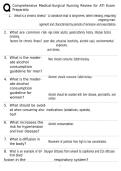
1. What is a chronic illness? A condition that is long-term, often lifelong, requiring
ongoing man-
agement and characterized by periods of remission and exacerbation.
2. What are common risk Age (older adults), genetics/family history, lifestyle factors
(smoking,
factors for chronic illness? poor diet, physical inactivity, alcohol use), environmental
exposure,
and stress.
3. What is the moder- Men should consume 2ddrinks/day.
ate alcohol
consumption
guideline for men?
Women should consume 1ddrink/day.
4. What is the moder-
ate alcohol
consumption
guideline for Alcohol should be avoided with liver disease, pancreatitis, and
women? certain
5. What should be avoid-
ed when consuming alco- medications (sedatives, opioids).
hol?
6. What increases the Alcohol consumption.
risk for hypertension
and liver disease?
7. What is diffusion in
Movement of particles from high to low concentration.
the body?
8. What is an example of dif- Oxygen dittuses from alveoli to capillaries and CO₂ dittuses
from blood
fusion in the respiratory system?
1/
17
, Comprehensive Medical-Surgical Nursing Review for ATI Exam
Preparatio
9. What is the priorityalveoli.
nurs-ing action for
respiratory acidosis
due to COPD? Improve ventilation.
2/
17
, Comprehensive Medical-Surgical Nursing Review for ATI Exam
Preparatio
10. What position sided heart failure?
should a patient
with respiratory 17. What indicates
acidosis be placed right-sided heart failure?
in?
18. What are the clinical manifestations
11. What are the of hyper-kalemia?
manifes-tations of
fluid volume
deficit?
12. What is the priority
inter-vention for fluid
volume deficit?
13. What are the
correct
manifestations of
fluid volume
excess?
14. What are the
cardinal
manifestations of
fluid volume
excess?
15. What are the
pulmonary
manifestations of
fluid volume
excess?
16. What indicates left-
3/
17
Preparatio
1. What is a chronic illness? A condition that is long-term, often lifelong, requiring
ongoing man-
agement and characterized by periods of remission and exacerbation.
2. What are common risk Age (older adults), genetics/family history, lifestyle factors
(smoking,
factors for chronic illness? poor diet, physical inactivity, alcohol use), environmental
exposure,
and stress.
3. What is the moder- Men should consume 2ddrinks/day.
ate alcohol
consumption
guideline for men?
Women should consume 1ddrink/day.
4. What is the moder-
ate alcohol
consumption
guideline for Alcohol should be avoided with liver disease, pancreatitis, and
women? certain
5. What should be avoid-
ed when consuming alco- medications (sedatives, opioids).
hol?
6. What increases the Alcohol consumption.
risk for hypertension
and liver disease?
7. What is diffusion in
Movement of particles from high to low concentration.
the body?
8. What is an example of dif- Oxygen dittuses from alveoli to capillaries and CO₂ dittuses
from blood
fusion in the respiratory system?
1/
17
, Comprehensive Medical-Surgical Nursing Review for ATI Exam
Preparatio
9. What is the priorityalveoli.
nurs-ing action for
respiratory acidosis
due to COPD? Improve ventilation.
2/
17
, Comprehensive Medical-Surgical Nursing Review for ATI Exam
Preparatio
10. What position sided heart failure?
should a patient
with respiratory 17. What indicates
acidosis be placed right-sided heart failure?
in?
18. What are the clinical manifestations
11. What are the of hyper-kalemia?
manifes-tations of
fluid volume
deficit?
12. What is the priority
inter-vention for fluid
volume deficit?
13. What are the
correct
manifestations of
fluid volume
excess?
14. What are the
cardinal
manifestations of
fluid volume
excess?
15. What are the
pulmonary
manifestations of
fluid volume
excess?
16. What indicates left-
3/
17


