
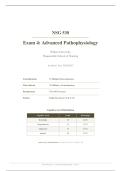
NSG 530
Exam 4: Advanced Pathophysiology
Wilkes University
Pasquariello School of Nursing
Academic Year 2026/2027
Total Questions 75 Multiple-Choice Questions
Time Allowed 120 Minutes (1.6 min/question)
Passing Score 75% (56/75 correct)
Format Single best answer (A, B, C, D)
Cognitive Level Distribution
Cognitive Level Count Percentage
Knowledge 18 24.0%
Comprehension 13 17.3%
Application 16 21.3%
Analysis 28 37.3%
Answer Key Distribution: A = 19 | B = 19 | C = 19 | D = 18
NSG 530 Exam 4 - Advanced Pathophysiology | Page 1
,Exam Instructions
1. Format: This exam consists of 75 multiple-choice questions. Each question has four options (A, B, C, D).
Select the single best answer for each question.
2. Time Management: You have 120 minutes to complete the exam. Budget approximately 1.6 minutes per
question. If unsure, mark your best guess and move on; return to difficult questions if time permits.
3. Scoring: Each correct answer is worth 1 point. There is no penalty for incorrect answers. The passing score is
75% (56 of 75 correct).
4. Content Coverage: Questions span five domains: Renal/Urinary Pathophysiology (Q1-20), GI/Hepatic
Pathophysiology (Q21-40), Endocrine Pathophysiology (Q41-55), Reproductive Pathophysiology (Q56-65), and
Integrated Clinical Scenarios (Q66-75).
5. Cognitive Levels: Questions assess knowledge recall, comprehension, clinical application, and analysis.
Integrated scenarios (Q66-75) require multi-system clinical reasoning.
6. Rationale Review: A comprehensive rationale follows each question explaining the correct answer and why
the distractors are incorrect. Use these for study purposes.
Section Questions Count
Renal and Urinary System Pathophysiology 1-20 20
GI and Hepatic Pathophysiology 21-40 20
Endocrine Pathophysiology 41-55 15
Reproductive Pathophysiology 56-65 10
Integrated Clinical Scenarios 66-75 10
Total 1-75 75
NSG 530 Exam 4 - Advanced Pathophysiology | Page 2
, Section 1: Renal and Urinary System Pathophysiology
Acute kidney injury, chronic kidney disease, glomerulopathies, nephrotic syndrome, renal stones, urinary tract infections, and
polycystic kidney disease.
1. A 62-year-old patient presents with decreased urine output over 48 hours following cardiac bypass
surgery. BUN is 45 mg/dL, creatinine is 3.2 mg/dL (baseline 1.0), urine sodium is 15 mEq/L, and FENa
is 0.8%. Which classification of AKI does this patient most likely have?
A. Intrarenal acute tubular necrosis (ATN)
B. Postrenal AKI from ureteral compression
✓ C. Prerenal AKI from decreased renal perfusion
D. CKD stage 3b with acute exacerbation
Correct Answer: C
Rationale: This patient has prerenal AKI. The low urine sodium (<20 mEq/L) and low FENa (<1%) indicate the kidneys are
retaining sodium and water in an attempt to restore perfusion, which is characteristic of prerenal azotemia. Intrarenal AKI
(ATN) would show FENa >2% and urine sodium >40. Postrenal AKI would present with obstruction. CKD would show bilateral
small kidneys on ultrasound rather than an acute rise in creatinine.
2. During the oliguric phase of acute kidney injury, which laboratory finding is the most immediately
life-threatening and requires urgent intervention?
A. Hypocalcemia
✓ B. Hyperkalemia causing cardiac arrhythmias
C. Metabolic alkalosis
D. Hypophosphatemia
Correct Answer: B
Rationale: Hyperkalemia is the most immediately life-threatening complication in the oliguric phase of AKI because it can cause
fatal cardiac arrhythmias, including ventricular fibrillation and asystole. The kidneys cannot excrete potassium during oliguria,
leading to rapid accumulation. Hypocalcemia, metabolic alkalosis, and hypophosphatemia may occur but are not immediately
fatal compared to hyperkalemia.
3. A CKD stage 4 patient presents with bone pain, Ca 7.8 mg/dL, P 6.5 mg/dL, and PTH 480 pg/mL.
Which pathophysiologic mechanism best explains these findings?
A. Primary hyperparathyroidism
B. Vitamin D toxicity
✓ C. Secondary hyperparathyroidism from hyperphosphatemia and decreased 1-alpha-hydroxylase
activity
D. Hypoparathyroidism
Correct Answer: C
Rationale: In CKD, decreased renal function leads to reduced phosphate excretion (hyperphosphatemia) and decreased
1-alpha-hydroxylase activity (reduced active vitamin D). Hyperphosphatemia and low vitamin D stimulate parathyroid hormone
secretion, causing secondary hyperparathyroidism. This results in bone demineralization and hypocalcemia. Primary
hyperparathyroidism is unrelated to CKD. Vitamin D toxicity would cause hypercalcemia, not hypocalcemia.
Hypoparathyroidism would show low PTH, not elevated.
4. A 10-year-old child presents with dark cola-colored urine, periorbital edema, and hypertension
approximately 2 weeks after a streptococcal infection. Laboratory findings show decreased C3
NSG 530 Exam 4 - Advanced Pathophysiology | Page 3


