

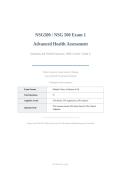
NSG500 / NSG 500 Exam 1
Advanced Health Assessment
Questions and Verified Answers | 100% Correct | Grade A
Wilkes University Passan School of Nursing
Latest 2026-2027 Curriculum Standards
75 Multiple Choice Questions
Exam Format Multiple Choice (4 Options A-D)
Total Questions 75
Cognitive Levels 25% Recall, 55% Application, 20% Analysis
70% Scenario-based, 20% Direct Recall, 10% Clinical
Question Style
Judgment
Aligned with 2026-2027 Wilkes University NSG 500 Advanced Health Assessment Curriculum
NSG500 Exam 1 | Page 1
,Section 1: Foundations of Advanced Health Assessment, Interviewing, and
Health History (Q1-Q15)
Q1: A 45-year-old patient presents to the clinic for an annual wellness examination. The advanced practice
nurse (APN) plans to conduct a comprehensive health assessment. Which of the following best describes
the rationale for choosing a comprehensive assessment over a focused assessment in this scenario?
A. A comprehensive assessment is shorter and more efficient than a focused assessment for returning patients.
B. A comprehensive assessment includes a complete health history and full physical examination, which is
appropriate for establishing a baseline in new patients and annual wellness visits. [CORRECT]
C. A focused assessment is preferred for annual visits because it targets only the presenting complaint.
D. A comprehensive assessment is only indicated when the patient has multiple chronic conditions.
Correct Answer: B
Rationale: A comprehensive assessment encompasses a complete health history and full head-to-toe physical
examination, making it the standard of care for new patients, annual wellness visits, and situations where a baseline
must be established (Jarvis, 2024; Wilkes NSG 500). A focused assessment is limited to a specific presenting complaint
or body system and is appropriate for acute, urgent, or follow-up visits. Option A is incorrect because a comprehensive
assessment takes more time. Option C reverses the appropriate assessment type. Option D incorrectly limits
comprehensive assessments to chronic conditions only.
Q2: A 62-year-old patient presents with acute onset of right-sided chest pain and shortness of breath. The
APN decides to perform a focused assessment. Which component is most appropriately included in a
focused/problem-oriented assessment?
A. Complete review of all body systems and a full head-to-toe physical examination.
B. Detailed prenatal history, family genetic history, and occupational health screening.
C. Targeted history and physical examination limited to the respiratory and cardiovascular systems
related to the presenting complaint. [CORRECT]
D. Comprehensive mental status examination and full neurological assessment.
Correct Answer: C
Rationale: A focused or problem-oriented assessment targets the specific presenting complaint and related body
systems. For a patient with chest pain and shortness of breath, the APN should focus on the respiratory and
cardiovascular systems to efficiently identify the likely cause and determine the urgency of intervention (Bickley, 2023).
Options A and B describe elements of a comprehensive assessment. Option D describes a neurological-focused
assessment, which is not the priority for this patient.
NSG500 Exam 1 | Page 2
, Q3: During a health history interview, the APN uses the OLDCARTS mnemonic to explore the patient's
chief complaint. Which of the following correctly matches the components of OLDCARTS?
A. Onset, Location, Duration, Character, Aggravating factors, Relieving factors, Timing, Severity.
[CORRECT]
B. Onset, Location, Diagnosis, Character, Assessment, Radiology, Treatment, Severity.
C. Onset, Location, Duration, Characteristics, Allergies, Review of systems, Timing, Signs.
D. Observation, Location, Duration, Color, Appearance, Relief, Treatment, Symptomatology.
Correct Answer: A
Rationale: The OLDCARTS mnemonic stands for Onset, Location/Radiation, Duration, Character, Aggravating
factors, Relieving factors, Timing, and Severity (Jarvis, 2024; Wilkes NSG 500). It is a systematic framework for
eliciting a complete History of Present Illness (HPI). Option B incorrectly substitutes diagnostic terms. Option C
confuses assessment components with OLDCARTS elements. Option D uses observational terminology unrelated to the
HPI framework.
Q4: A patient reports, "I have had a dull aching pain in my lower back for the past three weeks. It gets
worse when I bend over and feels better when I lie down." Which component of the HPI is being addressed
in this statement?
A. Onset and location only.
B. Character, duration, location, aggravating factors, and relieving factors. [CORRECT]
C. Severity and timing only.
D. Radiation and associated symptoms only.
Correct Answer: B
Rationale: The patient's statement contains multiple HPI elements captured by OLDCARTS: character (dull aching),
duration (three weeks), location (lower back), aggravating factors (worse when bending over), and relieving factors
(better when lying down). The APN should recognize that a well-constructed patient narrative often addresses multiple
OLDCARTS components simultaneously (Bickley, 2023). Options A, C, and D each identify only a subset of the
information provided.
Q5: During the health history interview, the APN asks, "Tell me more about what you have been
experiencing." Which interviewing technique is being employed, and what is its primary purpose?
A. Close-ended questioning; it ensures efficient data collection.
B. Open-ended questioning; it encourages the patient to provide detailed responses and builds rapport.
[CORRECT]
C. Direct questioning; it is used to clarify specific medical facts.
D. Leading questioning; it guides the patient toward a suspected diagnosis.
Correct Answer: B
Rationale: Open-ended questions invite the patient to share their story in their own words, which encourages detailed
responses, builds therapeutic rapport, and often reveals information the patient considers important but might not be
elicited by direct questioning (Jarvis, 2024; Wilkes NSG 500). Close-ended questions are appropriate for clarifying
specific symptoms but do not facilitate narrative sharing. Leading questions bias the patient's responses and should be
avoided.
NSG500 Exam 1 | Page 3
Advanced Health Assessment
Questions and Verified Answers | 100% Correct | Grade A
Wilkes University Passan School of Nursing
Latest 2026-2027 Curriculum Standards
75 Multiple Choice Questions
Exam Format Multiple Choice (4 Options A-D)
Total Questions 75
Cognitive Levels 25% Recall, 55% Application, 20% Analysis
70% Scenario-based, 20% Direct Recall, 10% Clinical
Question Style
Judgment
Aligned with 2026-2027 Wilkes University NSG 500 Advanced Health Assessment Curriculum
NSG500 Exam 1 | Page 1
,Section 1: Foundations of Advanced Health Assessment, Interviewing, and
Health History (Q1-Q15)
Q1: A 45-year-old patient presents to the clinic for an annual wellness examination. The advanced practice
nurse (APN) plans to conduct a comprehensive health assessment. Which of the following best describes
the rationale for choosing a comprehensive assessment over a focused assessment in this scenario?
A. A comprehensive assessment is shorter and more efficient than a focused assessment for returning patients.
B. A comprehensive assessment includes a complete health history and full physical examination, which is
appropriate for establishing a baseline in new patients and annual wellness visits. [CORRECT]
C. A focused assessment is preferred for annual visits because it targets only the presenting complaint.
D. A comprehensive assessment is only indicated when the patient has multiple chronic conditions.
Correct Answer: B
Rationale: A comprehensive assessment encompasses a complete health history and full head-to-toe physical
examination, making it the standard of care for new patients, annual wellness visits, and situations where a baseline
must be established (Jarvis, 2024; Wilkes NSG 500). A focused assessment is limited to a specific presenting complaint
or body system and is appropriate for acute, urgent, or follow-up visits. Option A is incorrect because a comprehensive
assessment takes more time. Option C reverses the appropriate assessment type. Option D incorrectly limits
comprehensive assessments to chronic conditions only.
Q2: A 62-year-old patient presents with acute onset of right-sided chest pain and shortness of breath. The
APN decides to perform a focused assessment. Which component is most appropriately included in a
focused/problem-oriented assessment?
A. Complete review of all body systems and a full head-to-toe physical examination.
B. Detailed prenatal history, family genetic history, and occupational health screening.
C. Targeted history and physical examination limited to the respiratory and cardiovascular systems
related to the presenting complaint. [CORRECT]
D. Comprehensive mental status examination and full neurological assessment.
Correct Answer: C
Rationale: A focused or problem-oriented assessment targets the specific presenting complaint and related body
systems. For a patient with chest pain and shortness of breath, the APN should focus on the respiratory and
cardiovascular systems to efficiently identify the likely cause and determine the urgency of intervention (Bickley, 2023).
Options A and B describe elements of a comprehensive assessment. Option D describes a neurological-focused
assessment, which is not the priority for this patient.
NSG500 Exam 1 | Page 2
, Q3: During a health history interview, the APN uses the OLDCARTS mnemonic to explore the patient's
chief complaint. Which of the following correctly matches the components of OLDCARTS?
A. Onset, Location, Duration, Character, Aggravating factors, Relieving factors, Timing, Severity.
[CORRECT]
B. Onset, Location, Diagnosis, Character, Assessment, Radiology, Treatment, Severity.
C. Onset, Location, Duration, Characteristics, Allergies, Review of systems, Timing, Signs.
D. Observation, Location, Duration, Color, Appearance, Relief, Treatment, Symptomatology.
Correct Answer: A
Rationale: The OLDCARTS mnemonic stands for Onset, Location/Radiation, Duration, Character, Aggravating
factors, Relieving factors, Timing, and Severity (Jarvis, 2024; Wilkes NSG 500). It is a systematic framework for
eliciting a complete History of Present Illness (HPI). Option B incorrectly substitutes diagnostic terms. Option C
confuses assessment components with OLDCARTS elements. Option D uses observational terminology unrelated to the
HPI framework.
Q4: A patient reports, "I have had a dull aching pain in my lower back for the past three weeks. It gets
worse when I bend over and feels better when I lie down." Which component of the HPI is being addressed
in this statement?
A. Onset and location only.
B. Character, duration, location, aggravating factors, and relieving factors. [CORRECT]
C. Severity and timing only.
D. Radiation and associated symptoms only.
Correct Answer: B
Rationale: The patient's statement contains multiple HPI elements captured by OLDCARTS: character (dull aching),
duration (three weeks), location (lower back), aggravating factors (worse when bending over), and relieving factors
(better when lying down). The APN should recognize that a well-constructed patient narrative often addresses multiple
OLDCARTS components simultaneously (Bickley, 2023). Options A, C, and D each identify only a subset of the
information provided.
Q5: During the health history interview, the APN asks, "Tell me more about what you have been
experiencing." Which interviewing technique is being employed, and what is its primary purpose?
A. Close-ended questioning; it ensures efficient data collection.
B. Open-ended questioning; it encourages the patient to provide detailed responses and builds rapport.
[CORRECT]
C. Direct questioning; it is used to clarify specific medical facts.
D. Leading questioning; it guides the patient toward a suspected diagnosis.
Correct Answer: B
Rationale: Open-ended questions invite the patient to share their story in their own words, which encourages detailed
responses, builds therapeutic rapport, and often reveals information the patient considers important but might not be
elicited by direct questioning (Jarvis, 2024; Wilkes NSG 500). Close-ended questions are appropriate for clarifying
specific symptoms but do not facilitate narrative sharing. Leading questions bias the patient's responses and should be
avoided.
NSG500 Exam 1 | Page 3


