

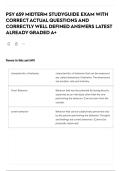
PSY 659 MIDTERM STUDYGUIDE EXAM WITH
CORRECT ACTUAL QUESTIONS AND
CORRECTLY WELL DEFINED ANSWERS LATEST
ALREADY GRADED A+
Terms in this set (49)
characteristic of behavior characteristics of behavior that can be measured
are called dimensions if behavior. The dimensions
are duration, rate and intensity.
Overt Behavior Behavior that has the potential for being directly
observed by an individual other than the one
performing the behavior. (Can be seen from the
outside.
covert behavior Behavior that can be subjectively perceived only
by the person performing the behavior. Thoughts
and feelings are covert behaviors. (Cannot be
physically observed)
, Behavioral deficit and excess Deficit- behavior that is not happening enough
(insomnia)
Excess- behavior that happens too much (child
throwing a tantrum)
Characteristics of Behavior 1. Focus on behavior
Modification 2. Focus on environment (internal and external)
3. Precise description of procedures
4. Implemented by people in everyday life
5. Based on behavioral principles
6. Involves measurement of behavior change
7. Emphasis on accountability
• Dimensions of behavior: How often a behavior occurs
Frequency
Dimensions of behavior: duration How long a behavior occurs
Dimensions of behavior: intensity What's the strength of the behavior?
Dimensions of behavior: latency *** From a certain point in time, when does a
behavior actually start?
Classical conditioning Behaviors that are (a) elicited by prior stimuli and
are not affected by their consequences; (b)
referred to as involuntary; and (c) usually involve
smooth muscles and glands. (Examples include
salivating when food is in your mouth, sweating
when exposed to high temperatures, and
experiencing a pounding heart when falling.)
CORRECT ACTUAL QUESTIONS AND
CORRECTLY WELL DEFINED ANSWERS LATEST
ALREADY GRADED A+
Terms in this set (49)
characteristic of behavior characteristics of behavior that can be measured
are called dimensions if behavior. The dimensions
are duration, rate and intensity.
Overt Behavior Behavior that has the potential for being directly
observed by an individual other than the one
performing the behavior. (Can be seen from the
outside.
covert behavior Behavior that can be subjectively perceived only
by the person performing the behavior. Thoughts
and feelings are covert behaviors. (Cannot be
physically observed)
, Behavioral deficit and excess Deficit- behavior that is not happening enough
(insomnia)
Excess- behavior that happens too much (child
throwing a tantrum)
Characteristics of Behavior 1. Focus on behavior
Modification 2. Focus on environment (internal and external)
3. Precise description of procedures
4. Implemented by people in everyday life
5. Based on behavioral principles
6. Involves measurement of behavior change
7. Emphasis on accountability
• Dimensions of behavior: How often a behavior occurs
Frequency
Dimensions of behavior: duration How long a behavior occurs
Dimensions of behavior: intensity What's the strength of the behavior?
Dimensions of behavior: latency *** From a certain point in time, when does a
behavior actually start?
Classical conditioning Behaviors that are (a) elicited by prior stimuli and
are not affected by their consequences; (b)
referred to as involuntary; and (c) usually involve
smooth muscles and glands. (Examples include
salivating when food is in your mouth, sweating
when exposed to high temperatures, and
experiencing a pounding heart when falling.)


