
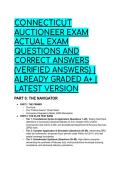
CONNECTICUT
AUCTIONEER EXAM
ACTUAL EXAM
QUESTIONS AND
CORRECT ANSWERS
(VERIFIED ANSWERS) |
ALREADY GRADED A+ |
LATEST VERSION
PART 0: THE NAVIGATOR
● PART I: THE PRIMER
○ The Hook
○ The "Critical Axioms" Cheat Sheet
○ Connecticut Regulatory Matrix (2026 Standards)
● PART II: THE ELITE TEST BANK
○ Tier 1: Foundational Syntax & Application (Questions 1–28): Testing Hard Deck
definitions of Connecticut General Statutes (C.G.S. Chapter 403), Uniform
Commercial Code (UCC) 2-328, and foundational Department of Revenue Services
(DRS) rules.
○ Tier 2: Complex Application & Simulation (Questions 29–58): Intersecting DRS
sales tax frameworks, temporary liquor permits under Public Act 25-51, and real
estate brokerage boundaries.
○ Tier 3: Grandmaster Synthesis (Questions 59–88): High-stakes scenarios
demanding the synthesis of fiduciary duty, multi-jurisdictional municipal licensing
compliance, and advanced statutory exemptions.
,PART I: THE PRIMER
Mastering this specific test bank translates directly to elite academic and professional
performance by bridging the gap between abstract Connecticut statutes and the high-velocity
realities of live auctioneering. By internalizing these frameworks, candidates transform from
mere bid-callers into bulletproof legal agents capable of navigating the strictest regulatory
gauntlets of the Department of Consumer Protection (DCP) and the Department of Revenue
Services (DRS).
The "Critical Axioms" Cheat Sheet:
● The Town Sovereignty Rule: Connecticut possesses NO state-level general auctioneer
license; jurisdiction is strictly municipal (C.G.S. Sec. 21-1). You must be licensed in the
specific town where the auction occurs unless you are a resident of that exact town.
● The Commodity Exemption: Town licensing is entirely bypassed when auctioning
specific exempt goods: provisions, charcoal, wood, farm products, and secondhand
household furniture.
● The Retailer Doctrine: Under DRS Bulletin 43, an auctioneer is classified as the retailer.
You must collect the 6.35% CT sales tax on the gross receipts, which mathematically
includes any buyer's premium.
● The UCC 2-328 Mandate: An auction is with reserve by default. If a seller shill bids
without prior explicit notice, the buyer may legally avoid the sale or claim the goods at the
last good faith bid price.
● The 2026 Liquor Framework (PA 25-51): Temporary Auction Permits for alcoholic liquor
cost $175/day, require a 60-day advance application to the DCP, and are capped at 12
days per calendar year.
Connecticut Regulatory Matrix (2026 Standards)
Regulatory Domain Governing Body Core Statutory Trigger Primary Legal
Exemption
General Auctioneering Municipal (Town/City) Exposing goods for Secondhand furniture,
sale out-of-town farm provisions
Retail Sales Tax Dept. of Revenue Acting as the Charity event (max 5/yr,
Services (DRS) transaction retailer no professional)
Real Estate Auctions Dept. of Consumer Negotiating real None (Strict state
Protection (DCP) property sales licensure required)
Alcoholic Liquor Liquor Control Auctioning beer, wine, None (Temporary
Commission (DCP) or spirits Permit Required)
PART II: THE ELITE TEST BANK
Tier 1: Foundational Syntax & Application
Q1: An auctioneer residing in Hartford is hired to conduct an estate auction in the town of
Greenwich. The estate consists entirely of high-end jewelry and contemporary art. Based on the
principles of C.G.S. Chapter 403, which action is the FIRST legal requirement before exposing
the goods for sale? A) Procure a Connecticut State Auctioneer License from the DCP. B) Submit
a written application to the Greenwich municipal authority at least three days prior. C) Collect a
6.35% DRS tax deposit from the estate executor. D) Post a $10,000 surety bond with the
,Connecticut Secretary of State.
● The Answer: B (Submit a written application to the Greenwich municipal authority at least
three days prior.)
● Distractor Analysis:
○ A is incorrect: Connecticut does not issue state-level auctioneer licenses; regulation
is municipal.
○ C is incorrect: Sales tax is collected from buyers on gross receipts post-sale, not as
a pre-sale deposit from the executor.
○ D is incorrect: This is a legacy distractor mirroring Massachusetts law, not
Connecticut law.
The Mentor's Analysis: Connecticut operates on municipal jurisdiction for auctioneers. If you do
not reside in the town where the auction is held, you must obtain a license from that specific
town's authority (usually the selectmen or mayor) with a minimum 3-day notice.
Professional/Academic Intuition: Always default to local municipal authority in CT unless a
specific statutory exemption applies.
Q2: A local farmer in Litchfield decides to auction off a surplus of harvested corn, chopped
firewood, and aged charcoal. The auctioneer is from out of state. Based on the principles of
Connecticut Town Licensing Exceptions, which conclusion is the MOST ACCURATE? A) The
auctioneer must obtain a temporary non-resident state permit. B) The auction requires a
standard municipal license because the auctioneer is a non-resident. C) The auction is exempt
from municipal licensing requirements. D) The auctioneer must pay a duty on all sales made at
the auction.
● The Answer: C (The auction is exempt from municipal licensing requirements.)
● Distractor Analysis:
○ A is incorrect: Connecticut has no temporary state permit for general auctioneers.
○ B is incorrect: The status of the auctioneer is irrelevant when the commodities
themselves trigger the exemption.
○ D is incorrect: Paying a duty on auction sales is a Rhode Island statute, not
Connecticut.
The Mentor's Analysis: C.G.S. Sec. 21-1 explicitly exempts the auction of "provisions, charcoal,
wood, the products of a farm and secondhand household furniture" from municipal licensing
requirements. Professional/Academic Intuition: Commodity type overrides auctioneer
residency regarding CT municipal licensing.
Q3: During a commercial liquidation in Stamford, an auctioneer announces the sale of an
industrial lathe. As the auctioneer's hammer is falling to accept a bid of $5,000, another bidder
shouts $5,500. Based on the principles of UCC 2-328, which action is the auctioneer
IMMEDIATELY authorized to take? A) The auctioneer must accept the $5,500 bid as it is higher.
B) The auctioneer may in his discretion reopen the bidding or declare the goods sold under the
$5,000 bid. C) The auctioneer must declare the auction void and restart the lot. D) The
auctioneer must defer to the seller's preference before acknowledging the new bid.
● The Answer: B (The auctioneer may in his discretion reopen the bidding or declare the
goods sold under the $5,000 bid.)
● Distractor Analysis:
○ A is incorrect: The auctioneer is not strictly forced to accept the late bid; it is purely
discretionary.
○ C is incorrect: Voiding the entire lot is an unnecessary overreaction not mandated
by the UCC.
○ D is incorrect: The UCC places this specific operational discretion squarely on the
, auctioneer, not the seller.
The Mentor's Analysis: Under UCC 2-328(2), the "fall of the hammer" signifies completion. A bid
made while the hammer is falling creates a narrow window of operational discretion for the
auctioneer to either finalize the original bid or reopen the floor. Professional/Academic Intuition:
The falling hammer grants the auctioneer absolute discretion over late bids.
Q4: An auctioneer in New Haven is conducting an absolute auction (without reserve) for a
collection of vintage motorcycles. After calling for bids on a 1969 Triumph, there is absolute
silence in the room. Based on the principles of UCC 2-328, what is the MOST ACCURATE
action the auctioneer can take? A) Withdraw the motorcycle immediately, as no minimum bid
was established. B) Withdraw the motorcycle only after a reasonable time has passed with no
bids. C) The auctioneer is legally forced to sell the motorcycle to the seller for $1. D) Convert the
auction to a "with reserve" auction on the spot.
● The Answer: B (Withdraw the motorcycle only after a reasonable time has passed with no
bids.)
● Distractor Analysis:
○ A is incorrect: In a without reserve auction, once the item is put up, it cannot be
arbitrarily withdrawn just because the initial response is slow.
○ C is incorrect: This is a fabricated novice assumption regarding "forced sales."
○ D is incorrect: You cannot unilaterally change the advertised terms of the auction
from absolute to reserve mid-lot.
The Mentor's Analysis: UCC 2-328(3) dictates that in an auction without reserve, an article or lot
cannot be withdrawn after the auctioneer calls for bids unless no bid is made within a
reasonable time. Professional/Academic Intuition: In absolute auctions, withdrawal is only
permitted if the market completely fails to respond after a reasonable duration.
Q5: A Connecticut DRS auditor is reviewing the books of an independent auctioneer. The
auctioneer charged a seller a 10% commission on a $1,000 sale, and charged the buyer a 15%
buyer's premium. Based on the principles of DRS Bulletin 43, what is the correct gross receipt
amount subject to the 6.35% sales tax? A) $1,000 B) $1,150 C) $1,250 D) $150
● The Answer: B ($1,150)
● Distractor Analysis:
○ A is incorrect: This ignores the buyer's premium, which the DRS considers part of
the taxable gross receipts.
○ C is incorrect: This illegally taxes the seller's commission. The seller's commission
is an exempt service fee.
○ D is incorrect: This taxes only the buyer's premium, completely ignoring the
hammer price of the tangible personal property.
The Mentor's Analysis: DRS Bulletin 43 clearly states that a commission charged to the buyer
(buyer's premium) is not taxable independently, but it is added to the total amount paid by the
buyer, making the gross receipts for the sale of the goods the hammer price plus the buyer's
premium. Professional/Academic Intuition: Sales Tax Base = Hammer Price + Buyer's
Premium (Seller's commission is mathematically irrelevant to the DRS).
Q6: A legally blind resident of Connecticut hand-carves wooden statues and wishes to sell them
at an auction within their local borough. Based on the principles of C.G.S. Sec. 21-5, which
action regarding the municipal license fee is the MOST ACCURATE? A) The borough must
charge a standard $50 fee. B) The borough is legally prohibited from requiring any license fee
from this individual. C) The individual must pay the fee but can claim it as a state tax credit. D)
The borough may charge a reduced fee at the mayor's discretion.
● The Answer: B (The borough is legally prohibited from requiring any license fee from this
AUCTIONEER EXAM
ACTUAL EXAM
QUESTIONS AND
CORRECT ANSWERS
(VERIFIED ANSWERS) |
ALREADY GRADED A+ |
LATEST VERSION
PART 0: THE NAVIGATOR
● PART I: THE PRIMER
○ The Hook
○ The "Critical Axioms" Cheat Sheet
○ Connecticut Regulatory Matrix (2026 Standards)
● PART II: THE ELITE TEST BANK
○ Tier 1: Foundational Syntax & Application (Questions 1–28): Testing Hard Deck
definitions of Connecticut General Statutes (C.G.S. Chapter 403), Uniform
Commercial Code (UCC) 2-328, and foundational Department of Revenue Services
(DRS) rules.
○ Tier 2: Complex Application & Simulation (Questions 29–58): Intersecting DRS
sales tax frameworks, temporary liquor permits under Public Act 25-51, and real
estate brokerage boundaries.
○ Tier 3: Grandmaster Synthesis (Questions 59–88): High-stakes scenarios
demanding the synthesis of fiduciary duty, multi-jurisdictional municipal licensing
compliance, and advanced statutory exemptions.
,PART I: THE PRIMER
Mastering this specific test bank translates directly to elite academic and professional
performance by bridging the gap between abstract Connecticut statutes and the high-velocity
realities of live auctioneering. By internalizing these frameworks, candidates transform from
mere bid-callers into bulletproof legal agents capable of navigating the strictest regulatory
gauntlets of the Department of Consumer Protection (DCP) and the Department of Revenue
Services (DRS).
The "Critical Axioms" Cheat Sheet:
● The Town Sovereignty Rule: Connecticut possesses NO state-level general auctioneer
license; jurisdiction is strictly municipal (C.G.S. Sec. 21-1). You must be licensed in the
specific town where the auction occurs unless you are a resident of that exact town.
● The Commodity Exemption: Town licensing is entirely bypassed when auctioning
specific exempt goods: provisions, charcoal, wood, farm products, and secondhand
household furniture.
● The Retailer Doctrine: Under DRS Bulletin 43, an auctioneer is classified as the retailer.
You must collect the 6.35% CT sales tax on the gross receipts, which mathematically
includes any buyer's premium.
● The UCC 2-328 Mandate: An auction is with reserve by default. If a seller shill bids
without prior explicit notice, the buyer may legally avoid the sale or claim the goods at the
last good faith bid price.
● The 2026 Liquor Framework (PA 25-51): Temporary Auction Permits for alcoholic liquor
cost $175/day, require a 60-day advance application to the DCP, and are capped at 12
days per calendar year.
Connecticut Regulatory Matrix (2026 Standards)
Regulatory Domain Governing Body Core Statutory Trigger Primary Legal
Exemption
General Auctioneering Municipal (Town/City) Exposing goods for Secondhand furniture,
sale out-of-town farm provisions
Retail Sales Tax Dept. of Revenue Acting as the Charity event (max 5/yr,
Services (DRS) transaction retailer no professional)
Real Estate Auctions Dept. of Consumer Negotiating real None (Strict state
Protection (DCP) property sales licensure required)
Alcoholic Liquor Liquor Control Auctioning beer, wine, None (Temporary
Commission (DCP) or spirits Permit Required)
PART II: THE ELITE TEST BANK
Tier 1: Foundational Syntax & Application
Q1: An auctioneer residing in Hartford is hired to conduct an estate auction in the town of
Greenwich. The estate consists entirely of high-end jewelry and contemporary art. Based on the
principles of C.G.S. Chapter 403, which action is the FIRST legal requirement before exposing
the goods for sale? A) Procure a Connecticut State Auctioneer License from the DCP. B) Submit
a written application to the Greenwich municipal authority at least three days prior. C) Collect a
6.35% DRS tax deposit from the estate executor. D) Post a $10,000 surety bond with the
,Connecticut Secretary of State.
● The Answer: B (Submit a written application to the Greenwich municipal authority at least
three days prior.)
● Distractor Analysis:
○ A is incorrect: Connecticut does not issue state-level auctioneer licenses; regulation
is municipal.
○ C is incorrect: Sales tax is collected from buyers on gross receipts post-sale, not as
a pre-sale deposit from the executor.
○ D is incorrect: This is a legacy distractor mirroring Massachusetts law, not
Connecticut law.
The Mentor's Analysis: Connecticut operates on municipal jurisdiction for auctioneers. If you do
not reside in the town where the auction is held, you must obtain a license from that specific
town's authority (usually the selectmen or mayor) with a minimum 3-day notice.
Professional/Academic Intuition: Always default to local municipal authority in CT unless a
specific statutory exemption applies.
Q2: A local farmer in Litchfield decides to auction off a surplus of harvested corn, chopped
firewood, and aged charcoal. The auctioneer is from out of state. Based on the principles of
Connecticut Town Licensing Exceptions, which conclusion is the MOST ACCURATE? A) The
auctioneer must obtain a temporary non-resident state permit. B) The auction requires a
standard municipal license because the auctioneer is a non-resident. C) The auction is exempt
from municipal licensing requirements. D) The auctioneer must pay a duty on all sales made at
the auction.
● The Answer: C (The auction is exempt from municipal licensing requirements.)
● Distractor Analysis:
○ A is incorrect: Connecticut has no temporary state permit for general auctioneers.
○ B is incorrect: The status of the auctioneer is irrelevant when the commodities
themselves trigger the exemption.
○ D is incorrect: Paying a duty on auction sales is a Rhode Island statute, not
Connecticut.
The Mentor's Analysis: C.G.S. Sec. 21-1 explicitly exempts the auction of "provisions, charcoal,
wood, the products of a farm and secondhand household furniture" from municipal licensing
requirements. Professional/Academic Intuition: Commodity type overrides auctioneer
residency regarding CT municipal licensing.
Q3: During a commercial liquidation in Stamford, an auctioneer announces the sale of an
industrial lathe. As the auctioneer's hammer is falling to accept a bid of $5,000, another bidder
shouts $5,500. Based on the principles of UCC 2-328, which action is the auctioneer
IMMEDIATELY authorized to take? A) The auctioneer must accept the $5,500 bid as it is higher.
B) The auctioneer may in his discretion reopen the bidding or declare the goods sold under the
$5,000 bid. C) The auctioneer must declare the auction void and restart the lot. D) The
auctioneer must defer to the seller's preference before acknowledging the new bid.
● The Answer: B (The auctioneer may in his discretion reopen the bidding or declare the
goods sold under the $5,000 bid.)
● Distractor Analysis:
○ A is incorrect: The auctioneer is not strictly forced to accept the late bid; it is purely
discretionary.
○ C is incorrect: Voiding the entire lot is an unnecessary overreaction not mandated
by the UCC.
○ D is incorrect: The UCC places this specific operational discretion squarely on the
, auctioneer, not the seller.
The Mentor's Analysis: Under UCC 2-328(2), the "fall of the hammer" signifies completion. A bid
made while the hammer is falling creates a narrow window of operational discretion for the
auctioneer to either finalize the original bid or reopen the floor. Professional/Academic Intuition:
The falling hammer grants the auctioneer absolute discretion over late bids.
Q4: An auctioneer in New Haven is conducting an absolute auction (without reserve) for a
collection of vintage motorcycles. After calling for bids on a 1969 Triumph, there is absolute
silence in the room. Based on the principles of UCC 2-328, what is the MOST ACCURATE
action the auctioneer can take? A) Withdraw the motorcycle immediately, as no minimum bid
was established. B) Withdraw the motorcycle only after a reasonable time has passed with no
bids. C) The auctioneer is legally forced to sell the motorcycle to the seller for $1. D) Convert the
auction to a "with reserve" auction on the spot.
● The Answer: B (Withdraw the motorcycle only after a reasonable time has passed with no
bids.)
● Distractor Analysis:
○ A is incorrect: In a without reserve auction, once the item is put up, it cannot be
arbitrarily withdrawn just because the initial response is slow.
○ C is incorrect: This is a fabricated novice assumption regarding "forced sales."
○ D is incorrect: You cannot unilaterally change the advertised terms of the auction
from absolute to reserve mid-lot.
The Mentor's Analysis: UCC 2-328(3) dictates that in an auction without reserve, an article or lot
cannot be withdrawn after the auctioneer calls for bids unless no bid is made within a
reasonable time. Professional/Academic Intuition: In absolute auctions, withdrawal is only
permitted if the market completely fails to respond after a reasonable duration.
Q5: A Connecticut DRS auditor is reviewing the books of an independent auctioneer. The
auctioneer charged a seller a 10% commission on a $1,000 sale, and charged the buyer a 15%
buyer's premium. Based on the principles of DRS Bulletin 43, what is the correct gross receipt
amount subject to the 6.35% sales tax? A) $1,000 B) $1,150 C) $1,250 D) $150
● The Answer: B ($1,150)
● Distractor Analysis:
○ A is incorrect: This ignores the buyer's premium, which the DRS considers part of
the taxable gross receipts.
○ C is incorrect: This illegally taxes the seller's commission. The seller's commission
is an exempt service fee.
○ D is incorrect: This taxes only the buyer's premium, completely ignoring the
hammer price of the tangible personal property.
The Mentor's Analysis: DRS Bulletin 43 clearly states that a commission charged to the buyer
(buyer's premium) is not taxable independently, but it is added to the total amount paid by the
buyer, making the gross receipts for the sale of the goods the hammer price plus the buyer's
premium. Professional/Academic Intuition: Sales Tax Base = Hammer Price + Buyer's
Premium (Seller's commission is mathematically irrelevant to the DRS).
Q6: A legally blind resident of Connecticut hand-carves wooden statues and wishes to sell them
at an auction within their local borough. Based on the principles of C.G.S. Sec. 21-5, which
action regarding the municipal license fee is the MOST ACCURATE? A) The borough must
charge a standard $50 fee. B) The borough is legally prohibited from requiring any license fee
from this individual. C) The individual must pay the fee but can claim it as a state tax credit. D)
The borough may charge a reduced fee at the mayor's discretion.
● The Answer: B (The borough is legally prohibited from requiring any license fee from this


