
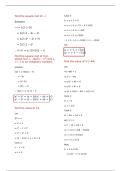
Find the square root of −i. Case 2:
z² + z + 1 = 0
Solution:
⇒ z = (−1 ± √(1 − 4·1·1))/2
−i = 1/2 (−2i)
⇒ z = (−1 ± √−3)/2
= 1/2 (1 − 2i − 1)
⇒ z = (−1 ± √3i)/2
= 1/2 (1² − 2i + i²) ∴ z = 1, (−1 + √3i)/2, (−1 − √3i)/2
= 1/2 (1 − i)² Let,
∴ √(−i) = ± (1/√2)(1 − i) ω = (−1 + √3i)/2
ω² = (−1 − √3i)/2
Find the square root of h(x),
where h(x) = −8x/(1 − x²) and x
= i. [i is an imaginary number] Find the value of ⁶√(−64).
Solution: Let,
h(i) = (−8i)/(1 − i²) ⁶√(−64) = z
= −4i ⇒ z⁶ = −64
= 2(−2i) ⇒ (z²)³ + 64 = 0
= 2(1 − i)² ⇒ (z²)³ + 4³ = 0
∴ √h(i) = ± √2 (1 − i) ⇒ (z² + 4)(z⁴ − 4z² + 16) = 0
a³ + b³ = (a + b)(a² − ab + b²) Case 1:
a³ − b³ = (a − b)(a² + ab + b²)
z² = −4
⇒ z = ±2i
Find the value of ∛1.
Case 2:
Let,
z⁴ − 4z² + 16 = 0
∛1 = z
Let, z² = t
⇒ z³ = 1
⇒ t² − 4t + 16 = 0
⇒ z³ − 1 = 0
⇒ t = (4 ± √(16 − 64))/2
⇒ z³ − 1³ = 0
⇒ t = (4 ± 4√3i)/2
⇒ (z − 1)(z² + z + 1) = 0
⇒ t = 2 ± 2√3i
Case 1:
Now,
z−1=0
z² = 2 ± 2√3i
⇒z=1
= (√3)² − i² ± 2(√3)i
, = (√3)² ± 2√3i + i² √2 x = 1 + i
= (√3 ± i)² ⇒ x = (1 + i) / √2
∴ z = ±(√3 ± i) ⇒ x² = (1 + i)² / 2
Find the value of, √(−3 + √(−3 + =i
√(−3 + ... ∞)))
L.S. = x⁶ + x⁴ + x² + 1
Let,
= (x²)³ + (x²)² + x² + 1
y = √(−3 + √(−3 + √(−3 + ... ∞)))
= i³ + i² + i + 1
⇒ y = √(−3 + y)
= (−i) + (−1) + i + 1
⇒ y² = −3 + y
=0
⇒ y² − y + 3 = 0
∴ L.S. = R.S.
⇒ y = (−(−1) ± √((−1)² − 4·1·3)) / (2·1)
Hence Proved.
⇒ y = (1 ± √(1 − 12)) / 2
Shortcut:
⇒ y = (1 ± √−11) / 2 2i = (1 + i)²
⇒ y = (1 ± √11 i) / 2 ⇒ i = (1 + i)² / 2
If ∛(a + ib) = x + iy,
If x = 2 + √−3, prove that,
prove that,
3x⁴ − 17x³ + 41x² − 35x + 5 = 5
∛(a − ib) = x − iy
Given,
x = 2 + √−3 Given,
⇒ x − 2 = √−3 ∛(a + ib) = x + iy
⇒ x² − 4x + 4 = −3 ⇒ a + ib = (x + iy)³
⇒ x² − 4x + 7 = 0 ⇒ a + ib = x³ + 3x²(iy) + 3x(iy)² + (iy)³
L.S. = 3x⁴ − 17x³ + 41x² − 35x + 5 ⇒ a + ib = (x³ − 3xy²) + i(3x²y − y³)
= 3x⁴ − 12x³ + 21x² − 5x³ + 20x² − Comparing the real and imaginary parts,
35x + 5
a = x³ − 3xy² ...(1)
= 3x²(x² − 4x + 7) − 5x(x² − 4x + 7)
+5 b = 3x²y − y³ ...(2)
=0+0+5 Now,
= 5 = R.S. L.S. = ∛(a − ib)
Hence Proved.
= ∛[(x³ − 3xy²) − i(3x²y − y³)]
If √2 x = 1 + i, prove that,
x⁶ + x⁴ + x² + 1 = 0 = ∛[x³ − 3x²(iy) + 3x(iy)² − (iy)³]
Given, = ∛[(x − iy)³]


