

CH 222Z Midterm 2 Review
LA Review Session
Intermolecular Forces
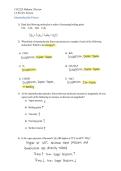
1) Rank the following molecules in order of increasing boiling point:
CH4 C3H8 H2O C2H6
2) What kinds of intermolecular forces are present in a sample of each of the following
molecules? Which is the strongest?
a) CH2O b) BrF5
c) N2 d) CH3CH2F
e) CH3OH f) NaCl
3) As the intermolecular attractive forces between molecules increase in magnitude, do you
expect each of the following to increase or decrease in magnitude?
a) Vapor pressure
b) Boiling point
c) Viscosity
d) Freezing point
e) Surface tension
4) Is the vapor pressure of hexanol C6H13OH higher at 25°𝐶 or 60°𝐶? Why?
, CH 222Z Midterm 2 Review
LA Review Session
5) Using the following phase diagram for Carbon Dioxide, what phase change will take
place when a sample at 2 atm cools from 0°𝐶 to -80°𝐶?
Energetics Related to Phase Changes
6) Why does it take more energy to boil one mole of water at 100°𝐶 than it does to melt one
mole of water at 0°𝐶?
7) Calculate the total energy input required to cool 25 g of water from 150°𝐶 to -5°𝐶
𝐽 𝐽 𝐽
(Cs H2O (s) = 2. 09 𝑔°𝐶
, Cs H2O (l) = 4. 18 𝑔°𝐶
, Cs H2O (g) = 2. 01 𝑔°𝐶
)
𝑘𝐽 𝑘𝐽
(ΔHfus = 6.02 𝑚𝑜𝑙
, ΔHvap = 40.7 𝑚𝑜𝑙
)
LA Review Session
Intermolecular Forces
1) Rank the following molecules in order of increasing boiling point:
CH4 C3H8 H2O C2H6
2) What kinds of intermolecular forces are present in a sample of each of the following
molecules? Which is the strongest?
a) CH2O b) BrF5
c) N2 d) CH3CH2F
e) CH3OH f) NaCl
3) As the intermolecular attractive forces between molecules increase in magnitude, do you
expect each of the following to increase or decrease in magnitude?
a) Vapor pressure
b) Boiling point
c) Viscosity
d) Freezing point
e) Surface tension
4) Is the vapor pressure of hexanol C6H13OH higher at 25°𝐶 or 60°𝐶? Why?
, CH 222Z Midterm 2 Review
LA Review Session
5) Using the following phase diagram for Carbon Dioxide, what phase change will take
place when a sample at 2 atm cools from 0°𝐶 to -80°𝐶?
Energetics Related to Phase Changes
6) Why does it take more energy to boil one mole of water at 100°𝐶 than it does to melt one
mole of water at 0°𝐶?
7) Calculate the total energy input required to cool 25 g of water from 150°𝐶 to -5°𝐶
𝐽 𝐽 𝐽
(Cs H2O (s) = 2. 09 𝑔°𝐶
, Cs H2O (l) = 4. 18 𝑔°𝐶
, Cs H2O (g) = 2. 01 𝑔°𝐶
)
𝑘𝐽 𝑘𝐽
(ΔHfus = 6.02 𝑚𝑜𝑙
, ΔHvap = 40.7 𝑚𝑜𝑙
)


