

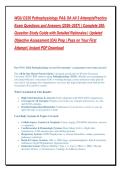
WGU D236 Pathophysiology PA& OA All 3 AttemptsPractice
Exam Questions and Answers (2026–2027) | Complete 300-
Question Study Guide with Detailed Rationales | Updated
Objective Assessment (OA) Prep | Pass on Your First
Attempt | Instant PDF Download
Pass WGU D236 Pathophysiology on your first attempt—or guarantee your retake success!
This All-In-One Master Practice Bank is designed specifically for Western Governors
University (WGU) BSN students taking Pathophysiology (D236). Whether you are prepping for
your initial Objective Assessment (OA) or working through a course instructor retake plan for
your 2nd or 3rd attempt, this comprehensive set covers key high-yield topics from both the Pre-
Assessment (PA) and OA variants.
What’s Included in This Bundle:
High-Yield Questions & Answers: Direct alignment with WGU D236 competencies.
Coverage for All Attempts: Prepares you for the core concepts tested across 1st, 2nd,
and 3rd OA attempts.
Detailed Explanations/Rationales: Understand why an answer is correct so you can
apply the logic to any question variant.
Core Body Systems & Topics Covered:
Cellular Injury, Genetics & Neoplasia: Cancer staging, DNA/RNA alterations, necrosis
vs. apoptosis.
Cardiovascular & Hematologic Systems: Heart failure (Left vs. Right side),
hypertension, CAD, anemia types, and clotting disorders.
Respiratory System: COPD (Emphysema vs. Chronic Bronchitis), asthma, pneumonia,
pulmonary embolism.
Renal & Urinary Systems: AKI vs. CKD stages, glomerulonephritis, fluid & electrolyte
imbalances (Hyper/Hypokalemia, Hyponatremia).
Endocrine System: Diabetes Mellitus (Type 1 vs. Type 2, DKA vs. HHS), Thyroid
disorders (Graves' vs. Hashimoto's), Cushing's & Addison's disease.
, Neurologic & Musculoskeletal: Stroke types (Ischemic vs. Hemorrhagic), MS, ALS,
Parkinson's, and inflammatory joint conditions.
Gastrointestinal & Immune Systems: Hepatitis, cirrhosis, IBD (Crohn's vs. UC),
hypersensitivity reactions (Types I–IV).
Why Choose This Resource?
All-in-One Efficiency: No need to buy separate retake guides—get all questions in one
organized file.
Targeted Study: Perfect for last-minute cramming or verifying readiness before
requesting your OA voucher.
Instant PDF Download: Easily readable on desktop, iPad, or mobile devices.
1. A patient experiences myocardial ischemia after an acute coronary artery
occlusion. Which cellular adaptation occurs first because of decreased oxygen
delivery?
A. Cellular hypertrophy
B. Cellular hyperplasia
C. Decreased ATP production resulting from impaired aerobic metabolism
D. Increased protein synthesis
Answer: C
Rationale: Oxygen deprivation impairs oxidative phosphorylation within mitochondria,
leading to decreased ATP production. ATP depletion disrupts sodium-potassium pumps,
causing cellular swelling and potentially reversible injury.
2. Which laboratory finding is most consistent with metabolic acidosis?
,A. pH 7.48, HCO₃⁻ 30 mEq/L
B. pH 7.50, PaCO₂ 30 mm Hg
C. pH 7.28, HCO₃⁻ 18 mEq/L
D. pH 7.40, PaCO₂ 40 mm Hg
Answer: C
Rationale: Metabolic acidosis is characterized by a low pH and decreased bicarbonate
concentration due to excess acid or bicarbonate loss.
3. A patient develops edema after severe burns. Which pathophysiologic mechanism
is primarily responsible?
A. Increased plasma albumin
B. Increased capillary permeability allowing proteins and fluid to leak into tissues
C. Increased lymphatic drainage
D. Decreased hydrostatic pressure
Answer: B
Rationale: Burn injuries trigger inflammation that increases vascular permeability, allowing
protein-rich fluid to move into the interstitial space.*
, 4. Which electrolyte imbalance is most likely to produce dangerous cardiac
dysrhythmias?
A. Mild hypernatremia
B. Hyperkalemia
C. Hypermagnesemia
D. Hyperphosphatemia
Answer: B
Rationale: Potassium directly affects cardiac electrical conduction. Elevated serum
potassium can rapidly produce life-threatening arrhythmias.*
5. Which inflammatory mediator is primarily responsible for vasodilation during acute
inflammation?
A. Insulin
B. Aldosterone
C. Histamine
D. Cortisol
Answer: C
Rationale: Histamine released from mast cells produces vasodilation and increased
vascular permeability during the inflammatory response.*
Exam Questions and Answers (2026–2027) | Complete 300-
Question Study Guide with Detailed Rationales | Updated
Objective Assessment (OA) Prep | Pass on Your First
Attempt | Instant PDF Download
Pass WGU D236 Pathophysiology on your first attempt—or guarantee your retake success!
This All-In-One Master Practice Bank is designed specifically for Western Governors
University (WGU) BSN students taking Pathophysiology (D236). Whether you are prepping for
your initial Objective Assessment (OA) or working through a course instructor retake plan for
your 2nd or 3rd attempt, this comprehensive set covers key high-yield topics from both the Pre-
Assessment (PA) and OA variants.
What’s Included in This Bundle:
High-Yield Questions & Answers: Direct alignment with WGU D236 competencies.
Coverage for All Attempts: Prepares you for the core concepts tested across 1st, 2nd,
and 3rd OA attempts.
Detailed Explanations/Rationales: Understand why an answer is correct so you can
apply the logic to any question variant.
Core Body Systems & Topics Covered:
Cellular Injury, Genetics & Neoplasia: Cancer staging, DNA/RNA alterations, necrosis
vs. apoptosis.
Cardiovascular & Hematologic Systems: Heart failure (Left vs. Right side),
hypertension, CAD, anemia types, and clotting disorders.
Respiratory System: COPD (Emphysema vs. Chronic Bronchitis), asthma, pneumonia,
pulmonary embolism.
Renal & Urinary Systems: AKI vs. CKD stages, glomerulonephritis, fluid & electrolyte
imbalances (Hyper/Hypokalemia, Hyponatremia).
Endocrine System: Diabetes Mellitus (Type 1 vs. Type 2, DKA vs. HHS), Thyroid
disorders (Graves' vs. Hashimoto's), Cushing's & Addison's disease.
, Neurologic & Musculoskeletal: Stroke types (Ischemic vs. Hemorrhagic), MS, ALS,
Parkinson's, and inflammatory joint conditions.
Gastrointestinal & Immune Systems: Hepatitis, cirrhosis, IBD (Crohn's vs. UC),
hypersensitivity reactions (Types I–IV).
Why Choose This Resource?
All-in-One Efficiency: No need to buy separate retake guides—get all questions in one
organized file.
Targeted Study: Perfect for last-minute cramming or verifying readiness before
requesting your OA voucher.
Instant PDF Download: Easily readable on desktop, iPad, or mobile devices.
1. A patient experiences myocardial ischemia after an acute coronary artery
occlusion. Which cellular adaptation occurs first because of decreased oxygen
delivery?
A. Cellular hypertrophy
B. Cellular hyperplasia
C. Decreased ATP production resulting from impaired aerobic metabolism
D. Increased protein synthesis
Answer: C
Rationale: Oxygen deprivation impairs oxidative phosphorylation within mitochondria,
leading to decreased ATP production. ATP depletion disrupts sodium-potassium pumps,
causing cellular swelling and potentially reversible injury.
2. Which laboratory finding is most consistent with metabolic acidosis?
,A. pH 7.48, HCO₃⁻ 30 mEq/L
B. pH 7.50, PaCO₂ 30 mm Hg
C. pH 7.28, HCO₃⁻ 18 mEq/L
D. pH 7.40, PaCO₂ 40 mm Hg
Answer: C
Rationale: Metabolic acidosis is characterized by a low pH and decreased bicarbonate
concentration due to excess acid or bicarbonate loss.
3. A patient develops edema after severe burns. Which pathophysiologic mechanism
is primarily responsible?
A. Increased plasma albumin
B. Increased capillary permeability allowing proteins and fluid to leak into tissues
C. Increased lymphatic drainage
D. Decreased hydrostatic pressure
Answer: B
Rationale: Burn injuries trigger inflammation that increases vascular permeability, allowing
protein-rich fluid to move into the interstitial space.*
, 4. Which electrolyte imbalance is most likely to produce dangerous cardiac
dysrhythmias?
A. Mild hypernatremia
B. Hyperkalemia
C. Hypermagnesemia
D. Hyperphosphatemia
Answer: B
Rationale: Potassium directly affects cardiac electrical conduction. Elevated serum
potassium can rapidly produce life-threatening arrhythmias.*
5. Which inflammatory mediator is primarily responsible for vasodilation during acute
inflammation?
A. Insulin
B. Aldosterone
C. Histamine
D. Cortisol
Answer: C
Rationale: Histamine released from mast cells produces vasodilation and increased
vascular permeability during the inflammatory response.*


