EBP Exam 1 - Module 1 (Chapters 1-6) with all Correct &
100% Verified Answers |Actual Complete Update |Already
Graded A+
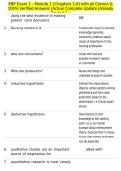
using the best evidence in making
EBP
patient care decisions
1. Nursing research is Is systematic inquiry to develop
knowl-edge (generate
trustworthy evidence) about
issues of importance to the
nursing profession.
2. who are consumers? nurses who read and
evaluate re-search reports
or summaries
3. Who are producers? Nurses who design and
undertake re-search studies
4. Inductive hypothesis Inferred from observations.
Observe certain patterns among
phenomena and then make
predictions based on the
observations. I.e Clinical experi-
ences
5. deductive hypothesis Have theories or prior
knowledge as the starting
point, as in our earlier
example about reinforcement
theory. Deduced that if a theory
is true, then certain outcomes
can be expected
6. qualitative studies are an important allied with
source of inspiration for
7. quantitative research is most closely
1/
30
, EBP Exam 1 - Module 1 (Chapters 1-6) with all Correct &
100% Verified Answers |Actual Complete Update |Already
inductive hypothesis Graded A+
positivist tradition
8. constructivist inquiry
2/
30
, EBP Exam 1 - Module 1 (Chapters 1-6) with all Correct &
100% Verified Answers |Actual Complete Update |Already
Graded
qualitative research is most closely A+
associated
with
9. Positivist Paradigm Positivism reflects a broader
cultural phenomenon
(modernism) that em-phasizes
the rational and the scientific.
10. Positivist assumption Reality exists.
There is a real world driven by natural
causes.
11. Naturalistic (constructivist) assumption reality is multiple and subjective,
con-
structed by individuals
12. Which occurs in the positivist paradigm? Reality is fixed
13. Fixed design positivist/Quantitative research
Discrete, specific
concepts Deductive
processes control over
context verification of
hunches quantitative
information seeks
generalization
constructivist aka
14. Flexible design vs. fixed naturalistic/Qualita-tive
inductive processes vs
deductive holistic versus
discrete
seeks patterns vs seeks
generalizations
15. purpose of research: basic research extending information for sake of
3/
30
100% Verified Answers |Actual Complete Update |Already
Graded A+
using the best evidence in making
EBP
patient care decisions
1. Nursing research is Is systematic inquiry to develop
knowl-edge (generate
trustworthy evidence) about
issues of importance to the
nursing profession.
2. who are consumers? nurses who read and
evaluate re-search reports
or summaries
3. Who are producers? Nurses who design and
undertake re-search studies
4. Inductive hypothesis Inferred from observations.
Observe certain patterns among
phenomena and then make
predictions based on the
observations. I.e Clinical experi-
ences
5. deductive hypothesis Have theories or prior
knowledge as the starting
point, as in our earlier
example about reinforcement
theory. Deduced that if a theory
is true, then certain outcomes
can be expected
6. qualitative studies are an important allied with
source of inspiration for
7. quantitative research is most closely
1/
30
, EBP Exam 1 - Module 1 (Chapters 1-6) with all Correct &
100% Verified Answers |Actual Complete Update |Already
inductive hypothesis Graded A+
positivist tradition
8. constructivist inquiry
2/
30
, EBP Exam 1 - Module 1 (Chapters 1-6) with all Correct &
100% Verified Answers |Actual Complete Update |Already
Graded
qualitative research is most closely A+
associated
with
9. Positivist Paradigm Positivism reflects a broader
cultural phenomenon
(modernism) that em-phasizes
the rational and the scientific.
10. Positivist assumption Reality exists.
There is a real world driven by natural
causes.
11. Naturalistic (constructivist) assumption reality is multiple and subjective,
con-
structed by individuals
12. Which occurs in the positivist paradigm? Reality is fixed
13. Fixed design positivist/Quantitative research
Discrete, specific
concepts Deductive
processes control over
context verification of
hunches quantitative
information seeks
generalization
constructivist aka
14. Flexible design vs. fixed naturalistic/Qualita-tive
inductive processes vs
deductive holistic versus
discrete
seeks patterns vs seeks
generalizations
15. purpose of research: basic research extending information for sake of
3/
30