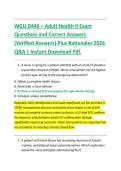
WGU D446 – Adult Health II Exam
Questions and Correct Answers
(Verified Answers) Plus Rationales 2026
Q&A | Instant Download Pdf.
1. A nurse is caring for a patient admitted with an acute ST-elevation
myocardial infarction (STEMI). Which intervention has the highest
priority upon arrival to the emergency department?
A. Obtain a complete health history
B. Administer a stool softener
C. Perform a 12-lead ECG and prepare for reperfusion therapy
D. Schedule cardiac rehabilitation
Rationale: Early identification and rapid reperfusion are the priorities in
STEMI management because myocardial tissue begins to die within
minutes of complete coronary artery occlusion. A 12-lead ECG confirms
the diagnosis and facilitates timely PCI or fibrinolytic therapy,
significantly improving outcomes. Other interventions are important but
are secondary to restoring coronary blood flow.
2. A patient with heart failure has increasing shortness of breath,
crackles, and bilateral lower-extremity edema. Which medication
would the nurse anticipate administering first?
,A. Digoxin
B. Furosemide
C. Metoprolol
D. Aspirin
Rationale: Furosemide is a loop diuretic that rapidly decreases preload
by promoting diuresis, reducing pulmonary congestion and edema.
Although beta-blockers and digoxin improve long-term heart failure
management, they do not provide the immediate symptom relief
needed during acute fluid overload.
3. A patient receiving warfarin has an INR of 5.8 without evidence of
bleeding. Which nursing action is most appropriate?
A. Administer heparin immediately.
B. Hold the warfarin dose and notify the provider.
C. Encourage foods high in vitamin K without notifying anyone.
D. Double the next warfarin dose.
Rationale: An INR of 5.8 places the patient at increased risk for bleeding.
The appropriate intervention is to hold warfarin and notify the provider,
who may prescribe vitamin K depending on the clinical situation.
Administering additional anticoagulants would increase bleeding risk.
4. Which assessment finding is most consistent with left-sided heart
failure?
A. Hepatomegaly
B. Peripheral edema
,C. Pulmonary crackles
D. Jugular vein distention
Rationale: Left-sided heart failure causes blood to back up into the
pulmonary circulation, leading to pulmonary congestion, crackles,
dyspnea, and orthopnea. Peripheral edema and jugular vein distention
are more characteristic of right-sided heart failure.
5. A nurse is caring for a patient with atrial fibrillation. Which
complication is the greatest concern?
A. Hyperkalemia
B. Ischemic stroke
C. Pneumothorax
D. Pulmonary fibrosis
Rationale: Atrial fibrillation promotes blood stasis within the atria,
increasing the likelihood of thrombus formation. Embolization of these
clots can result in ischemic stroke, making anticoagulation an important
component of therapy.
6. Which laboratory value is most important for the nurse to monitor
before administering intravenous potassium chloride?
A. Hemoglobin
B. White blood cell count
C. Serum potassium level
D. Platelet count
, Rationale: Potassium replacement should never be administered
without verifying the patient's current potassium level because
hyperkalemia can cause life-threatening cardiac dysrhythmias.
Monitoring renal function is also important, but confirming the
potassium level is the immediate priority.
7. A patient develops sudden unilateral weakness, facial drooping,
and slurred speech. What is the nurse's priority action?
A. Administer aspirin.
B. Encourage oral fluids.
C. Activate the stroke response team immediately.
D. Place the patient in Trendelenburg position.
Rationale: Time-sensitive treatment is essential for ischemic stroke.
Rapid activation of the stroke response team allows prompt
neuroimaging and evaluation for thrombolytic therapy or mechanical
thrombectomy when indicated.
8. Which intervention is most appropriate for preventing ventilator-
associated pneumonia (VAP)?
A. Maintain the patient flat in bed.
B. Elevate the head of the bed 30–45 degrees.
C. Restrict oral care.
D. Limit suctioning.
Rationale: Elevating the head of the bed reduces aspiration risk and is a
core evidence-based intervention for preventing ventilator-associated
Questions and Correct Answers
(Verified Answers) Plus Rationales 2026
Q&A | Instant Download Pdf.
1. A nurse is caring for a patient admitted with an acute ST-elevation
myocardial infarction (STEMI). Which intervention has the highest
priority upon arrival to the emergency department?
A. Obtain a complete health history
B. Administer a stool softener
C. Perform a 12-lead ECG and prepare for reperfusion therapy
D. Schedule cardiac rehabilitation
Rationale: Early identification and rapid reperfusion are the priorities in
STEMI management because myocardial tissue begins to die within
minutes of complete coronary artery occlusion. A 12-lead ECG confirms
the diagnosis and facilitates timely PCI or fibrinolytic therapy,
significantly improving outcomes. Other interventions are important but
are secondary to restoring coronary blood flow.
2. A patient with heart failure has increasing shortness of breath,
crackles, and bilateral lower-extremity edema. Which medication
would the nurse anticipate administering first?
,A. Digoxin
B. Furosemide
C. Metoprolol
D. Aspirin
Rationale: Furosemide is a loop diuretic that rapidly decreases preload
by promoting diuresis, reducing pulmonary congestion and edema.
Although beta-blockers and digoxin improve long-term heart failure
management, they do not provide the immediate symptom relief
needed during acute fluid overload.
3. A patient receiving warfarin has an INR of 5.8 without evidence of
bleeding. Which nursing action is most appropriate?
A. Administer heparin immediately.
B. Hold the warfarin dose and notify the provider.
C. Encourage foods high in vitamin K without notifying anyone.
D. Double the next warfarin dose.
Rationale: An INR of 5.8 places the patient at increased risk for bleeding.
The appropriate intervention is to hold warfarin and notify the provider,
who may prescribe vitamin K depending on the clinical situation.
Administering additional anticoagulants would increase bleeding risk.
4. Which assessment finding is most consistent with left-sided heart
failure?
A. Hepatomegaly
B. Peripheral edema
,C. Pulmonary crackles
D. Jugular vein distention
Rationale: Left-sided heart failure causes blood to back up into the
pulmonary circulation, leading to pulmonary congestion, crackles,
dyspnea, and orthopnea. Peripheral edema and jugular vein distention
are more characteristic of right-sided heart failure.
5. A nurse is caring for a patient with atrial fibrillation. Which
complication is the greatest concern?
A. Hyperkalemia
B. Ischemic stroke
C. Pneumothorax
D. Pulmonary fibrosis
Rationale: Atrial fibrillation promotes blood stasis within the atria,
increasing the likelihood of thrombus formation. Embolization of these
clots can result in ischemic stroke, making anticoagulation an important
component of therapy.
6. Which laboratory value is most important for the nurse to monitor
before administering intravenous potassium chloride?
A. Hemoglobin
B. White blood cell count
C. Serum potassium level
D. Platelet count
, Rationale: Potassium replacement should never be administered
without verifying the patient's current potassium level because
hyperkalemia can cause life-threatening cardiac dysrhythmias.
Monitoring renal function is also important, but confirming the
potassium level is the immediate priority.
7. A patient develops sudden unilateral weakness, facial drooping,
and slurred speech. What is the nurse's priority action?
A. Administer aspirin.
B. Encourage oral fluids.
C. Activate the stroke response team immediately.
D. Place the patient in Trendelenburg position.
Rationale: Time-sensitive treatment is essential for ischemic stroke.
Rapid activation of the stroke response team allows prompt
neuroimaging and evaluation for thrombolytic therapy or mechanical
thrombectomy when indicated.
8. Which intervention is most appropriate for preventing ventilator-
associated pneumonia (VAP)?
A. Maintain the patient flat in bed.
B. Elevate the head of the bed 30–45 degrees.
C. Restrict oral care.
D. Limit suctioning.
Rationale: Elevating the head of the bed reduces aspiration risk and is a
core evidence-based intervention for preventing ventilator-associated