

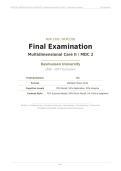
NUR 2392 / NUR2392 Final Exam (2026/2027): Multidimensional Care II / MDC 2 - Rasmussen University 100 Questions
NUR 2392 / NUR2392
Final Examination
Multidimensional Care II / MDC 2
Rasmussen University
2026 - 2027 Curriculum
Total Questions 100
Format Multiple Choice (A-D)
Cognitive Levels 25% Recall, 55% Application, 20% Analysis
Content Style 75% Scenario-Based, 20% Direct Recall, 5% Clinical Judgment
Sections: Cardiovascular | Peripheral Vascular | Hematologic | Renal/Urinary | Endocrine |
Fluid/Electrolyte/ABG | Integrated Clinical Scenarios
Page 1
,NUR 2392 / NUR2392 Final Exam (2026/2027): Multidimensional Care II / MDC 2 - Rasmussen University 100 Questions
Section 1: Cardiovascular Disorders (Q1-Q25)
CAD, Heart Failure, Hypertension, Valvular Disorders, Dysrhythmias
Q1: A 58-year-old male presents to the emergency department with crushing
substernal chest pain that began 2 hours ago. The pain radiates to his left arm
and jaw. He reports diaphoresis and nausea. Which cardiac biomarker is
considered the gold standard for diagnosing acute myocardial infarction (MI)
and rises 3-4 hours post-MI?
A. Creatine kinase-MB (CK-MB)
B. Myoglobin
C. Troponin I [CORRECT]
D. B-type natriuretic peptide (BNP)
Correct Answer: C
Rationale: Troponin I is the gold standard cardiac biomarker for diagnosing acute MI because it is
highly specific to cardiac muscle and rises within 3-4 hours post-MI, peaking at 12-24 hours. CK-MB
is less specific and also rises early but is not the gold standard. Myoglobin rises earliest (within 1-2
hours) but lacks cardiac specificity. BNP is used for heart failure diagnosis, not acute MI detection.
This aligns with MDC 2 cardiovascular competency on cardiac biomarker interpretation per 2026
Rasmussen curriculum standards.
Q2: A 65-year-old female with a history of hyperlipidemia and type 2 diabetes
mellitus is admitted with unstable angina. The nurse notes ST-segment
depression and T-wave inversion on the 12-lead ECG. Which type of acute
coronary syndrome (ACS) does this presentation most accurately describe?
A. ST-elevation myocardial infarction (STEMI)
B. Non-ST-elevation myocardial infarction (NSTEMI) [CORRECT]
C. Prinzmetal angina
D. Stable angina
Correct Answer: B
Rationale: This patient presents with NSTEMI, characterized by ST-segment depression and/or
T-wave inversion on ECG, with partial occlusion of the coronary artery. STEMI presents with
ST-segment elevation indicating complete occlusion requiring emergent reperfusion. Prinzmetal
(variant) angina is caused by coronary vasospasm with transient ST elevation at rest. Stable angina
is predictable chest pain relieved by rest or nitroglycerin. MDC 2 emphasizes differentiating ACS
types based on ECG findings and clinical presentation for appropriate triage and intervention.
Q3: A patient arrives at the emergency department with suspected acute
myocardial infarction. The healthcare provider orders the initial collaborative
care mnemonic MONA. Which of the following correctly identifies the
components of MONA in the proper clinical sequence?
A. Morphine, Oxygen, Nitroglycerin, Aspirin [CORRECT]
B. Morphine, Oxygen, Atenolol, Aspirin
C. Metoprolol, Oxygen, Nitroglycerin, Aspirin
D. Morphine, Oxygen, Nifedipine, Alteplase
Correct Answer: A
Page 2
,NUR 2392 / NUR2392 Final Exam (2026/2027): Multidimensional Care II / MDC 2 - Rasmussen University 100 Questions
Rationale: MONA is the standard mnemonic for initial ACS management: Morphine (for pain and
anxiety reduction, also reduces preload), Oxygen (to improve myocardial oxygenation),
Nitroglycerin (vasodilator to reduce preload and afterload, relieve chest pain), and Aspirin
(antiplatelet to inhibit thrombus formation). MDC 2 curriculum identifies MONA as foundational
collaborative care for ACS patients per 2026 Rasmussen standards. Other options substitute
incorrect medications that are not part of the MONA protocol.
Q4: The nurse is providing discharge teaching to a patient following a
percutaneous coronary intervention (PCI) with stent placement. Which
statement by the patient indicates a need for further education?
A. I will take my aspirin and clopidogrel exactly as prescribed to prevent stent
thrombosis.
B. I should avoid MRI scans for at least 6 months after my stent placement.
[CORRECT]
C. I will report any signs of bleeding, such as unusual bruising or blood in my stool.
D. I need to keep the puncture site clean and dry and avoid heavy lifting for about a
week.
Correct Answer: B
Rationale: The statement about avoiding MRI scans is incorrect and indicates a need for further
education. Most modern coronary stents are MRI-safe immediately after placement, and there is no
standard 6-month MRI avoidance recommendation. The patient should take dual antiplatelet
therapy (aspirin and clopidogrel) as prescribed, report signs of bleeding due to anticoagulant
therapy, and care for the puncture site post-PCI. MDC 2 emphasizes post-PCI patient education as a
key nursing competency for the 2026 curriculum.
Q5: A 72-year-old patient is prescribed atorvastatin for hyperlipidemia
following a myocardial infarction. The nurse teaches the patient about the
medication. Which statement by the patient demonstrates an accurate
understanding of the teaching?
A. I should take this medication in the morning with breakfast for best absorption.
B. I need to report any unexplained muscle pain or weakness to my provider
immediately. [CORRECT]
C. This medication will dissolve the existing plaque in my coronary arteries.
D. I should expect my cholesterol levels to improve within the first week of therapy.
Correct Answer: B
Rationale: Atorvastatin inhibits HMG-CoA reductase, reducing cholesterol synthesis. Patients must
report unexplained muscle pain or weakness because statins can cause rhabdomyolysis, a serious
side effect involving muscle breakdown. Statins should typically be taken in the evening (not
morning) because endogenous cholesterol synthesis occurs at night. Statins stabilize existing
plaque and reduce new plaque formation but do not dissolve established plaque. Therapeutic effects
take 4-6 weeks. MDC 2 pharmacology content covers statin monitoring as a key competency per
2026 Rasmussen standards.
Q6: A nurse is caring for a patient with heart failure who reports increasing
shortness of breath when lying flat and needs to use three pillows to sleep
comfortably. Which term best describes this finding?
A. Orthopnea [CORRECT]
Page 3
, NUR 2392 / NUR2392 Final Exam (2026/2027): Multidimensional Care II / MDC 2 - Rasmussen University 100 Questions
B. Dyspnea on exertion
C. Paroxysmal nocturnal dyspnea
D. Platypnea
Correct Answer: A
Rationale: Orthopnea is the inability to breathe comfortably when lying flat, relieved by sitting
upright. It is a classic symptom of left-sided heart failure caused by increased venous return to the
heart when supine, leading to increased pulmonary congestion. The number of pillows needed is
often quantified (e.g., two-pillow orthopnea). Paroxysmal nocturnal dyspnea (PND) is sudden
awakening from sleep with severe shortness of breath. Dyspnea on exertion occurs with activity.
Platypnea is relieved by lying flat. MDC 2 heart failure module identifies orthopnea as a key
assessment finding for left-sided HF per the 2026 Rasmussen curriculum.
Q7: A patient with left-sided heart failure (HFrEF) presents with crackles in
bilateral lung fields, S3 gallop, and fatigue. Which pathophysiological
mechanism best explains why left-sided heart failure causes pulmonary
symptoms?
A. The left ventricle cannot eject blood effectively, causing blood to back up
into the pulmonary circulation, increasing pulmonary capillary hydrostatic
pressure and resulting in pulmonary congestion. [CORRECT]
B. The right ventricle fails to pump blood to the lungs adequately, causing fluid
accumulation in the alveoli.
C. The left atrium becomes overstretched, triggering excessive antidiuretic hormone
release and fluid retention.
D. Pulmonary vasodilation occurs secondary to reduced cardiac output, causing fluid to
leak into interstitial spaces.
Correct Answer: A
Rationale: In left-sided heart failure (specifically HFrEF, heart failure with reduced ejection fraction),
the left ventricle cannot eject blood effectively. This causes blood to back up from the left atrium
into the pulmonary veins, increasing pulmonary capillary hydrostatic pressure. The resulting
transudation of fluid into the pulmonary interstitium and alveoli produces crackles, dyspnea, and
orthopnea. S3 gallop reflects rapid ventricular filling into a stiff, noncompliant ventricle. MDC 2
pathophysiology content emphasizes understanding the backward effects of ventricular failure as a
core competency per 2026 Rasmussen standards.
Q8: The nurse is caring for a patient with right-sided heart failure. Which
assessment finding would the nurse most likely observe?
A. Crackles on auscultation and pink frothy sputum
B. Bilateral peripheral edema, jugular venous distension (JVD), and
hepatomegaly [CORRECT]
C. Chest pain radiating to the left arm with ST elevation on ECG
D. Dry cough worse at night and paroxysmal nocturnal dyspnea
Correct Answer: B
Rationale: Right-sided heart failure causes systemic venous congestion because the right ventricle
cannot pump blood effectively to the pulmonary circulation. Blood backs up into the systemic
venous system, causing jugular venous distension (JVD), peripheral edema (dependent, bilateral),
hepatomegaly (liver engorgement), ascites, and weight gain from fluid retention. Crackles and pink
frothy sputum are signs of left-sided heart failure with pulmonary edema. Chest pain with ST
elevation indicates acute MI. MDC 2 emphasizes differentiating left-sided versus right-sided heart
Page 4
NUR 2392 / NUR2392
Final Examination
Multidimensional Care II / MDC 2
Rasmussen University
2026 - 2027 Curriculum
Total Questions 100
Format Multiple Choice (A-D)
Cognitive Levels 25% Recall, 55% Application, 20% Analysis
Content Style 75% Scenario-Based, 20% Direct Recall, 5% Clinical Judgment
Sections: Cardiovascular | Peripheral Vascular | Hematologic | Renal/Urinary | Endocrine |
Fluid/Electrolyte/ABG | Integrated Clinical Scenarios
Page 1
,NUR 2392 / NUR2392 Final Exam (2026/2027): Multidimensional Care II / MDC 2 - Rasmussen University 100 Questions
Section 1: Cardiovascular Disorders (Q1-Q25)
CAD, Heart Failure, Hypertension, Valvular Disorders, Dysrhythmias
Q1: A 58-year-old male presents to the emergency department with crushing
substernal chest pain that began 2 hours ago. The pain radiates to his left arm
and jaw. He reports diaphoresis and nausea. Which cardiac biomarker is
considered the gold standard for diagnosing acute myocardial infarction (MI)
and rises 3-4 hours post-MI?
A. Creatine kinase-MB (CK-MB)
B. Myoglobin
C. Troponin I [CORRECT]
D. B-type natriuretic peptide (BNP)
Correct Answer: C
Rationale: Troponin I is the gold standard cardiac biomarker for diagnosing acute MI because it is
highly specific to cardiac muscle and rises within 3-4 hours post-MI, peaking at 12-24 hours. CK-MB
is less specific and also rises early but is not the gold standard. Myoglobin rises earliest (within 1-2
hours) but lacks cardiac specificity. BNP is used for heart failure diagnosis, not acute MI detection.
This aligns with MDC 2 cardiovascular competency on cardiac biomarker interpretation per 2026
Rasmussen curriculum standards.
Q2: A 65-year-old female with a history of hyperlipidemia and type 2 diabetes
mellitus is admitted with unstable angina. The nurse notes ST-segment
depression and T-wave inversion on the 12-lead ECG. Which type of acute
coronary syndrome (ACS) does this presentation most accurately describe?
A. ST-elevation myocardial infarction (STEMI)
B. Non-ST-elevation myocardial infarction (NSTEMI) [CORRECT]
C. Prinzmetal angina
D. Stable angina
Correct Answer: B
Rationale: This patient presents with NSTEMI, characterized by ST-segment depression and/or
T-wave inversion on ECG, with partial occlusion of the coronary artery. STEMI presents with
ST-segment elevation indicating complete occlusion requiring emergent reperfusion. Prinzmetal
(variant) angina is caused by coronary vasospasm with transient ST elevation at rest. Stable angina
is predictable chest pain relieved by rest or nitroglycerin. MDC 2 emphasizes differentiating ACS
types based on ECG findings and clinical presentation for appropriate triage and intervention.
Q3: A patient arrives at the emergency department with suspected acute
myocardial infarction. The healthcare provider orders the initial collaborative
care mnemonic MONA. Which of the following correctly identifies the
components of MONA in the proper clinical sequence?
A. Morphine, Oxygen, Nitroglycerin, Aspirin [CORRECT]
B. Morphine, Oxygen, Atenolol, Aspirin
C. Metoprolol, Oxygen, Nitroglycerin, Aspirin
D. Morphine, Oxygen, Nifedipine, Alteplase
Correct Answer: A
Page 2
,NUR 2392 / NUR2392 Final Exam (2026/2027): Multidimensional Care II / MDC 2 - Rasmussen University 100 Questions
Rationale: MONA is the standard mnemonic for initial ACS management: Morphine (for pain and
anxiety reduction, also reduces preload), Oxygen (to improve myocardial oxygenation),
Nitroglycerin (vasodilator to reduce preload and afterload, relieve chest pain), and Aspirin
(antiplatelet to inhibit thrombus formation). MDC 2 curriculum identifies MONA as foundational
collaborative care for ACS patients per 2026 Rasmussen standards. Other options substitute
incorrect medications that are not part of the MONA protocol.
Q4: The nurse is providing discharge teaching to a patient following a
percutaneous coronary intervention (PCI) with stent placement. Which
statement by the patient indicates a need for further education?
A. I will take my aspirin and clopidogrel exactly as prescribed to prevent stent
thrombosis.
B. I should avoid MRI scans for at least 6 months after my stent placement.
[CORRECT]
C. I will report any signs of bleeding, such as unusual bruising or blood in my stool.
D. I need to keep the puncture site clean and dry and avoid heavy lifting for about a
week.
Correct Answer: B
Rationale: The statement about avoiding MRI scans is incorrect and indicates a need for further
education. Most modern coronary stents are MRI-safe immediately after placement, and there is no
standard 6-month MRI avoidance recommendation. The patient should take dual antiplatelet
therapy (aspirin and clopidogrel) as prescribed, report signs of bleeding due to anticoagulant
therapy, and care for the puncture site post-PCI. MDC 2 emphasizes post-PCI patient education as a
key nursing competency for the 2026 curriculum.
Q5: A 72-year-old patient is prescribed atorvastatin for hyperlipidemia
following a myocardial infarction. The nurse teaches the patient about the
medication. Which statement by the patient demonstrates an accurate
understanding of the teaching?
A. I should take this medication in the morning with breakfast for best absorption.
B. I need to report any unexplained muscle pain or weakness to my provider
immediately. [CORRECT]
C. This medication will dissolve the existing plaque in my coronary arteries.
D. I should expect my cholesterol levels to improve within the first week of therapy.
Correct Answer: B
Rationale: Atorvastatin inhibits HMG-CoA reductase, reducing cholesterol synthesis. Patients must
report unexplained muscle pain or weakness because statins can cause rhabdomyolysis, a serious
side effect involving muscle breakdown. Statins should typically be taken in the evening (not
morning) because endogenous cholesterol synthesis occurs at night. Statins stabilize existing
plaque and reduce new plaque formation but do not dissolve established plaque. Therapeutic effects
take 4-6 weeks. MDC 2 pharmacology content covers statin monitoring as a key competency per
2026 Rasmussen standards.
Q6: A nurse is caring for a patient with heart failure who reports increasing
shortness of breath when lying flat and needs to use three pillows to sleep
comfortably. Which term best describes this finding?
A. Orthopnea [CORRECT]
Page 3
, NUR 2392 / NUR2392 Final Exam (2026/2027): Multidimensional Care II / MDC 2 - Rasmussen University 100 Questions
B. Dyspnea on exertion
C. Paroxysmal nocturnal dyspnea
D. Platypnea
Correct Answer: A
Rationale: Orthopnea is the inability to breathe comfortably when lying flat, relieved by sitting
upright. It is a classic symptom of left-sided heart failure caused by increased venous return to the
heart when supine, leading to increased pulmonary congestion. The number of pillows needed is
often quantified (e.g., two-pillow orthopnea). Paroxysmal nocturnal dyspnea (PND) is sudden
awakening from sleep with severe shortness of breath. Dyspnea on exertion occurs with activity.
Platypnea is relieved by lying flat. MDC 2 heart failure module identifies orthopnea as a key
assessment finding for left-sided HF per the 2026 Rasmussen curriculum.
Q7: A patient with left-sided heart failure (HFrEF) presents with crackles in
bilateral lung fields, S3 gallop, and fatigue. Which pathophysiological
mechanism best explains why left-sided heart failure causes pulmonary
symptoms?
A. The left ventricle cannot eject blood effectively, causing blood to back up
into the pulmonary circulation, increasing pulmonary capillary hydrostatic
pressure and resulting in pulmonary congestion. [CORRECT]
B. The right ventricle fails to pump blood to the lungs adequately, causing fluid
accumulation in the alveoli.
C. The left atrium becomes overstretched, triggering excessive antidiuretic hormone
release and fluid retention.
D. Pulmonary vasodilation occurs secondary to reduced cardiac output, causing fluid to
leak into interstitial spaces.
Correct Answer: A
Rationale: In left-sided heart failure (specifically HFrEF, heart failure with reduced ejection fraction),
the left ventricle cannot eject blood effectively. This causes blood to back up from the left atrium
into the pulmonary veins, increasing pulmonary capillary hydrostatic pressure. The resulting
transudation of fluid into the pulmonary interstitium and alveoli produces crackles, dyspnea, and
orthopnea. S3 gallop reflects rapid ventricular filling into a stiff, noncompliant ventricle. MDC 2
pathophysiology content emphasizes understanding the backward effects of ventricular failure as a
core competency per 2026 Rasmussen standards.
Q8: The nurse is caring for a patient with right-sided heart failure. Which
assessment finding would the nurse most likely observe?
A. Crackles on auscultation and pink frothy sputum
B. Bilateral peripheral edema, jugular venous distension (JVD), and
hepatomegaly [CORRECT]
C. Chest pain radiating to the left arm with ST elevation on ECG
D. Dry cough worse at night and paroxysmal nocturnal dyspnea
Correct Answer: B
Rationale: Right-sided heart failure causes systemic venous congestion because the right ventricle
cannot pump blood effectively to the pulmonary circulation. Blood backs up into the systemic
venous system, causing jugular venous distension (JVD), peripheral edema (dependent, bilateral),
hepatomegaly (liver engorgement), ascites, and weight gain from fluid retention. Crackles and pink
frothy sputum are signs of left-sided heart failure with pulmonary edema. Chest pain with ST
elevation indicates acute MI. MDC 2 emphasizes differentiating left-sided versus right-sided heart
Page 4


