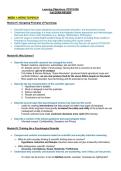
Learning Objectives: PSYCH100
Full EXAM REVIEW
WEEK 1: INTRO TO PSYCH
Module #1: Navigating Principles of Psychology
• Describe factors that impact adjustment to post-secondary education, and that predict success
• Understand that psychology is a broad science that integrates diverse approaches and methodologies
that have their roots in other disciplines (e.g., Biology, Mathematics, Philosophy).
• Learn the scope of mental health problems faced by University students (including those enrolled in
Principles of Psychology) and how that might affect working with course content.
• Define trigger warnings and describe the existing evidence for why they are not used in PSYCH100
• Understand and use (where appropriate) strategies to overcome the academic and emotional
challenges that this course may present.
Module #2: Why Science?
• Describe how scientific research has changed the world.
- Modern medicine, electronics, automobiles, jets and birth control
- Dr. Edward Jenner: “father of immunology” (among the first to conceive of and test
vaccinations)- got rid of smallpox
- Fritz Haber & Norman Borlaug: “Green Revolution” (produced hybrid agricultural crops and
synthetic fertilizer)- we can now produce food for the seven billion people on the planet
- More people are educated, have technology and life expectancy has increased
• Describe the key characteristics of the scientific approach
1. Hypothesis that is testable
2. Study is designed to test the prediction
3. Data is collected
4. Results are obtained
5. Conclusions can be drawn
• Describe several ways that psychological science has improved the world.
- useful for creating interventions that help people live better lives (types of therapies)
- Human factor engineers have greatly increased the safety and utility of the products we use
(redesigned cockpit of airplanes)
- Forensic sciences have made courtroom decisions more valid (DNA testing)
• Describe a number of the ethical guidelines that psychologists follow
- Informed consent, Confidentiality, Deception and Privacy
Module #3: Thinking like a Psychological Scientist
• Compare and contrast conclusions based on scientific and everyday inductive reasoning.
What do both everyday thinking & scientific thinking have in common?
- Hypothesis, Induction and Sample (induction alone does not give trustworthy information)
What distinguishes scientific- thinking?
- Accuracy, Consistency, Scope, Simplicity, Fruitfulness
• Understand why scientific conclusions/ theories are trustworthy, even if they can’t be proven.
- If a claim can be proven- it can be falsified (tested)- example: “all people are righthanded”
, - If a claim cannot be proven, you can use inductive reasoning (based on probabilities). All
other explanations must be researched and ruled out. This will leave the scientist with a few
options- there may not be a definitive answer, but there will be possibilities backed by extensive
research- example: “what led to the car crash?”
• Articulate what it means to think like a psychological scientist, considering qualities of good
scientific explanations and theories.
- Scientists measure the correlation between the two variables in their hypothesis
- Scientists look at the distribution (spread of values) of the data
- Null-hypothesis significance testing (NHST) assesses the probability that the collected data
would be the same if there were no relationship between the variables in the study.
• Null hypothesis: 2 variables are not related
• Alternative hypothesis: 2 variables are related
- If scientist’s conclusions are wrong:
• type 1 error (thinks there is a relationship but is none)
• type 2 error (thinks there is no relationship but there is one)
- probability values (threshold for type 1 and 2 errors)- typically .05 (5% chance), .01 (1%
chance), and .001 (1/10th of 1% chance)
- A key component of good theories is that they can be empirically tested & potentially falsified.
• Discuss science as a social activity, comparing and contrasting facts and values.
- Kuhn said no science is objective: it is influenced by scientists’ personal values and interests.
- Kuhn’s argument: distinction between facts (information about the world), and values (beliefs
about the way the world is or ought to be).
Example: Global Warming
- Evidence (facts) shows the impact human activity has on the levels of greenhouse gases
- Set of beliefs (values), influences people’s choices in an attempt to address that impact
- Our values—in this case, that Earth as we know it is in danger and should be protected—
influence how we engage with facts
Module #4: History of Psychology
• Describe the precursors to the establishment of the science of psychology.
- Precursors can be found in philosophy and physiology
- Philosophers such as John Locke (1632–1704) and Thomas Reid (1710–1796)
promoted empiricism, the idea that all knowledge comes from experience.
- They emphasized the role of the human observer & how the mind comes to acquire knowledge.
• Identify key individuals and events in the history of American psychology.
- Wilhelm Wundt (1832–1920): helped to establish the field of experimental psychology (created
a psych program at German University)
- Edward Bradford Titchener (1867–1927). brought a brand of experimental psychology
referred to as “structuralism” to America
- William James (1842-1910): “functionalism”, proposed that consciousness is ongoing
- G Stanley Hall (1844-1924): “functionalism”, founded American Psychological Association
- James Cattell (1860-1944): individual differences, supported eugenics (selective breeding)
• Describe the rise of professional psychology in America.
- After WW2 there was a high demand for clinical psychologists
, - AAPA: education, industry, counselling, clinical
- APA: academic psychologists
• Combined these two after WW2
- Boulder meeting: Scientist- practitioner model (research and clinical skills)
- Vail conference: Scholar- practitioner model (just clinical practice skills)
• Recognize the role of women and people of color in the history of American psychology
- Leta S. Hollingworth: showed emotion and menstruation does not greatly affect a women’s
decision making
- Mamie Clark: school segregation deeply affected African/ American kids’ self esteem
- Evelyn Hooker: no difference in minds of gay people vs. straight men
, WEEK 2: RESEARCH METHODS
Module #5: Statistical Thinking
• Define basic elements of a statistical investigation.
- Planning the study: asking a testable research question
- Examining the data: graphs? Patterns? Individual observances?
- Inferring from the data: valid statistical methods for drawing inferences
- Drawing conclusions: what conclusions can you draw? Cause & effect conclusions?
• Describe the role of p-values and confidence intervals in statistical inference.
- p-value tells you how often a random process would give a result at least as extreme as what
was found in the actual study, assuming there was nothing other than random chance at play
- Baby toy study: probability that 14/16 infants would choose the helper toy is 0.0021
- Only two logical possibilities: either the infants have a preference for the helper toy, or the
infants have no preference (50/50) and an outcome that would occur only 2 times in 1,000
iterations happened in this study.
- Because p-value of 0.0021 is quite small there is very strong evidence that these infants have a
genuine preference for the helper toy.
- level of significance- typically around 0.05 (If the p-value is smaller than that cut-off value, then
we reject the hypothesis that only random chance was at play here)
• Describe the role of random sampling in generalizing conclusions from a sample to a
population.
- goal of random sampling is to select a sample that is representative of the population
- gives every member of the population an equal chance of being selected for the sample
- it involves numbering every member of the population and then using a computer to randomly
select the subset to be surveyed
- this ensures the conclusions from the sample represent the population best
• Describe the role of random assignment in drawing cause-and-effect conclusions.
- Random assignment: balances out all the variables related to creativity we can all think of
- Should put people who are as similar as possible except for motivation (same # of women, age)
- This should produce groups that are as similar as possible except for the type of motivation,
which presumably eliminates all those other variables as possible explanations for the
observed tendency for higher scores in the intrinsic group.
- This makes it easier to determine if there is a cause and effect relationship
• Critique statistical studies.
- There can be measurement errors (even your own body temperature can fluctuate by almost 1
°F over the course of the day)
- May also only have a “snapshot” of observations from a more long-term process
- May have only a small subset of individuals from the population of interest
- Random assignment: groups may be a little different prior to answering the motivation survey
Full EXAM REVIEW
WEEK 1: INTRO TO PSYCH
Module #1: Navigating Principles of Psychology
• Describe factors that impact adjustment to post-secondary education, and that predict success
• Understand that psychology is a broad science that integrates diverse approaches and methodologies
that have their roots in other disciplines (e.g., Biology, Mathematics, Philosophy).
• Learn the scope of mental health problems faced by University students (including those enrolled in
Principles of Psychology) and how that might affect working with course content.
• Define trigger warnings and describe the existing evidence for why they are not used in PSYCH100
• Understand and use (where appropriate) strategies to overcome the academic and emotional
challenges that this course may present.
Module #2: Why Science?
• Describe how scientific research has changed the world.
- Modern medicine, electronics, automobiles, jets and birth control
- Dr. Edward Jenner: “father of immunology” (among the first to conceive of and test
vaccinations)- got rid of smallpox
- Fritz Haber & Norman Borlaug: “Green Revolution” (produced hybrid agricultural crops and
synthetic fertilizer)- we can now produce food for the seven billion people on the planet
- More people are educated, have technology and life expectancy has increased
• Describe the key characteristics of the scientific approach
1. Hypothesis that is testable
2. Study is designed to test the prediction
3. Data is collected
4. Results are obtained
5. Conclusions can be drawn
• Describe several ways that psychological science has improved the world.
- useful for creating interventions that help people live better lives (types of therapies)
- Human factor engineers have greatly increased the safety and utility of the products we use
(redesigned cockpit of airplanes)
- Forensic sciences have made courtroom decisions more valid (DNA testing)
• Describe a number of the ethical guidelines that psychologists follow
- Informed consent, Confidentiality, Deception and Privacy
Module #3: Thinking like a Psychological Scientist
• Compare and contrast conclusions based on scientific and everyday inductive reasoning.
What do both everyday thinking & scientific thinking have in common?
- Hypothesis, Induction and Sample (induction alone does not give trustworthy information)
What distinguishes scientific- thinking?
- Accuracy, Consistency, Scope, Simplicity, Fruitfulness
• Understand why scientific conclusions/ theories are trustworthy, even if they can’t be proven.
- If a claim can be proven- it can be falsified (tested)- example: “all people are righthanded”
, - If a claim cannot be proven, you can use inductive reasoning (based on probabilities). All
other explanations must be researched and ruled out. This will leave the scientist with a few
options- there may not be a definitive answer, but there will be possibilities backed by extensive
research- example: “what led to the car crash?”
• Articulate what it means to think like a psychological scientist, considering qualities of good
scientific explanations and theories.
- Scientists measure the correlation between the two variables in their hypothesis
- Scientists look at the distribution (spread of values) of the data
- Null-hypothesis significance testing (NHST) assesses the probability that the collected data
would be the same if there were no relationship between the variables in the study.
• Null hypothesis: 2 variables are not related
• Alternative hypothesis: 2 variables are related
- If scientist’s conclusions are wrong:
• type 1 error (thinks there is a relationship but is none)
• type 2 error (thinks there is no relationship but there is one)
- probability values (threshold for type 1 and 2 errors)- typically .05 (5% chance), .01 (1%
chance), and .001 (1/10th of 1% chance)
- A key component of good theories is that they can be empirically tested & potentially falsified.
• Discuss science as a social activity, comparing and contrasting facts and values.
- Kuhn said no science is objective: it is influenced by scientists’ personal values and interests.
- Kuhn’s argument: distinction between facts (information about the world), and values (beliefs
about the way the world is or ought to be).
Example: Global Warming
- Evidence (facts) shows the impact human activity has on the levels of greenhouse gases
- Set of beliefs (values), influences people’s choices in an attempt to address that impact
- Our values—in this case, that Earth as we know it is in danger and should be protected—
influence how we engage with facts
Module #4: History of Psychology
• Describe the precursors to the establishment of the science of psychology.
- Precursors can be found in philosophy and physiology
- Philosophers such as John Locke (1632–1704) and Thomas Reid (1710–1796)
promoted empiricism, the idea that all knowledge comes from experience.
- They emphasized the role of the human observer & how the mind comes to acquire knowledge.
• Identify key individuals and events in the history of American psychology.
- Wilhelm Wundt (1832–1920): helped to establish the field of experimental psychology (created
a psych program at German University)
- Edward Bradford Titchener (1867–1927). brought a brand of experimental psychology
referred to as “structuralism” to America
- William James (1842-1910): “functionalism”, proposed that consciousness is ongoing
- G Stanley Hall (1844-1924): “functionalism”, founded American Psychological Association
- James Cattell (1860-1944): individual differences, supported eugenics (selective breeding)
• Describe the rise of professional psychology in America.
- After WW2 there was a high demand for clinical psychologists
, - AAPA: education, industry, counselling, clinical
- APA: academic psychologists
• Combined these two after WW2
- Boulder meeting: Scientist- practitioner model (research and clinical skills)
- Vail conference: Scholar- practitioner model (just clinical practice skills)
• Recognize the role of women and people of color in the history of American psychology
- Leta S. Hollingworth: showed emotion and menstruation does not greatly affect a women’s
decision making
- Mamie Clark: school segregation deeply affected African/ American kids’ self esteem
- Evelyn Hooker: no difference in minds of gay people vs. straight men
, WEEK 2: RESEARCH METHODS
Module #5: Statistical Thinking
• Define basic elements of a statistical investigation.
- Planning the study: asking a testable research question
- Examining the data: graphs? Patterns? Individual observances?
- Inferring from the data: valid statistical methods for drawing inferences
- Drawing conclusions: what conclusions can you draw? Cause & effect conclusions?
• Describe the role of p-values and confidence intervals in statistical inference.
- p-value tells you how often a random process would give a result at least as extreme as what
was found in the actual study, assuming there was nothing other than random chance at play
- Baby toy study: probability that 14/16 infants would choose the helper toy is 0.0021
- Only two logical possibilities: either the infants have a preference for the helper toy, or the
infants have no preference (50/50) and an outcome that would occur only 2 times in 1,000
iterations happened in this study.
- Because p-value of 0.0021 is quite small there is very strong evidence that these infants have a
genuine preference for the helper toy.
- level of significance- typically around 0.05 (If the p-value is smaller than that cut-off value, then
we reject the hypothesis that only random chance was at play here)
• Describe the role of random sampling in generalizing conclusions from a sample to a
population.
- goal of random sampling is to select a sample that is representative of the population
- gives every member of the population an equal chance of being selected for the sample
- it involves numbering every member of the population and then using a computer to randomly
select the subset to be surveyed
- this ensures the conclusions from the sample represent the population best
• Describe the role of random assignment in drawing cause-and-effect conclusions.
- Random assignment: balances out all the variables related to creativity we can all think of
- Should put people who are as similar as possible except for motivation (same # of women, age)
- This should produce groups that are as similar as possible except for the type of motivation,
which presumably eliminates all those other variables as possible explanations for the
observed tendency for higher scores in the intrinsic group.
- This makes it easier to determine if there is a cause and effect relationship
• Critique statistical studies.
- There can be measurement errors (even your own body temperature can fluctuate by almost 1
°F over the course of the day)
- May also only have a “snapshot” of observations from a more long-term process
- May have only a small subset of individuals from the population of interest
- Random assignment: groups may be a little different prior to answering the motivation survey