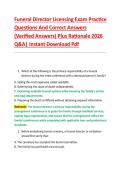
Funeral Director Licensing Exam Practice
Questions And Correct Answers
(Verified Answers) Plus Rationale 2026
Q&A| Instant Download Pdf
1. Which of the following is the primary responsibility of a funeral
director during the initial conference with a deceased person's family?
A. Selling the most expensive casket available
B. Determining the cause of death independently
C. Explaining available funeral options while honoring the family's wishes
and legal requirements
D. Preparing the death certificate without obtaining required information
Rationale: The funeral director's primary responsibility during the
arrangement conference is to guide the family through available services,
explain legal requirements, and ensure that the arrangements reflect the
family's preferences while complying with applicable laws and professional
standards.
2. Before embalming human remains, a funeral director or embalmer
should first verify that:
A. The cemetery has accepted the burial reservation.
B. The family has purchased a burial vault.
,C. Proper legal authorization has been obtained when required by law.
D. An obituary has been published.
Rationale: Authorization requirements vary by jurisdiction, but embalming
generally requires legal authority or consent unless specifically exempted
by law. Verification protects both the family and the funeral establishment.
3. The primary purpose of embalming is to:
A. Permanently preserve human remains.
B. Prevent all decomposition indefinitely.
C. Temporarily preserve, sanitize, and improve the appearance of the
deceased.
D. Eliminate the need for refrigeration.
Rationale: Embalming temporarily delays decomposition, reduces health
risks, and restores a natural appearance for viewing or funeral services. It is
not intended to permanently preserve remains.
4. Which federal regulation primarily protects consumers by requiring
funeral providers to disclose prices and prohibit deceptive practices?
A. Occupational Safety and Health Act
B. Funeral Rule
C. Fair Labor Standards Act
D. Clean Air Act
Rationale: The Funeral Rule requires funeral homes to provide accurate
pricing information, offer General Price Lists, and prevent unfair or
deceptive sales practices.
5. A General Price List (GPL) must generally be presented to the
consumer:
A. Only after a contract has been signed.
B. Only if cremation is selected.
,C. Only upon written request.
D. At the beginning of discussions regarding funeral arrangements.
Rationale: Consumers must receive the GPL at the appropriate point in the
arrangement process so they can make informed purchasing decisions
before selecting services.
6. Which document is generally used to officially record the legal facts
surrounding an individual's death?
A. Embalming report
B. Cemetery deed
C. Death certificate
D. Funeral program
Rationale: The death certificate serves as the official legal record of death
and is necessary for numerous legal, financial, and governmental purposes.
7. Universal precautions are primarily intended to:
A. Improve customer satisfaction.
B. Reduce funeral expenses.
C. Prevent exposure to bloodborne pathogens and infectious materials.
D. Eliminate the need for disinfectants.
Rationale: Universal precautions require treating all human blood and
bodily fluids as potentially infectious, reducing occupational exposure risks
for funeral personnel.
8. During restorative art, the primary objective is to:
A. Alter the deceased beyond recognition.
B. Restore a natural and recognizable appearance whenever possible.
C. Accelerate decomposition.
D. Replace embalming.
, Rationale: Restorative art helps return the deceased to a natural
appearance that provides comfort to surviving family members while
respecting the individual's identity.
9. Which communication skill is most important when meeting with
recently bereaved families?
A. Aggressive salesmanship
B. Technical medical terminology
C. Active listening with empathy and professionalism
D. Frequent interruption to maintain efficiency
Rationale: Active listening allows funeral directors to understand family
needs, provide compassionate guidance, and establish trust during an
emotionally difficult time.
10. A funeral director should refuse to engage in any practice that:
A. Increases paperwork.
B. Requires continuing education.
C. Reduces profits.
D. Violates ethical standards or applicable laws.
Rationale: Professional ethics require funeral directors to comply with all
applicable laws, maintain integrity, protect public trust, and avoid
fraudulent or unethical conduct.
11. Which of the following best describes the legal role of a funeral
director when handling human remains?
A. Determining medical cause of death
B. Ensuring compliance with all applicable laws and regulations governing
disposition of remains
Questions And Correct Answers
(Verified Answers) Plus Rationale 2026
Q&A| Instant Download Pdf
1. Which of the following is the primary responsibility of a funeral
director during the initial conference with a deceased person's family?
A. Selling the most expensive casket available
B. Determining the cause of death independently
C. Explaining available funeral options while honoring the family's wishes
and legal requirements
D. Preparing the death certificate without obtaining required information
Rationale: The funeral director's primary responsibility during the
arrangement conference is to guide the family through available services,
explain legal requirements, and ensure that the arrangements reflect the
family's preferences while complying with applicable laws and professional
standards.
2. Before embalming human remains, a funeral director or embalmer
should first verify that:
A. The cemetery has accepted the burial reservation.
B. The family has purchased a burial vault.
,C. Proper legal authorization has been obtained when required by law.
D. An obituary has been published.
Rationale: Authorization requirements vary by jurisdiction, but embalming
generally requires legal authority or consent unless specifically exempted
by law. Verification protects both the family and the funeral establishment.
3. The primary purpose of embalming is to:
A. Permanently preserve human remains.
B. Prevent all decomposition indefinitely.
C. Temporarily preserve, sanitize, and improve the appearance of the
deceased.
D. Eliminate the need for refrigeration.
Rationale: Embalming temporarily delays decomposition, reduces health
risks, and restores a natural appearance for viewing or funeral services. It is
not intended to permanently preserve remains.
4. Which federal regulation primarily protects consumers by requiring
funeral providers to disclose prices and prohibit deceptive practices?
A. Occupational Safety and Health Act
B. Funeral Rule
C. Fair Labor Standards Act
D. Clean Air Act
Rationale: The Funeral Rule requires funeral homes to provide accurate
pricing information, offer General Price Lists, and prevent unfair or
deceptive sales practices.
5. A General Price List (GPL) must generally be presented to the
consumer:
A. Only after a contract has been signed.
B. Only if cremation is selected.
,C. Only upon written request.
D. At the beginning of discussions regarding funeral arrangements.
Rationale: Consumers must receive the GPL at the appropriate point in the
arrangement process so they can make informed purchasing decisions
before selecting services.
6. Which document is generally used to officially record the legal facts
surrounding an individual's death?
A. Embalming report
B. Cemetery deed
C. Death certificate
D. Funeral program
Rationale: The death certificate serves as the official legal record of death
and is necessary for numerous legal, financial, and governmental purposes.
7. Universal precautions are primarily intended to:
A. Improve customer satisfaction.
B. Reduce funeral expenses.
C. Prevent exposure to bloodborne pathogens and infectious materials.
D. Eliminate the need for disinfectants.
Rationale: Universal precautions require treating all human blood and
bodily fluids as potentially infectious, reducing occupational exposure risks
for funeral personnel.
8. During restorative art, the primary objective is to:
A. Alter the deceased beyond recognition.
B. Restore a natural and recognizable appearance whenever possible.
C. Accelerate decomposition.
D. Replace embalming.
, Rationale: Restorative art helps return the deceased to a natural
appearance that provides comfort to surviving family members while
respecting the individual's identity.
9. Which communication skill is most important when meeting with
recently bereaved families?
A. Aggressive salesmanship
B. Technical medical terminology
C. Active listening with empathy and professionalism
D. Frequent interruption to maintain efficiency
Rationale: Active listening allows funeral directors to understand family
needs, provide compassionate guidance, and establish trust during an
emotionally difficult time.
10. A funeral director should refuse to engage in any practice that:
A. Increases paperwork.
B. Requires continuing education.
C. Reduces profits.
D. Violates ethical standards or applicable laws.
Rationale: Professional ethics require funeral directors to comply with all
applicable laws, maintain integrity, protect public trust, and avoid
fraudulent or unethical conduct.
11. Which of the following best describes the legal role of a funeral
director when handling human remains?
A. Determining medical cause of death
B. Ensuring compliance with all applicable laws and regulations governing
disposition of remains