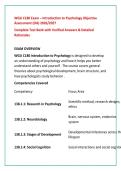
WGU C180 Exam – Introduction to Psychology Objective
Assessment (OA) 2026/2027
Complete Test Bank with Verified Answers & Detailed
Rationales
EXAM OVERVIEW
WGU C180 Introduction to Psychology is designed to develop
an understanding of psychology and how it helps you better
understand others and yourself . The course covers general
theories about psychological development, brain structure, and
how psychologists study behavior .
Competencies Covered
Competency Focus Area
Scientific method, research designs,
138.1.1: Research in Psychology
ethics
Brain, nervous system, endocrine
138.1.2: Neurobiology
system
Developmental milestones across the
138.1.3: Stages of Development
lifespan
138.1.4: Social Cognition Social interactions and social cognitio
,Competency Focus Area
138.1.5: Behaviorism and Classical, operant, and observational
Learning Theories learning
138.1.6: Intelligence and
Intelligence and memory relationship
Memory
138.1.7: Emotion, Motivation, Major theories of emotion, motivatio
and Personality and personality
Exam Domain Weights
Domain Approximate Weight
Foundations of Psychology & Research Methods 15-20%
Biological Perspectives 15%
Theories of Memory & Learning 15%
Personality Development 15-20%
Social Psychology 10-15%
Psychological Disorders & Treatments 20-25%
,SECTION 1: RESEARCH IN PSYCHOLOGY (Competency 138.1.1)
Question 1: What is the formal definition of psychology?
A) The study of human evolution and cultural development
B) The scientific study of the mind and behavior
C) The analysis of social structures and group dynamics
D) The examination of brain structure and function only
Correct Answer: B
Rationale: Psychology is formally defined as the scientific
discipline that studies mental processes (thoughts, emotions,
perceptions) and observable behaviors . The key elements are
that it is "scientific" (based on empirical evidence) and covers
both internal mental life and external actions.
Key Concept: Psychology is the scientific study of behavior and
mental processes.
Difficulty: Easy
Question 2: Which philosopher proposed the idea that the
mind and body are separate entities that interact, known as
dualism?
A) Aristotle
B) Plato
C) René Descartes
D) John Locke
, Correct Answer: C
Rationale: Descartes proposed mind-body dualism, arguing
that the mind (non-physical) and body (physical) are separate
but interact via the pineal gland . Aristotle and Plato had
different views on the soul, and Locke was an empiricist who
rejected innate ideas .
Key Concept: Descartes introduced mind-body dualism.
Difficulty: Easy
Question 3: The school of psychology that focused on
analyzing the mind by breaking it down into its smallest
components is called:
A) Functionalism
B) Structuralism
C) Gestalt Psychology
D) Behaviorism
Correct Answer: B
Rationale: Structuralism, pioneered by Wilhelm Wundt and
Edward Titchener, aimed to understand the mind by examining
its smallest and simplest components and how they fit together
to form complete experiences . This approach used
introspection as its primary method.
Key Concept: Structuralism breaks consciousness into its basic
elements.
Assessment (OA) 2026/2027
Complete Test Bank with Verified Answers & Detailed
Rationales
EXAM OVERVIEW
WGU C180 Introduction to Psychology is designed to develop
an understanding of psychology and how it helps you better
understand others and yourself . The course covers general
theories about psychological development, brain structure, and
how psychologists study behavior .
Competencies Covered
Competency Focus Area
Scientific method, research designs,
138.1.1: Research in Psychology
ethics
Brain, nervous system, endocrine
138.1.2: Neurobiology
system
Developmental milestones across the
138.1.3: Stages of Development
lifespan
138.1.4: Social Cognition Social interactions and social cognitio
,Competency Focus Area
138.1.5: Behaviorism and Classical, operant, and observational
Learning Theories learning
138.1.6: Intelligence and
Intelligence and memory relationship
Memory
138.1.7: Emotion, Motivation, Major theories of emotion, motivatio
and Personality and personality
Exam Domain Weights
Domain Approximate Weight
Foundations of Psychology & Research Methods 15-20%
Biological Perspectives 15%
Theories of Memory & Learning 15%
Personality Development 15-20%
Social Psychology 10-15%
Psychological Disorders & Treatments 20-25%
,SECTION 1: RESEARCH IN PSYCHOLOGY (Competency 138.1.1)
Question 1: What is the formal definition of psychology?
A) The study of human evolution and cultural development
B) The scientific study of the mind and behavior
C) The analysis of social structures and group dynamics
D) The examination of brain structure and function only
Correct Answer: B
Rationale: Psychology is formally defined as the scientific
discipline that studies mental processes (thoughts, emotions,
perceptions) and observable behaviors . The key elements are
that it is "scientific" (based on empirical evidence) and covers
both internal mental life and external actions.
Key Concept: Psychology is the scientific study of behavior and
mental processes.
Difficulty: Easy
Question 2: Which philosopher proposed the idea that the
mind and body are separate entities that interact, known as
dualism?
A) Aristotle
B) Plato
C) René Descartes
D) John Locke
, Correct Answer: C
Rationale: Descartes proposed mind-body dualism, arguing
that the mind (non-physical) and body (physical) are separate
but interact via the pineal gland . Aristotle and Plato had
different views on the soul, and Locke was an empiricist who
rejected innate ideas .
Key Concept: Descartes introduced mind-body dualism.
Difficulty: Easy
Question 3: The school of psychology that focused on
analyzing the mind by breaking it down into its smallest
components is called:
A) Functionalism
B) Structuralism
C) Gestalt Psychology
D) Behaviorism
Correct Answer: B
Rationale: Structuralism, pioneered by Wilhelm Wundt and
Edward Titchener, aimed to understand the mind by examining
its smallest and simplest components and how they fit together
to form complete experiences . This approach used
introspection as its primary method.
Key Concept: Structuralism breaks consciousness into its basic
elements.