

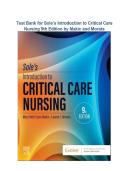
Test Bank for Sole's Introduction to Critical Care Nursing, 9th Edition by Mary Beth Flynn Makic & Lauren T. Morata
Test Bank for Sole's Introduction to Critical Care Nursing, 9th Edition by Mary Beth Flynn Makic & Lauren T. Morata Enhance your understanding of critical care nursing with this comprehensive study companion designed to reinforce the concepts presented in Sole's Introduction to Critical Care Nursing, 9th Edition by Mary Beth Flynn Makic and Lauren T. Morata. The 9th edition emphasizes evidence-based, patient-centered critical and progressive care nursing, incorporating updated clinical content, Next-Generation NCLEX (NGN)-style learning activities, and current best practices in intensive care. This study resource is intended for nursing students enrolled in critical care, adult health, progressive care, or advanced medical-surgical nursing courses. It provides an extensive collection of practice questions with detailed answer explanations that help learners reinforce classroom instruction, strengthen clinical reasoning, and improve confidence when caring for critically ill patients. The practice questions are designed to assess comprehension, application, analysis, and clinical judgment across a wide range of critical care topics. Rather than focusing solely on memorization, they encourage students to evaluate patient scenarios, identify priority nursing interventions, recognize life-threatening complications, interpret diagnostic findings, and apply evidence-based nursing care. Coverage aligns with the major concepts presented throughout the textbook, including: Foundations of critical and progressive care nursing Patient and family-centered care Ethical and legal considerations End-of-life and palliative care Organ donation Pain management, comfort, and sedation Nutritional support Dysrhythmia recognition and management Hemodynamic monitoring Mechanical ventilation and respiratory support Rapid response systems and code management Shock, sepsis, and multiple organ dysfunction syndrome Cardiovascular emergencies Neurological disorders Acute respiratory failure Acute kidney injury Hematologic and immune disorders Gastrointestinal disorders Endocrine emergencies Trauma and perioperative critical care Burn management and rehabilitation. Each practice question is accompanied by a detailed rationale explaining the correct response while discussing why the remaining options are less appropriate. This approach transforms every question into a valuable learning opportunity that promotes long-term retention and deeper understanding of critical care principles. Clinical judgment is emphasized throughout the resource. Students are challenged to prioritize nursing actions, interpret laboratory values, recognize deteriorating patient conditions, identify early warning signs of complications, and make safe, evidence-based clinical decisions. These competencies are essential for success in nursing education and future professional practice. The study guide also integrates pharmacology throughout the review. Questions reinforce medication indications, mechanisms of action, adverse reactions, contraindications, dosage considerations, nursing responsibilities, and patient education associated with commonly used critical care medications. High-alert medications, vasoactive drugs, anticoagulants, sedatives, analgesics, and emergency medications are reviewed within realistic patient scenarios. Patient safety remains a central theme. Learners review infection prevention strategies, isolation precautions, ventilator-associated pneumonia prevention, central line care, pressure injury prevention, fall prevention, medication safety, documentation standards, delegation, communication, and interdisciplinary collaboration. These concepts prepare students to provide safe and effective care within high-acuity healthcare environments. In addition to knowledge review, this resource promotes development of essential nursing competencies, including assessment, clinical decision-making, therapeutic communication, patient advocacy, and evidence-based practice. Students practice interpreting patient histories, recognizing abnormal findings, selecting appropriate interventions, and evaluating treatment outcomes. The question bank is suitable for self-study, instructor-led review, classroom discussions, and group learning sessions. Students can use it throughout the semester, during clinical rotations, or as part of comprehensive examination preparation. Working through practice questions systematically helps identify knowledge gaps while reinforcing key concepts before major nursing examinations. Because critical care nursing requires rapid assessment and timely intervention, repeated practice with scenario-based questions helps students build confidence and improve critical thinking under pressure. The detailed explanations encourage active learning rather than passive memorization, making this an effective companion for both academic coursework and professional development. Whether preparing for course examinations, standardized nursing assessments, or comprehensive nursing reviews, this study resource supports learners in mastering the essential concepts of critical and progressive care nursing. It complements textbook learning by encouraging application of theoretical knowledge to realistic clinical situations. Ideal for associate degree nursing (ADN), bachelor of science in nursing (BSN), accelerated BSN, and graduate nursing students, this resource serves as a valuable educational supplement that reinforces safe, evidence-based nursing practice while promoting professional growth and clinical excellence. Disclaimer: This product is provided as an independent educational study aid. It is not affiliated with, endorsed by, authorized by, or produced by Elsevier or the textbook authors. It does not contain or claim to contain official publisher test bank content or confidential exam materials. The practice questions are independently developed for educational and review purposes.
Document information
- Uploaded on
- July 30, 2026
- Number of pages
- 335
- Written in
- 2025/2026
- Type
- Exam (elaborations)
- Contains
- Questions & answers


