

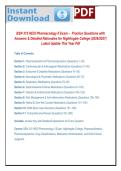
BSN 315 HESI Pharmacology II Exam – Practice Questions with
Answers & Detailed Rationales for Nightingale College (2026/2027)
Latest Update This Year Pdf
Table of Contents:
Section 1: Pharmacokinetics & Pharmacodynamics (Questions 1–20)
Section 2: Cardiovascular & Anticoagulant Medications (Questions 21–40)
Section 3: Endocrine & Diabetes Medications (Questions 41–55)
Section 4: Neurological & Psychiatric Medications (Questions 56–75)
Section 5: Respiratory Medications (Questions 76–90)
Section 6: Gastrointestinal & Renal Medications (Questions 91–105)
Section 7: Infection & Antimicrobial Medications (Questions 106–125)
Section 8: Pain Management & Anti-inflammatory Medications (Questions 126–140)
Section 9: Herbal & Over-the-Counter Medications (Questions 141–150)
Section 10: NGN-Style Case Scenarios (Questions 151–160)
Section 11: Comprehensive Review (Questions 161–200)
Includes: Answer Key with Detailed Explanations for Every Question
Covers: BSN 315 HESI Pharmacology II Exam, Nightingale College, Pharmacokinetics,
Pharmacodynamics, Drug Classifications, Medication Administration, and NGN Clinical
Judgment
,Section 1: Pharmacokinetics & Pharmacodynamics (Questions 1-20)
1. A client is prescribed a medication with a half-life of 4 days. Based on this half-life,
the medication will most likely be prescribed:
A) Once a day
B) Twice a day
C) Three times a day
D) Four times a day
Answer: A) Once a day
Explanation: Medications with long half-lives remain at therapeutic levels between doses for
extended periods, allowing for once-daily dosing .
2. A client being discharged home is prescribed an antibiotic with a dosage three
times higher than when administered in the hospital. Which route of administration is
associated with the greatest first-pass effect?
A) Oral
B) Sublingual
C) Intravenous
D) Subcutaneous
Answer: A) Oral
Explanation: Oral medications undergo extensive first-pass metabolism in the liver,
significantly reducing bioavailability before reaching systemic circulation .
3. The nurse is caring for a patient taking cimetidine (Tagamet) orally. Which should
the nurse consider regarding absorption?
A) It should be taken with food to enhance absorption
B) It should be taken on an empty stomach
,C) Antacids increase its absorption
D) It is not affected by gastric pH
Answer: B) It should be taken on an empty stomach
Explanation: Cimetidine absorption is reduced by food; it should be taken 1 hour before or 2
hours after meals .
4. A drug that acts as an agonist at a receptor will:
A) Block the receptor and produce no effect
B) Bind to the receptor and produce a maximal cellular response
C) Bind to the receptor and produce a partial response
D) Bind to an allosteric site and alter receptor conformation
Answer: B) Bind to the receptor and produce a maximal cellular response
Explanation: Agonists bind to receptors and activate them to produce a biological response .
5. The nurse understands that the therapeutic index of a drug is:
A) The ratio of the minimum effective dose to the maximum tolerated dose
B) The ratio of the lethal dose to the effective dose
C) The time required for the drug to reach steady state
D) The amount of drug that is bound to plasma proteins
Answer: B) The ratio of the lethal dose to the effective dose
Explanation: The therapeutic index is the ratio of the toxic dose to the therapeutic dose
(TD50/ED50). A narrow therapeutic index indicates a small margin of safety .
6. Which patient factor most significantly alters drug distribution in older adults?
A) Increased gastric motility
B) Decreased body water and increased adipose tissue
, C) Increased hepatic blood flow
D) Increased glomerular filtration rate
Answer: B) Decreased body water and increased adipose tissue
Explanation: Age-related changes lead to higher fat-to-water ratio, causing lipophilic drugs
to have prolonged half-lives .
7. A medication has a first-order elimination rate. This means:
A) A constant amount of drug is eliminated per unit time
B) A constant percentage of drug is eliminated per unit time
C) Elimination is independent of drug concentration
D) Elimination is saturable at therapeutic doses
Answer: B) A constant percentage of drug is eliminated per unit time
Explanation: First-order kinetics means a fixed fraction of the drug is eliminated per half-life .
8. A patient is prescribed a loading dose of digoxin. The primary purpose of a loading
dose is to:
A) Increase the half-life of the drug
B) Reduce the risk of adverse effects
C) Achieve therapeutic drug levels rapidly
D) Decrease the frequency of administration
Answer: C) Achieve therapeutic drug levels rapidly
Explanation: Loading doses are used when rapid onset of action is required before steady
state is reached .
9. The nurse monitors a patient for nephrotoxicity when administering which class of
antibiotics?
A) Penicillins
Answers & Detailed Rationales for Nightingale College (2026/2027)
Latest Update This Year Pdf
Table of Contents:
Section 1: Pharmacokinetics & Pharmacodynamics (Questions 1–20)
Section 2: Cardiovascular & Anticoagulant Medications (Questions 21–40)
Section 3: Endocrine & Diabetes Medications (Questions 41–55)
Section 4: Neurological & Psychiatric Medications (Questions 56–75)
Section 5: Respiratory Medications (Questions 76–90)
Section 6: Gastrointestinal & Renal Medications (Questions 91–105)
Section 7: Infection & Antimicrobial Medications (Questions 106–125)
Section 8: Pain Management & Anti-inflammatory Medications (Questions 126–140)
Section 9: Herbal & Over-the-Counter Medications (Questions 141–150)
Section 10: NGN-Style Case Scenarios (Questions 151–160)
Section 11: Comprehensive Review (Questions 161–200)
Includes: Answer Key with Detailed Explanations for Every Question
Covers: BSN 315 HESI Pharmacology II Exam, Nightingale College, Pharmacokinetics,
Pharmacodynamics, Drug Classifications, Medication Administration, and NGN Clinical
Judgment
,Section 1: Pharmacokinetics & Pharmacodynamics (Questions 1-20)
1. A client is prescribed a medication with a half-life of 4 days. Based on this half-life,
the medication will most likely be prescribed:
A) Once a day
B) Twice a day
C) Three times a day
D) Four times a day
Answer: A) Once a day
Explanation: Medications with long half-lives remain at therapeutic levels between doses for
extended periods, allowing for once-daily dosing .
2. A client being discharged home is prescribed an antibiotic with a dosage three
times higher than when administered in the hospital. Which route of administration is
associated with the greatest first-pass effect?
A) Oral
B) Sublingual
C) Intravenous
D) Subcutaneous
Answer: A) Oral
Explanation: Oral medications undergo extensive first-pass metabolism in the liver,
significantly reducing bioavailability before reaching systemic circulation .
3. The nurse is caring for a patient taking cimetidine (Tagamet) orally. Which should
the nurse consider regarding absorption?
A) It should be taken with food to enhance absorption
B) It should be taken on an empty stomach
,C) Antacids increase its absorption
D) It is not affected by gastric pH
Answer: B) It should be taken on an empty stomach
Explanation: Cimetidine absorption is reduced by food; it should be taken 1 hour before or 2
hours after meals .
4. A drug that acts as an agonist at a receptor will:
A) Block the receptor and produce no effect
B) Bind to the receptor and produce a maximal cellular response
C) Bind to the receptor and produce a partial response
D) Bind to an allosteric site and alter receptor conformation
Answer: B) Bind to the receptor and produce a maximal cellular response
Explanation: Agonists bind to receptors and activate them to produce a biological response .
5. The nurse understands that the therapeutic index of a drug is:
A) The ratio of the minimum effective dose to the maximum tolerated dose
B) The ratio of the lethal dose to the effective dose
C) The time required for the drug to reach steady state
D) The amount of drug that is bound to plasma proteins
Answer: B) The ratio of the lethal dose to the effective dose
Explanation: The therapeutic index is the ratio of the toxic dose to the therapeutic dose
(TD50/ED50). A narrow therapeutic index indicates a small margin of safety .
6. Which patient factor most significantly alters drug distribution in older adults?
A) Increased gastric motility
B) Decreased body water and increased adipose tissue
, C) Increased hepatic blood flow
D) Increased glomerular filtration rate
Answer: B) Decreased body water and increased adipose tissue
Explanation: Age-related changes lead to higher fat-to-water ratio, causing lipophilic drugs
to have prolonged half-lives .
7. A medication has a first-order elimination rate. This means:
A) A constant amount of drug is eliminated per unit time
B) A constant percentage of drug is eliminated per unit time
C) Elimination is independent of drug concentration
D) Elimination is saturable at therapeutic doses
Answer: B) A constant percentage of drug is eliminated per unit time
Explanation: First-order kinetics means a fixed fraction of the drug is eliminated per half-life .
8. A patient is prescribed a loading dose of digoxin. The primary purpose of a loading
dose is to:
A) Increase the half-life of the drug
B) Reduce the risk of adverse effects
C) Achieve therapeutic drug levels rapidly
D) Decrease the frequency of administration
Answer: C) Achieve therapeutic drug levels rapidly
Explanation: Loading doses are used when rapid onset of action is required before steady
state is reached .
9. The nurse monitors a patient for nephrotoxicity when administering which class of
antibiotics?
A) Penicillins


