

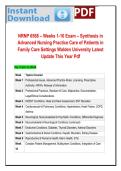
NRNP 6568 – Weeks 1-10 Exam – Synthesis in
Advanced Nursing Practice Care of Patients in
Family Care Settings Walden University Latest
Update This Year Pdf
Key Topics by Week
Week Topics Covered
Week 1 Professional Issues, Advanced Practice Roles, Licensing, Prescriptive
Authority, HIPAA, Release of Information
Week 2 Professional Practices, Standard of Care, Malpractice, Documentation,
Legal/Ethical Considerations
Week 3 HEENT Conditions, Head and Neck Assessment, ENT Disorders
Week 4 Cardiovascular & Pulmonary Conditions, Hypertension, Heart Failure, COPD,
Asthma
Week 5 Neurological, Musculoskeletal & Psychiatric Conditions, Differential Diagnosis
Week 6 Musculoskeletal & Neurological Conditions (continued)
Week 7 Endocrine Conditions, Diabetes, Thyroid Disorders, Adrenal Disorders
Week 8 Gastrointestinal & Renal Conditions, Hepatic Disorders, Kidney Disease
Week 9 Reproductive & Women's Health, Men's Health, STIs
Week Complex Patient Management, Multisystem Conditions, Integration of Care
10
,SECTION 1: WEEK 1 – PROFESSIONAL ISSUES (Questions 1-30)
1. What does DNP stand for in the context of advanced nursing practice?
A) Doctor of Nursing Profession
B) Doctor of Nursing Practice
C) Doctor of Nursing Philosophy
D) Doctor of Nursing Science
Answer: B. DNP stands for Doctor of Nursing Practice, which is the terminal degree for
advanced practice nurses.
2. Release of information (ROI) to third parties requires:
A) Authorization by the healthcare provider only
B) Authorization by the patient or their legal representative
C) A court order in all cases
D) No authorization if the information is requested by insurance
Answer: B. Release of information to third parties requires authorization by the patient or
their legal representative.
3. At what level of government is the role of the nurse practitioner defined?
A) Federal level
B) State level
C) Local level
D) International level
,Answer: B. The role of the nurse practitioner is defined at the state level through state
legislation and boards of nursing.
4. True or False: An NP must have a DNP to prescribe controlled substances.
A) True
B) False
Answer: B. False. An NP does not necessarily need a DNP to prescribe controlled
substances; this requirement varies by state.
5. A provider may be terribly negligent, but if there is no injury, there is no
malpractice. True or False?
A) True
B) False
Answer: A. True. Malpractice requires four elements: duty, breach of duty, causation, and
damages (injury). Without injury, there is no malpractice.
6. The role of the nurse practitioner (NP) is primarily regulated by which entity?
A) The American Nurses Association (ANA)
B) The National Council of State Boards of Nursing (NCSBN)
C) The state board of nursing
D) The Drug Enforcement Administration (DEA)
Answer: C. The state board of nursing regulates the scope of practice, licensure, and
prescriptive authority for nurse practitioners.
, 7. Which of the following is a key component of the standard of care for nurse
practitioners?
A) Practicing according to personal beliefs
B) Following institutional policies only
C) Providing care consistent with what a reasonably prudent NP would do in similar
circumstances
D) Delegating all clinical decisions to physicians
Answer: C. The standard of care is defined as the care that a reasonably prudent NP would
provide in similar circumstances.
8. The Health Insurance Portability and Accountability Act (HIPAA) primarily protects:
A) The NP's right to practice
B) Patient privacy and confidentiality
C) The hospital's financial interests
D) Insurance company profits
Answer: B. HIPAA protects patient privacy and confidentiality of health information.
9. Which of the following is considered a violation of HIPAA?
A) Discussing a patient's case with the treatment team
B) Leaving patient records in a public area
C) Obtaining patient consent for release of information
D) Using encrypted email for patient communication
Answer: B. Leaving patient records in a public area is a violation of HIPAA's privacy and
security rules.
Advanced Nursing Practice Care of Patients in
Family Care Settings Walden University Latest
Update This Year Pdf
Key Topics by Week
Week Topics Covered
Week 1 Professional Issues, Advanced Practice Roles, Licensing, Prescriptive
Authority, HIPAA, Release of Information
Week 2 Professional Practices, Standard of Care, Malpractice, Documentation,
Legal/Ethical Considerations
Week 3 HEENT Conditions, Head and Neck Assessment, ENT Disorders
Week 4 Cardiovascular & Pulmonary Conditions, Hypertension, Heart Failure, COPD,
Asthma
Week 5 Neurological, Musculoskeletal & Psychiatric Conditions, Differential Diagnosis
Week 6 Musculoskeletal & Neurological Conditions (continued)
Week 7 Endocrine Conditions, Diabetes, Thyroid Disorders, Adrenal Disorders
Week 8 Gastrointestinal & Renal Conditions, Hepatic Disorders, Kidney Disease
Week 9 Reproductive & Women's Health, Men's Health, STIs
Week Complex Patient Management, Multisystem Conditions, Integration of Care
10
,SECTION 1: WEEK 1 – PROFESSIONAL ISSUES (Questions 1-30)
1. What does DNP stand for in the context of advanced nursing practice?
A) Doctor of Nursing Profession
B) Doctor of Nursing Practice
C) Doctor of Nursing Philosophy
D) Doctor of Nursing Science
Answer: B. DNP stands for Doctor of Nursing Practice, which is the terminal degree for
advanced practice nurses.
2. Release of information (ROI) to third parties requires:
A) Authorization by the healthcare provider only
B) Authorization by the patient or their legal representative
C) A court order in all cases
D) No authorization if the information is requested by insurance
Answer: B. Release of information to third parties requires authorization by the patient or
their legal representative.
3. At what level of government is the role of the nurse practitioner defined?
A) Federal level
B) State level
C) Local level
D) International level
,Answer: B. The role of the nurse practitioner is defined at the state level through state
legislation and boards of nursing.
4. True or False: An NP must have a DNP to prescribe controlled substances.
A) True
B) False
Answer: B. False. An NP does not necessarily need a DNP to prescribe controlled
substances; this requirement varies by state.
5. A provider may be terribly negligent, but if there is no injury, there is no
malpractice. True or False?
A) True
B) False
Answer: A. True. Malpractice requires four elements: duty, breach of duty, causation, and
damages (injury). Without injury, there is no malpractice.
6. The role of the nurse practitioner (NP) is primarily regulated by which entity?
A) The American Nurses Association (ANA)
B) The National Council of State Boards of Nursing (NCSBN)
C) The state board of nursing
D) The Drug Enforcement Administration (DEA)
Answer: C. The state board of nursing regulates the scope of practice, licensure, and
prescriptive authority for nurse practitioners.
, 7. Which of the following is a key component of the standard of care for nurse
practitioners?
A) Practicing according to personal beliefs
B) Following institutional policies only
C) Providing care consistent with what a reasonably prudent NP would do in similar
circumstances
D) Delegating all clinical decisions to physicians
Answer: C. The standard of care is defined as the care that a reasonably prudent NP would
provide in similar circumstances.
8. The Health Insurance Portability and Accountability Act (HIPAA) primarily protects:
A) The NP's right to practice
B) Patient privacy and confidentiality
C) The hospital's financial interests
D) Insurance company profits
Answer: B. HIPAA protects patient privacy and confidentiality of health information.
9. Which of the following is considered a violation of HIPAA?
A) Discussing a patient's case with the treatment team
B) Leaving patient records in a public area
C) Obtaining patient consent for release of information
D) Using encrypted email for patient communication
Answer: B. Leaving patient records in a public area is a violation of HIPAA's privacy and
security rules.


