

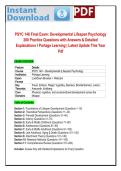
PSYC 140 Final Exam: Developmental Lifespan Psychology
200 Practice Questions with Answers & Detailed
Explanations I Portage Learning | Latest Update This Year
Pdf
EXAM OVERVIEW
Feature Details
Course PSYC 140 – Developmental (Lifespan) Psychology
Institution Portage Learning
Exam LockDown Browser + Webcam
Format
Key Freud, Erikson, Piaget, Vygotsky, Bandura, Bronfenbrenner, Lorenz,
Theorists Ainsworth, Kohlberg
Core Physical, cognitive, and socioemotional development across the
Domains lifespan
Table of Contents:
Section 1: Foundations of Lifespan Development (Questions 1–10)
Section 2: Theoretical Perspectives (Questions 11–30)
Section 3: Prenatal Development (Questions 31–40)
Section 4: Infancy (Questions 41–70)
Section 5: Early & Middle Childhood (Questions 71–80)
Section 6: Adolescence (Questions 81–90)
Section 7: Early & Middle Adulthood (Questions 91–100)
Section 8: Late Adulthood, Aging & Death (Questions 101–120)
Section 9: Attachment Theory (Questions 121–140)
Section 10: Research Methods (Questions 141–150)
Section 11: Comprehensive Review (Questions 151–200)
Includes: Answer Key with Detailed Explanations for Every Question
,Covers: PSYC 140 Final Exam, Lifespan Development, Freud, Erikson, Piaget, Vygotsky,
Attachment Theory, Prenatal Development, Infancy, Childhood, Adolescence, Adulthood,
Aging, and Death & Dying
SECTION 1: FOUNDATIONS OF LIFESPAN DEVELOPMENT (Questions 1-30)
1. Which of the following best defines lifespan development?
A) Changes that occur only during childhood and adolescence
B) Physical, social, cognitive, and emotional changes throughout human life
C) Only biological changes that occur with aging
D) Changes that occur only during the prenatal period
Answer: B) Physical, social, cognitive, and emotional changes throughout human life
Explanation: Lifespan development encompasses physical, social, cognitive, and emotional
changes that occur from conception to death .
2. Which of the following is a characteristic of lifespan development according to
modern developmental psychology?
A) It ends at adolescence
B) It is unidirectional and always positive
C) It is lifelong, multidirectional, multidimensional, and multidisciplinary
D) It only involves biological changes
,Answer: C) It is lifelong, multidirectional, multidimensional, and multidisciplinary
Explanation: Lifespan development is lifelong, multidirectional (changes can be positive or
negative), multidimensional (biological, social, emotional, cognitive), and multidisciplinary .
3. What is the difference between "aging" and "maturation"?
A) Aging is the process of becoming old; maturation is becoming more developed and
advanced
B) Aging and maturation are the same thing
C) Aging only occurs in late adulthood
D) Maturation only occurs in childhood
Answer: A) Aging is the process of becoming old; maturation is becoming more
developed and advanced
Explanation: Aging refers to the process of becoming old, while maturation involves
becoming more developed and advanced—brains and bodies mature .
4. Which of the following correctly lists the eight stages of lifespan development in
order?
A) Prenatal, Infancy, Early Childhood, Middle Childhood, Adolescence, Early Adulthood,
Middle Adulthood, Late Adulthood
B) Infancy, Toddlerhood, Early Childhood, Middle Childhood, Adolescence, Young
Adulthood, Middle Adulthood, Old Age
, C) Prenatal, Childhood, Adolescence, Adulthood, Old Age
D) Birth, Infancy, Childhood, Adolescence, Adulthood, Elderly
Answer: A) Prenatal, Infancy, Early Childhood, Middle Childhood, Adolescence, Early
Adulthood, Middle Adulthood, Late Adulthood
Explanation: The lifespan is divided into eight stages: Prenatal Development, Infancy and
Toddlerhood, Early Childhood, Middle Childhood, Adolescence, Early Adulthood, Middle
Adulthood, and Late Adulthood .
5. Development is considered "multidirectional" because:
A) It only occurs in one direction
B) It involves both gains and losses at various points in life
C) It only involves positive changes
D) It follows a single, predictable path
Answer: B) It involves both gains and losses at various points in life
Explanation: Multidirectional development means that change can be both positive and
negative—gains in one area may be accompanied by losses in another .
6. The "nature vs. nurture" debate in developmental psychology concerns:
A) Whether genetics or environment has a greater influence on development
B) Whether development is continuous or discontinuous
C) Whether development is universal or culture-specific
D) Whether development is biological or social
200 Practice Questions with Answers & Detailed
Explanations I Portage Learning | Latest Update This Year
EXAM OVERVIEW
Feature Details
Course PSYC 140 – Developmental (Lifespan) Psychology
Institution Portage Learning
Exam LockDown Browser + Webcam
Format
Key Freud, Erikson, Piaget, Vygotsky, Bandura, Bronfenbrenner, Lorenz,
Theorists Ainsworth, Kohlberg
Core Physical, cognitive, and socioemotional development across the
Domains lifespan
Table of Contents:
Section 1: Foundations of Lifespan Development (Questions 1–10)
Section 2: Theoretical Perspectives (Questions 11–30)
Section 3: Prenatal Development (Questions 31–40)
Section 4: Infancy (Questions 41–70)
Section 5: Early & Middle Childhood (Questions 71–80)
Section 6: Adolescence (Questions 81–90)
Section 7: Early & Middle Adulthood (Questions 91–100)
Section 8: Late Adulthood, Aging & Death (Questions 101–120)
Section 9: Attachment Theory (Questions 121–140)
Section 10: Research Methods (Questions 141–150)
Section 11: Comprehensive Review (Questions 151–200)
Includes: Answer Key with Detailed Explanations for Every Question
,Covers: PSYC 140 Final Exam, Lifespan Development, Freud, Erikson, Piaget, Vygotsky,
Attachment Theory, Prenatal Development, Infancy, Childhood, Adolescence, Adulthood,
Aging, and Death & Dying
SECTION 1: FOUNDATIONS OF LIFESPAN DEVELOPMENT (Questions 1-30)
1. Which of the following best defines lifespan development?
A) Changes that occur only during childhood and adolescence
B) Physical, social, cognitive, and emotional changes throughout human life
C) Only biological changes that occur with aging
D) Changes that occur only during the prenatal period
Answer: B) Physical, social, cognitive, and emotional changes throughout human life
Explanation: Lifespan development encompasses physical, social, cognitive, and emotional
changes that occur from conception to death .
2. Which of the following is a characteristic of lifespan development according to
modern developmental psychology?
A) It ends at adolescence
B) It is unidirectional and always positive
C) It is lifelong, multidirectional, multidimensional, and multidisciplinary
D) It only involves biological changes
,Answer: C) It is lifelong, multidirectional, multidimensional, and multidisciplinary
Explanation: Lifespan development is lifelong, multidirectional (changes can be positive or
negative), multidimensional (biological, social, emotional, cognitive), and multidisciplinary .
3. What is the difference between "aging" and "maturation"?
A) Aging is the process of becoming old; maturation is becoming more developed and
advanced
B) Aging and maturation are the same thing
C) Aging only occurs in late adulthood
D) Maturation only occurs in childhood
Answer: A) Aging is the process of becoming old; maturation is becoming more
developed and advanced
Explanation: Aging refers to the process of becoming old, while maturation involves
becoming more developed and advanced—brains and bodies mature .
4. Which of the following correctly lists the eight stages of lifespan development in
order?
A) Prenatal, Infancy, Early Childhood, Middle Childhood, Adolescence, Early Adulthood,
Middle Adulthood, Late Adulthood
B) Infancy, Toddlerhood, Early Childhood, Middle Childhood, Adolescence, Young
Adulthood, Middle Adulthood, Old Age
, C) Prenatal, Childhood, Adolescence, Adulthood, Old Age
D) Birth, Infancy, Childhood, Adolescence, Adulthood, Elderly
Answer: A) Prenatal, Infancy, Early Childhood, Middle Childhood, Adolescence, Early
Adulthood, Middle Adulthood, Late Adulthood
Explanation: The lifespan is divided into eight stages: Prenatal Development, Infancy and
Toddlerhood, Early Childhood, Middle Childhood, Adolescence, Early Adulthood, Middle
Adulthood, and Late Adulthood .
5. Development is considered "multidirectional" because:
A) It only occurs in one direction
B) It involves both gains and losses at various points in life
C) It only involves positive changes
D) It follows a single, predictable path
Answer: B) It involves both gains and losses at various points in life
Explanation: Multidirectional development means that change can be both positive and
negative—gains in one area may be accompanied by losses in another .
6. The "nature vs. nurture" debate in developmental psychology concerns:
A) Whether genetics or environment has a greater influence on development
B) Whether development is continuous or discontinuous
C) Whether development is universal or culture-specific
D) Whether development is biological or social


