

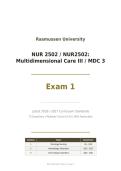
Rasmussen University
NUR 2502 / NUR2502:
Multidimensional Care III / MDC 3
Exam 1
Latest Curriculum Standards
75 Questions | Multiple Choice (A-D) | With Rationales
Section Topic Questions
1 Oncology Nursing Q1 - Q15
2 Hematologic Disorders Q16 - Q25
3 Immunologic Disorders Q26 - Q35
NUR 2502 MDC 3 Exam 1 | Page 1
, 4 Musculoskeletal Disorders Q36 - Q45
5 Integumentary Disorders Q46 - Q55
6 Sensory & Neurological Disorders Q56 - Q65
7 Integrated Clinical Scenarios Q66 - Q75
Cognitive Levels: 25% Recall | 55% Application | 20% Analysis
Question Styles: 70% Scenario-Based | 20% Direct Recall | 10% Clinical Judgment
NUR 2502 MDC 3 Exam 1 | Page 2
, Section 1: Oncology Nursing (Cancer Pathophysiology,
Staging, Treatment Modalities, & Nursing Care)
Q1: A nurse is caring for a client diagnosed with stage III breast cancer. The client
asks the nurse what 'stage III' means. Which of the following is the most accurate
response by the nurse?
A. "The cancer cells are well-differentiated and localized to one area."
B. "The tumor is larger, may have spread to nearby lymph nodes, but has not
metastasized to distant organs." **[CORRECT]**
C. "The cancer has spread extensively to distant organs such as the liver or lungs."
D. "Stage III means the cancer is in situ and has not invaded surrounding tissue."
Correct Answer: B
Rationale: Stage III cancer indicates a more advanced tumor that is larger in size and may have spread to
nearby lymph nodes but has not yet metastasized to distant organs. Stages range from 0 (in situ) to IV
(distant metastasis). Option A describes a low-grade, early-stage tumor. Option C describes stage IV
disease with distant metastasis. Option D describes stage 0 or carcinoma in situ. Understanding TNM
staging is essential for MDC 3 oncology nursing competency at Rasmussen University.
Q2: A client with cancer is scheduled to receive external beam radiation therapy.
The nurse teaches the client about potential side effects. Which statement by the
client indicates a need for further teaching?
A. "I may experience fatigue during the course of treatment."
B. "I should apply a warm heating pad to the treatment area to soothe skin
irritation." **[CORRECT]**
C. "I should protect the treated skin from sun exposure."
D. "I may notice skin changes such as redness or dryness in the treatment area."
Correct Answer: B
Rationale: The client should NOT apply heat (warm heating pads) to radiation-treated skin, as this can
exacerbate skin damage and increase tissue irritation. Radiation therapy causes local skin reactions
including erythema, dryness, moist desquamation, and fatigue. Clients should protect skin from sun
exposure, avoid tight clothing, use mild soap, and follow the radiation oncologist's specific skin care
protocol. Applying heat, cold, or abrasive substances to the treatment field is contraindicated. This aligns
with MDC 3 curriculum on radiation therapy nursing management at Rasmussen University.
Q3: A client receiving chemotherapy with doxorubicin (Adriamycin) reports
shortness of breath and ankle edema. The nurse recognizes these symptoms as
potential signs of which condition?
A. Hemorrhagic cystitis
B. Neurotoxicity
C. Cardiotoxicity **[CORRECT]**
D. Nephrotoxicity
Correct Answer: C
Rationale: Doxorubicin is known for its cumulative, dose-dependent cardiotoxicity, which can lead to
cardiomyopathy and congestive heart failure. Symptoms include shortness of breath, fatigue, ankle
edema, and dyspnea on exertion. Hemorrhagic cystitis is associated with cyclophosphamide.
Neurotoxicity (peripheral neuropathy) is associated with vincristine, vinblastine, and paclitaxel.
NUR 2502 MDC 3 Exam 1 | Page 3
NUR 2502 / NUR2502:
Multidimensional Care III / MDC 3
Exam 1
Latest Curriculum Standards
75 Questions | Multiple Choice (A-D) | With Rationales
Section Topic Questions
1 Oncology Nursing Q1 - Q15
2 Hematologic Disorders Q16 - Q25
3 Immunologic Disorders Q26 - Q35
NUR 2502 MDC 3 Exam 1 | Page 1
, 4 Musculoskeletal Disorders Q36 - Q45
5 Integumentary Disorders Q46 - Q55
6 Sensory & Neurological Disorders Q56 - Q65
7 Integrated Clinical Scenarios Q66 - Q75
Cognitive Levels: 25% Recall | 55% Application | 20% Analysis
Question Styles: 70% Scenario-Based | 20% Direct Recall | 10% Clinical Judgment
NUR 2502 MDC 3 Exam 1 | Page 2
, Section 1: Oncology Nursing (Cancer Pathophysiology,
Staging, Treatment Modalities, & Nursing Care)
Q1: A nurse is caring for a client diagnosed with stage III breast cancer. The client
asks the nurse what 'stage III' means. Which of the following is the most accurate
response by the nurse?
A. "The cancer cells are well-differentiated and localized to one area."
B. "The tumor is larger, may have spread to nearby lymph nodes, but has not
metastasized to distant organs." **[CORRECT]**
C. "The cancer has spread extensively to distant organs such as the liver or lungs."
D. "Stage III means the cancer is in situ and has not invaded surrounding tissue."
Correct Answer: B
Rationale: Stage III cancer indicates a more advanced tumor that is larger in size and may have spread to
nearby lymph nodes but has not yet metastasized to distant organs. Stages range from 0 (in situ) to IV
(distant metastasis). Option A describes a low-grade, early-stage tumor. Option C describes stage IV
disease with distant metastasis. Option D describes stage 0 or carcinoma in situ. Understanding TNM
staging is essential for MDC 3 oncology nursing competency at Rasmussen University.
Q2: A client with cancer is scheduled to receive external beam radiation therapy.
The nurse teaches the client about potential side effects. Which statement by the
client indicates a need for further teaching?
A. "I may experience fatigue during the course of treatment."
B. "I should apply a warm heating pad to the treatment area to soothe skin
irritation." **[CORRECT]**
C. "I should protect the treated skin from sun exposure."
D. "I may notice skin changes such as redness or dryness in the treatment area."
Correct Answer: B
Rationale: The client should NOT apply heat (warm heating pads) to radiation-treated skin, as this can
exacerbate skin damage and increase tissue irritation. Radiation therapy causes local skin reactions
including erythema, dryness, moist desquamation, and fatigue. Clients should protect skin from sun
exposure, avoid tight clothing, use mild soap, and follow the radiation oncologist's specific skin care
protocol. Applying heat, cold, or abrasive substances to the treatment field is contraindicated. This aligns
with MDC 3 curriculum on radiation therapy nursing management at Rasmussen University.
Q3: A client receiving chemotherapy with doxorubicin (Adriamycin) reports
shortness of breath and ankle edema. The nurse recognizes these symptoms as
potential signs of which condition?
A. Hemorrhagic cystitis
B. Neurotoxicity
C. Cardiotoxicity **[CORRECT]**
D. Nephrotoxicity
Correct Answer: C
Rationale: Doxorubicin is known for its cumulative, dose-dependent cardiotoxicity, which can lead to
cardiomyopathy and congestive heart failure. Symptoms include shortness of breath, fatigue, ankle
edema, and dyspnea on exertion. Hemorrhagic cystitis is associated with cyclophosphamide.
Neurotoxicity (peripheral neuropathy) is associated with vincristine, vinblastine, and paclitaxel.
NUR 2502 MDC 3 Exam 1 | Page 3


