
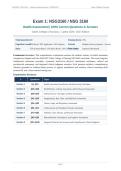
NSG3160 / NSG 3160 — Health Assessment Exam 1 (2026/2027) Galen College of Nursing
Exam 1: NSG3160 / NSG 3160
Health Assessment | 100% Correct Questions & Answers
Galen College of Nursing | Latest Edition
Total Questions:100 Passing Score: 70%
Cognitive Levels:
30% Recall / 50% Application / 20% Analysis Format: Multiple Choice (4 options, 1 correct)
Style: TimeAnalysis
75% Scenario-Based / 15% Direct Recall / 10% Clinical Limit: Instructor-Determined
Examination Overview: This comprehensive examination assesses the student's mastery of health assessment
competencies aligned with the 2026-2027 Galen College of Nursing NSG3160 curriculum. The exam integrates
foundational assessment principles, systematic head-to-toe physical examination techniques, cultural and
psychosocial assessment, and integrated clinical judgment scenarios. Each question includes a comprehensive
rationale grounded in evidence-based practice to support remediation and reinforce clinical reasoning skills
essential for safe, client-centered nursing care.
Examination Sections:
# Questions Topic
Section 1 Q1–Q15 Health Assessment Foundations and Interviewing Techniques
Section 2 Q16–Q28 Health History, Cultural Assessment, and Psychosocial Assessment
Section 3 Q29–Q40 General Survey, Vital Signs, and Pain Assessment
Section 4 Q41–Q50 Integumentary, Hair, Nails, and Head/Neck Assessment
Section 5 Q51–Q60 Thorax, Lungs, and Respiratory Assessment
Section 6 Q61–Q72 Cardiovascular and Peripheral Vascular Assessment
Section 7 Q73–Q82 Abdomen, Anus, Rectum, and Prostate Assessment
Section 8 Q83–Q90 Musculoskeletal, Neurological, and Cognitive Assessment
Section 9 Q91–Q100 Integrated Clinical Case Scenarios and Comprehensive Clinical Judgment
Page 1
,NSG3160 / NSG 3160 — Health Assessment Exam 1 (2026/2027) Galen College of Nursing
Section 1: Health Assessment Foundations and Interviewing
Techniques
Q1: A nurse is preparing to perform a comprehensive health assessment on a new client admitted to a
medical-surgical unit. Which statement best describes the primary purpose of conducting a
comprehensive health assessment?
A. To establish a medical diagnosis and prescribe appropriate pharmacological interventions for the client.
B. To gather holistic data that identifies the client's current health status, strengths, and potential or
actual health problems. [CORRECT]
C. To complete required admission documentation required by the Joint Commission within 24 hours of
arrival.
D. To validate the medical diagnosis already established by the attending healthcare provider.
Correct Answer: B
Rationale: The purpose of a health assessment is to collect holistic subjective and objective data to identify the client's
health status, strengths, and potential/actual problems — forming the foundation of the nursing process. Nursing
assessments do not establish medical diagnoses (option A) or prescribe medications, nor are they performed solely to
satisfy documentation requirements (option C) or to validate medical diagnoses (option D). The Galen NSG3160
curriculum emphasizes that assessment is the first step of the nursing process and drives all subsequent clinical
reasoning.
Q2: A 68-year-old client presents to the emergency department with acute, severe chest pain radiating
to the left arm. Which type of health assessment should the nurse perform first?
A. Comprehensive assessment to establish a complete baseline of the client's health status.
B. Focused assessment targeting the cardiovascular and respiratory systems and the client's pain.
C. Emergency assessment prioritizing ABC (airway, breathing, circulation) and level of consciousness.
[CORRECT]
D. Follow-up assessment to evaluate the effectiveness of previously administered nitroglycerin.
Correct Answer: C
Rationale: In a life-threatening situation such as suspected acute myocardial infarction, the nurse must perform an
EMERGENCY assessment beginning with ABCs (airway, breathing, circulation) and level of consciousness to identify
and stabilize immediately life-threatening problems. A comprehensive assessment (A) is inappropriate in emergencies
because it is too time-consuming. A focused assessment (B) follows stabilization. A follow-up assessment (D) is
reserved for evaluating response to interventions after they have been implemented. The 2026/2027 Galen curriculum
reinforces that emergency assessments use a prioritized, rapid head-to-toe approach with ABCs as the primary
framework.
Page 2
,NSG3160 / NSG 3160 — Health Assessment Exam 1 (2026/2027) Galen College of Nursing
Q3: A nurse is interviewing a client who was recently diagnosed with type 2 diabetes mellitus. The
client states, "I just don't know how I'm going to manage all of this." Which response by the nurse
demonstrates the therapeutic communication technique of clarifying?
A. "Don't worry, you'll figure it out. Diabetes is very manageable these days."
B. "Are you saying you feel overwhelmed by the daily management of your diabetes?" [CORRECT]
C. "Why do you feel that way when there are so many resources available?"
D. "You should attend a diabetes education class — that's what most of my patients do."
Correct Answer: B
Rationale: Clarifying restates the client's message in different words to confirm understanding and encourage further
exploration — option B does this by checking the meaning of "manage all of this." Option A is false reassurance, a
non-therapeutic response that dismisses the client's concern. Option C uses a "why" question, which is non-therapeutic
because it puts the client on the defensive. Option D gives advice, which removes client autonomy. Galen NSG3160
emphasizes that therapeutic techniques (active listening, clarifying, paraphrasing, reflecting) build trust, whereas
non-therapeutic techniques block communication.
Q4: A nurse is conducting a follow-up assessment on a client who was started on an antihypertensive
medication two weeks ago. Which statement best describes the purpose of a follow-up assessment in
this context?
A. To collect a complete health history and perform a full physical examination for baseline data.
B. To evaluate the effectiveness of the intervention and identify any adverse effects or needed
adjustments. [CORRECT]
C. To identify life-threatening conditions using the ABC framework as a priority.
D. To assess only the body system directly related to the client's chief complaint at the urgent visit.
Correct Answer: B
Rationale: A follow-up assessment is conducted after an intervention to evaluate the effectiveness of that intervention,
identify any adverse effects, and determine whether adjustments to the plan of care are needed — making option B
correct. Option A describes a comprehensive assessment. Option C describes an emergency assessment. Option D
describes a focused assessment. Galen NSG3160 2026/2027 curriculum stresses that follow-up assessments close the
loop in the nursing process by allowing the nurse to evaluate outcomes against expected goals.
Q5: During the interview, the nurse asks the client, "Tell me about how your pain has been affecting
your daily activities." This is an example of which type of question?
A. Closed-ended question that requires a yes or no answer.
B. Open-ended question that encourages a detailed, descriptive response. [CORRECT]
C. Leading question that influences the client's answer.
D. Neutral question used to gather specific quantitative data.
Correct Answer: B
Rationale: Open-ended questions such as "Tell me about..." encourage the client to provide a detailed, descriptive
response in their own words, building rapport and uncovering rich subjective data. Closed-ended questions (A) elicit
short, specific responses (yes/no). A leading question (C) suggests the desired answer. Open-ended questions are not
primarily for quantitative data (D). Galen faculty recommend beginning interviews with open-ended questions and
transitioning to closed-ended questions to fill in specific data gaps.
Page 3
, NSG3160 / NSG 3160 — Health Assessment Exam 1 (2026/2027) Galen College of Nursing
Q6: A nurse is collecting a health history from a client who states, "The pain in my stomach started
suddenly last night after dinner." Using the OLDCARTS mnemonic, which element of the history of
present illness (HPI) does "suddenly" represent?
A. Location of the pain.
B. Duration of the pain.
C. Onset of the pain. [CORRECT]
D. Timing of the pain.
Correct Answer: C
Rationale: In OLDCARTS, "O" stands for Onset — when and how the symptom began, including whether it was
sudden or gradual. "Suddenly" describes the onset of the pain, making C correct. Location (A) refers to anatomical
site. Duration (B) refers to how long the symptom lasts. Timing (D) refers to the pattern or frequency (constant,
intermittent). OLDCARTS = Onset, Location, Duration, Character, Aggravating/Alleviating factors, Radiation,
Timing, Severity — and is the standardized HPI framework taught in Galen NSG3160.
Q7: When obtaining a client's past medical history (PMH), which information should the nurse
include?
A. Only the client's current medications and allergies to avoid information overload.
B. Childhood and adult illnesses, surgeries, hospitalizations, allergies, and current medications.
[CORRECT]
C. Genetic conditions affecting the client's parents, siblings, and grandparents.
D. The client's occupation, living situation, lifestyle, and substance use patterns.
Correct Answer: B
Rationale: The past medical history (PMH) documents childhood and adult illnesses, surgeries, hospitalizations,
allergies, and current medications — providing a complete picture of the client's medical background. Option A is
incomplete. Option C describes the family history (FH). Option D describes the social history (SH). The 2026/2027
Galen curriculum specifies that PMH is distinct from FH and SH, and a complete PMH is essential for identifying risk
factors and potential interactions.
Q8: A nurse is preparing to assess a client in the dorsal recumbent position. Which body system is
most appropriately assessed in this position?
A. The posterior thorax and lungs during posterior auscultation.
B. The cardiovascular system for apical pulse and heart sounds, as well as the abdominal examination.
[CORRECT]
C. The rectum and prostate gland for digital rectal examination.
D. The female reproductive system during a pelvic examination with stirrups.
Correct Answer: B
Rationale: The dorsal recumbent position (supine with knees flexed) is used to assess the cardiovascular system
(apical pulse, heart sounds) and the abdomen because it relaxes the abdominal muscles and provides easy access to
these areas. The posterior thorax (A) requires the client to sit upright or lean forward. The rectum and prostate (C)
require the Sims or knee-chest position. Pelvic examinations (D) require the lithotomy position. Galen NSG3160
expects students to know the appropriate client position for each body system assessment.
Page 4
Exam 1: NSG3160 / NSG 3160
Health Assessment | 100% Correct Questions & Answers
Galen College of Nursing | Latest Edition
Total Questions:100 Passing Score: 70%
Cognitive Levels:
30% Recall / 50% Application / 20% Analysis Format: Multiple Choice (4 options, 1 correct)
Style: TimeAnalysis
75% Scenario-Based / 15% Direct Recall / 10% Clinical Limit: Instructor-Determined
Examination Overview: This comprehensive examination assesses the student's mastery of health assessment
competencies aligned with the 2026-2027 Galen College of Nursing NSG3160 curriculum. The exam integrates
foundational assessment principles, systematic head-to-toe physical examination techniques, cultural and
psychosocial assessment, and integrated clinical judgment scenarios. Each question includes a comprehensive
rationale grounded in evidence-based practice to support remediation and reinforce clinical reasoning skills
essential for safe, client-centered nursing care.
Examination Sections:
# Questions Topic
Section 1 Q1–Q15 Health Assessment Foundations and Interviewing Techniques
Section 2 Q16–Q28 Health History, Cultural Assessment, and Psychosocial Assessment
Section 3 Q29–Q40 General Survey, Vital Signs, and Pain Assessment
Section 4 Q41–Q50 Integumentary, Hair, Nails, and Head/Neck Assessment
Section 5 Q51–Q60 Thorax, Lungs, and Respiratory Assessment
Section 6 Q61–Q72 Cardiovascular and Peripheral Vascular Assessment
Section 7 Q73–Q82 Abdomen, Anus, Rectum, and Prostate Assessment
Section 8 Q83–Q90 Musculoskeletal, Neurological, and Cognitive Assessment
Section 9 Q91–Q100 Integrated Clinical Case Scenarios and Comprehensive Clinical Judgment
Page 1
,NSG3160 / NSG 3160 — Health Assessment Exam 1 (2026/2027) Galen College of Nursing
Section 1: Health Assessment Foundations and Interviewing
Techniques
Q1: A nurse is preparing to perform a comprehensive health assessment on a new client admitted to a
medical-surgical unit. Which statement best describes the primary purpose of conducting a
comprehensive health assessment?
A. To establish a medical diagnosis and prescribe appropriate pharmacological interventions for the client.
B. To gather holistic data that identifies the client's current health status, strengths, and potential or
actual health problems. [CORRECT]
C. To complete required admission documentation required by the Joint Commission within 24 hours of
arrival.
D. To validate the medical diagnosis already established by the attending healthcare provider.
Correct Answer: B
Rationale: The purpose of a health assessment is to collect holistic subjective and objective data to identify the client's
health status, strengths, and potential/actual problems — forming the foundation of the nursing process. Nursing
assessments do not establish medical diagnoses (option A) or prescribe medications, nor are they performed solely to
satisfy documentation requirements (option C) or to validate medical diagnoses (option D). The Galen NSG3160
curriculum emphasizes that assessment is the first step of the nursing process and drives all subsequent clinical
reasoning.
Q2: A 68-year-old client presents to the emergency department with acute, severe chest pain radiating
to the left arm. Which type of health assessment should the nurse perform first?
A. Comprehensive assessment to establish a complete baseline of the client's health status.
B. Focused assessment targeting the cardiovascular and respiratory systems and the client's pain.
C. Emergency assessment prioritizing ABC (airway, breathing, circulation) and level of consciousness.
[CORRECT]
D. Follow-up assessment to evaluate the effectiveness of previously administered nitroglycerin.
Correct Answer: C
Rationale: In a life-threatening situation such as suspected acute myocardial infarction, the nurse must perform an
EMERGENCY assessment beginning with ABCs (airway, breathing, circulation) and level of consciousness to identify
and stabilize immediately life-threatening problems. A comprehensive assessment (A) is inappropriate in emergencies
because it is too time-consuming. A focused assessment (B) follows stabilization. A follow-up assessment (D) is
reserved for evaluating response to interventions after they have been implemented. The 2026/2027 Galen curriculum
reinforces that emergency assessments use a prioritized, rapid head-to-toe approach with ABCs as the primary
framework.
Page 2
,NSG3160 / NSG 3160 — Health Assessment Exam 1 (2026/2027) Galen College of Nursing
Q3: A nurse is interviewing a client who was recently diagnosed with type 2 diabetes mellitus. The
client states, "I just don't know how I'm going to manage all of this." Which response by the nurse
demonstrates the therapeutic communication technique of clarifying?
A. "Don't worry, you'll figure it out. Diabetes is very manageable these days."
B. "Are you saying you feel overwhelmed by the daily management of your diabetes?" [CORRECT]
C. "Why do you feel that way when there are so many resources available?"
D. "You should attend a diabetes education class — that's what most of my patients do."
Correct Answer: B
Rationale: Clarifying restates the client's message in different words to confirm understanding and encourage further
exploration — option B does this by checking the meaning of "manage all of this." Option A is false reassurance, a
non-therapeutic response that dismisses the client's concern. Option C uses a "why" question, which is non-therapeutic
because it puts the client on the defensive. Option D gives advice, which removes client autonomy. Galen NSG3160
emphasizes that therapeutic techniques (active listening, clarifying, paraphrasing, reflecting) build trust, whereas
non-therapeutic techniques block communication.
Q4: A nurse is conducting a follow-up assessment on a client who was started on an antihypertensive
medication two weeks ago. Which statement best describes the purpose of a follow-up assessment in
this context?
A. To collect a complete health history and perform a full physical examination for baseline data.
B. To evaluate the effectiveness of the intervention and identify any adverse effects or needed
adjustments. [CORRECT]
C. To identify life-threatening conditions using the ABC framework as a priority.
D. To assess only the body system directly related to the client's chief complaint at the urgent visit.
Correct Answer: B
Rationale: A follow-up assessment is conducted after an intervention to evaluate the effectiveness of that intervention,
identify any adverse effects, and determine whether adjustments to the plan of care are needed — making option B
correct. Option A describes a comprehensive assessment. Option C describes an emergency assessment. Option D
describes a focused assessment. Galen NSG3160 2026/2027 curriculum stresses that follow-up assessments close the
loop in the nursing process by allowing the nurse to evaluate outcomes against expected goals.
Q5: During the interview, the nurse asks the client, "Tell me about how your pain has been affecting
your daily activities." This is an example of which type of question?
A. Closed-ended question that requires a yes or no answer.
B. Open-ended question that encourages a detailed, descriptive response. [CORRECT]
C. Leading question that influences the client's answer.
D. Neutral question used to gather specific quantitative data.
Correct Answer: B
Rationale: Open-ended questions such as "Tell me about..." encourage the client to provide a detailed, descriptive
response in their own words, building rapport and uncovering rich subjective data. Closed-ended questions (A) elicit
short, specific responses (yes/no). A leading question (C) suggests the desired answer. Open-ended questions are not
primarily for quantitative data (D). Galen faculty recommend beginning interviews with open-ended questions and
transitioning to closed-ended questions to fill in specific data gaps.
Page 3
, NSG3160 / NSG 3160 — Health Assessment Exam 1 (2026/2027) Galen College of Nursing
Q6: A nurse is collecting a health history from a client who states, "The pain in my stomach started
suddenly last night after dinner." Using the OLDCARTS mnemonic, which element of the history of
present illness (HPI) does "suddenly" represent?
A. Location of the pain.
B. Duration of the pain.
C. Onset of the pain. [CORRECT]
D. Timing of the pain.
Correct Answer: C
Rationale: In OLDCARTS, "O" stands for Onset — when and how the symptom began, including whether it was
sudden or gradual. "Suddenly" describes the onset of the pain, making C correct. Location (A) refers to anatomical
site. Duration (B) refers to how long the symptom lasts. Timing (D) refers to the pattern or frequency (constant,
intermittent). OLDCARTS = Onset, Location, Duration, Character, Aggravating/Alleviating factors, Radiation,
Timing, Severity — and is the standardized HPI framework taught in Galen NSG3160.
Q7: When obtaining a client's past medical history (PMH), which information should the nurse
include?
A. Only the client's current medications and allergies to avoid information overload.
B. Childhood and adult illnesses, surgeries, hospitalizations, allergies, and current medications.
[CORRECT]
C. Genetic conditions affecting the client's parents, siblings, and grandparents.
D. The client's occupation, living situation, lifestyle, and substance use patterns.
Correct Answer: B
Rationale: The past medical history (PMH) documents childhood and adult illnesses, surgeries, hospitalizations,
allergies, and current medications — providing a complete picture of the client's medical background. Option A is
incomplete. Option C describes the family history (FH). Option D describes the social history (SH). The 2026/2027
Galen curriculum specifies that PMH is distinct from FH and SH, and a complete PMH is essential for identifying risk
factors and potential interactions.
Q8: A nurse is preparing to assess a client in the dorsal recumbent position. Which body system is
most appropriately assessed in this position?
A. The posterior thorax and lungs during posterior auscultation.
B. The cardiovascular system for apical pulse and heart sounds, as well as the abdominal examination.
[CORRECT]
C. The rectum and prostate gland for digital rectal examination.
D. The female reproductive system during a pelvic examination with stirrups.
Correct Answer: B
Rationale: The dorsal recumbent position (supine with knees flexed) is used to assess the cardiovascular system
(apical pulse, heart sounds) and the abdomen because it relaxes the abdominal muscles and provides easy access to
these areas. The posterior thorax (A) requires the client to sit upright or lean forward. The rectum and prostate (C)
require the Sims or knee-chest position. Pelvic examinations (D) require the lithotomy position. Galen NSG3160
expects students to know the appropriate client position for each body system assessment.
Page 4


