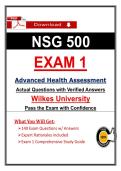
NSG 500
EXAM 1
Advanced Health Assessment
Actual Questions with Verified Answers
Wilkes University
Pass the Exam with Confidence
What You Will Get:
➢140 Exam Questions w/ Answers
➢Expert Rationales included
➢Exam 1 Comprehensive Study Guide
,Table of Contents
NSG 500 EXAM 1 ............................................................................ 2
NSG 500 EXAM 1 .......................................................................... 32
NSG 500 Exam 1 Study Guide .................................................... 63
NSG 500 EXAM 1
1. A nurse practitioner is conducting a comprehensive health history interview.
Which interview technique is considered the most effective for gathering
comprehensive subjective data?
A. Closed-ended questions to keep the interview structured
B. Open-ended questions to allow the patient to tell their story
C. Leading questions to guide the patient toward relevant information
D. Yes/no questions to save time during the assessment
Correct Answer: B
Rationale: Open-ended questions are the best interview technique because they encourage
patients to express their concerns in their own words, providing richer subjective data.
Closed-ended and yes/no questions limit the depth of information, while leading questions
may introduce bias. Open-ended questions are foundational to patient-centered care and
the subjective portion of the health history.
2. During a patient interview, the patient describes a symptom using terminology
that the nurse practitioner finds confusing. What is the most appropriate next step?
A. Document the statement verbatim and interpret it later
B. Ask clarifying questions to ensure accurate understanding
C. Assume the meaning based on common usage
D. Redirect the patient to a different topic to avoid confusion
Correct Answer: B
,Rationale: Clarifying questions are essential when patient statements are ambiguous or
confusing. This ensures accurate data collection and prevents misinterpretation.
Documenting verbatim without clarification (A) risks error, assuming meaning (C) is
unsafe, and redirecting (D) dismisses the patient's concerns and may miss critical
information.
3. Which term best describes the ability to understand and respond appropriately to
people from different cultures during a health assessment?
A. Cultural competence
B. Cultural sensitivity
C. Cultural assimilation
D. Cultural relativism
Correct Answer: B
Rationale: Cultural sensitivity refers to the awareness and ability to understand and
respond to individuals from diverse cultural backgrounds. While cultural competence (A) is
a broader concept encompassing knowledge, skills, and attitudes, cultural sensitivity
specifically addresses the interpersonal responsiveness required during patient
interactions. Cultural assimilation (C) and relativism (D) are anthropological concepts not
directly applicable to clinical assessment.
4. A nurse practitioner is caring for a diverse patient population. Which aspects of
care require particular attention to cultural sensitivity? (Select all that apply.)
A. Report of pain and pain management expectations
B. Acceptance of blood transfusions
C. Vaccination preferences for pediatric patients
D. Dietary restrictions and preferences
E. Vital sign measurement techniques
Correct Answers: A, B, C, D
Rationale: Cultural sensitivity is critical in pain assessment because cultural norms
influence pain expression and acceptable management goals (e.g., stoicism may mask pain).
Blood transfusions may be declined by Jehovah's Witnesses for religious reasons.
Vaccination acceptance varies across cultures. Dietary practices are deeply rooted in
cultural and religious traditions. Vital sign measurement (E) is a standardized technical
procedure not influenced by cultural factors.
, 5. During a health history, a patient from a different cultural background appears
stand-offish, becomes angry, or deflects questions. What should the nurse
practitioner consider first?
A. The patient is being noncompliant and uncooperative
B. The patient may be experiencing cognitive impairment
C. Cultural differences in emotional expression and communication styles
D. The patient requires a psychiatric referral
Correct Answer: C
Rationale: Emotional expression and communication styles vary significantly across
cultures. Behaviors that appear stand-offish, angry, or evasive may reflect cultural norms
rather than pathology or noncompliance. The nurse practitioner must first consider
cultural sensitivity before labeling behavior as problematic. Cognitive impairment (B) and
psychiatric referral (D) should only be considered after ruling out cultural and contextual
factors.
6. During a general physical examination (excluding the abdomen), what is the
correct sequence of assessment techniques?
A. Inspection, auscultation, palpation, percussion
B. Inspection, palpation, percussion, auscultation
C. Palpation, inspection, percussion, auscultation
D. Percussion, inspection, palpation, auscultation
Correct Answer: B
Rationale: The standard sequence for most body systems is inspection, palpation,
percussion, auscultation (IPPA). Inspection is always first to observe without altering the
patient's state. Palpation and percussion may alter bowel sounds or other findings, so
auscultation is performed last—except in abdominal assessment where the sequence
changes to prevent altering bowel sounds.
7. During an abdominal examination, what is the correct sequence of assessment
techniques?
A. Inspection, palpation, percussion, auscultation
B. Inspection, auscultation, palpation, percussion
EXAM 1
Advanced Health Assessment
Actual Questions with Verified Answers
Wilkes University
Pass the Exam with Confidence
What You Will Get:
➢140 Exam Questions w/ Answers
➢Expert Rationales included
➢Exam 1 Comprehensive Study Guide
,Table of Contents
NSG 500 EXAM 1 ............................................................................ 2
NSG 500 EXAM 1 .......................................................................... 32
NSG 500 Exam 1 Study Guide .................................................... 63
NSG 500 EXAM 1
1. A nurse practitioner is conducting a comprehensive health history interview.
Which interview technique is considered the most effective for gathering
comprehensive subjective data?
A. Closed-ended questions to keep the interview structured
B. Open-ended questions to allow the patient to tell their story
C. Leading questions to guide the patient toward relevant information
D. Yes/no questions to save time during the assessment
Correct Answer: B
Rationale: Open-ended questions are the best interview technique because they encourage
patients to express their concerns in their own words, providing richer subjective data.
Closed-ended and yes/no questions limit the depth of information, while leading questions
may introduce bias. Open-ended questions are foundational to patient-centered care and
the subjective portion of the health history.
2. During a patient interview, the patient describes a symptom using terminology
that the nurse practitioner finds confusing. What is the most appropriate next step?
A. Document the statement verbatim and interpret it later
B. Ask clarifying questions to ensure accurate understanding
C. Assume the meaning based on common usage
D. Redirect the patient to a different topic to avoid confusion
Correct Answer: B
,Rationale: Clarifying questions are essential when patient statements are ambiguous or
confusing. This ensures accurate data collection and prevents misinterpretation.
Documenting verbatim without clarification (A) risks error, assuming meaning (C) is
unsafe, and redirecting (D) dismisses the patient's concerns and may miss critical
information.
3. Which term best describes the ability to understand and respond appropriately to
people from different cultures during a health assessment?
A. Cultural competence
B. Cultural sensitivity
C. Cultural assimilation
D. Cultural relativism
Correct Answer: B
Rationale: Cultural sensitivity refers to the awareness and ability to understand and
respond to individuals from diverse cultural backgrounds. While cultural competence (A) is
a broader concept encompassing knowledge, skills, and attitudes, cultural sensitivity
specifically addresses the interpersonal responsiveness required during patient
interactions. Cultural assimilation (C) and relativism (D) are anthropological concepts not
directly applicable to clinical assessment.
4. A nurse practitioner is caring for a diverse patient population. Which aspects of
care require particular attention to cultural sensitivity? (Select all that apply.)
A. Report of pain and pain management expectations
B. Acceptance of blood transfusions
C. Vaccination preferences for pediatric patients
D. Dietary restrictions and preferences
E. Vital sign measurement techniques
Correct Answers: A, B, C, D
Rationale: Cultural sensitivity is critical in pain assessment because cultural norms
influence pain expression and acceptable management goals (e.g., stoicism may mask pain).
Blood transfusions may be declined by Jehovah's Witnesses for religious reasons.
Vaccination acceptance varies across cultures. Dietary practices are deeply rooted in
cultural and religious traditions. Vital sign measurement (E) is a standardized technical
procedure not influenced by cultural factors.
, 5. During a health history, a patient from a different cultural background appears
stand-offish, becomes angry, or deflects questions. What should the nurse
practitioner consider first?
A. The patient is being noncompliant and uncooperative
B. The patient may be experiencing cognitive impairment
C. Cultural differences in emotional expression and communication styles
D. The patient requires a psychiatric referral
Correct Answer: C
Rationale: Emotional expression and communication styles vary significantly across
cultures. Behaviors that appear stand-offish, angry, or evasive may reflect cultural norms
rather than pathology or noncompliance. The nurse practitioner must first consider
cultural sensitivity before labeling behavior as problematic. Cognitive impairment (B) and
psychiatric referral (D) should only be considered after ruling out cultural and contextual
factors.
6. During a general physical examination (excluding the abdomen), what is the
correct sequence of assessment techniques?
A. Inspection, auscultation, palpation, percussion
B. Inspection, palpation, percussion, auscultation
C. Palpation, inspection, percussion, auscultation
D. Percussion, inspection, palpation, auscultation
Correct Answer: B
Rationale: The standard sequence for most body systems is inspection, palpation,
percussion, auscultation (IPPA). Inspection is always first to observe without altering the
patient's state. Palpation and percussion may alter bowel sounds or other findings, so
auscultation is performed last—except in abdominal assessment where the sequence
changes to prevent altering bowel sounds.
7. During an abdominal examination, what is the correct sequence of assessment
techniques?
A. Inspection, palpation, percussion, auscultation
B. Inspection, auscultation, palpation, percussion