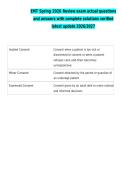
EMT Spring 2026 Review exam actual questions
and answers with complete solutions verified
latest update 2026/2027
Implied Consent Consent when a patient is too sick or
disoriented to consent or when a patient
refuses care and then becomes
unresponsive
Minor Consent Consent obtained by the parent or guardian of
an underage patient
Expressed Consent Consent given by an adult able to make rational
and informed decisions
,Involuntary Consent Consent that occurs with a mentally
incompetent adult or a patient in the custody
of law enforcement
Duty to act The obligation of the EMT to respond on scene
and provide emergency care to a patient
Simple Negligence When the EMT fails to perform care or makes a
mistake
Gross Negligence willful, wanton, or extremely reckless patient
care beyond negligent or careless
(intentional harm)
Abandonment Stopping care of a patient before transferring
care to another professional with the same
level of certification or higher
Assault Willful threat to inflict harm on a patient
Battery Touching a patient unlawfully without their
consent
Proximal Near the point of reference
Distal Far from the point of reference
, Inhalation Diaphragm and intercostal muscles contract
and diaphragm moves down creating negative
pressure and drawing air in
Exhalation Diaphragm and intercostal muscles relax and
diaphragm moves up creating positive
pressure and forcing air out
Respiration Physiological process of gas exchange in the
lungs. Also a process of heat loss.
Ventilation Mechanical process of moving air and in and
out of the lungs
Central Pulses 1. Carotid Pulse 2. Peripheral Pulse
and answers with complete solutions verified
latest update 2026/2027
Implied Consent Consent when a patient is too sick or
disoriented to consent or when a patient
refuses care and then becomes
unresponsive
Minor Consent Consent obtained by the parent or guardian of
an underage patient
Expressed Consent Consent given by an adult able to make rational
and informed decisions
,Involuntary Consent Consent that occurs with a mentally
incompetent adult or a patient in the custody
of law enforcement
Duty to act The obligation of the EMT to respond on scene
and provide emergency care to a patient
Simple Negligence When the EMT fails to perform care or makes a
mistake
Gross Negligence willful, wanton, or extremely reckless patient
care beyond negligent or careless
(intentional harm)
Abandonment Stopping care of a patient before transferring
care to another professional with the same
level of certification or higher
Assault Willful threat to inflict harm on a patient
Battery Touching a patient unlawfully without their
consent
Proximal Near the point of reference
Distal Far from the point of reference
, Inhalation Diaphragm and intercostal muscles contract
and diaphragm moves down creating negative
pressure and drawing air in
Exhalation Diaphragm and intercostal muscles relax and
diaphragm moves up creating positive
pressure and forcing air out
Respiration Physiological process of gas exchange in the
lungs. Also a process of heat loss.
Ventilation Mechanical process of moving air and in and
out of the lungs
Central Pulses 1. Carotid Pulse 2. Peripheral Pulse