
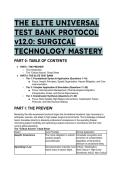
THE ELITE UNIVERSAL
TEST BANK PROTOCOL
v12.0: SURGICAL
TECHNOLOGY MASTERY
PART 0: TABLE OF CONTENTS
● PART I: THE PREVIEW
○ The Introduction
○ The "Critical Axioms" Cheat Sheet
● PART II: THE ELITE TEST BANK
○ Tier 1: Foundational Syntax & Application (Questions 1–10)
■ Focus: Aseptic Principles, Spatial Organization, Hazard Mitigation, and Core
Instrumentation.
○ Tier 2: Complex Application & Simulation (Questions 11–20)
■ Focus: Hemodynamic Management, Pharmacological Integration,
Intraoperative Crises, and Device Reprocessing.
○ Tier 3: Grandmaster Synthesis (Questions 21–30)
■ Focus: Multi-Variable High-Stakes Interventions, Catastrophic Failure
Protocols, and Elite Decision-Making.
PART I: THE PREVIEW
Mastering this elite assessment protocol forges the foundational academic rigor necessary to
anticipate, execute, and adapt in high-stakes surgical environments. The knowledge contained
herein translates directly to absolute professional competence in the operating theater,
minimizing patient morbidity and optimizing surgical outcomes in accordance with the most
current global standards.
The "Critical Axioms" Cheat Sheet
Axiom Core Principle Clinical Application
Aseptic Conscience The moral obligation to uphold Immediate recognition and
surgical asepsis correction of contamination,
unconditionally. regardless of hierarchical
pressure or procedural delay.
Spaulding’s Law Decontamination intensity must Critical = Sterilization;
match tissue invasion depth. Semi-Critical = High-Level
Disinfection (HLD); Non-Critical
,Axiom Core Principle Clinical Application
= Low-Level Disinfection.
Hazard Hierarchy Point-of-source extraction Surgical smoke requires
supersedes personal protective Ultra-Low Particulate Air
equipment. (ULPA) and carbon filtration at
the source; respirators serve
only as secondary defenses.
The Ischemic Threshold Pneumatic compression Strict adherence to maximum
induces time-dependent inflation parameters (Upper
hypoxic necrosis. limb: 60 min, Lower limb: 120
min) with calculated Limb
Occlusion Pressure (LOP).
Quantitative Resuscitation Pediatric fluid physiology lacks Utilization of the 4-2-1 rule with
adult compensatory reserves. isotonic balanced crystalloids to
prevent fatal dilutional
hyponatremia.
PART II: THE ELITE TEST BANK
Tier 1: Foundational Syntax & Application
Q1: During the setup for an exploratory laparotomy, the surgical technologist and circulating
nurse prepare to initiate the baseline surgical count. Based on the AST Standards of Practice
for surgical counts, which sequence is the MOST ACCURATE protocol for counting items on the
sterile field? A) Instruments, sponges, sharps, miscellaneous items B) Sponges, sharps,
miscellaneous items, instruments C) Sharps, sponges, instruments, miscellaneous items D)
Miscellaneous items, sponges, sharps, instruments
● Answer: B (Sponges, sharps, miscellaneous items, instruments)
● Distractor Analysis:
○ A is incorrect: Counting instruments first represents an inverted sequence; items
are counted from the highest risk of retention and smallest size to the largest.
○ C is incorrect: While sharps represent a high risk, standard protocol dictates that
absorbent soft goods (sponges) are counted prior to sharps.
○ D is incorrect: Miscellaneous items, such as vessel loops and umbilical tapes,
follow sponges and sharps in the procedural hierarchy.
The Mentor's Analysis: The sequence of the surgical count is a non-negotiable legal and
physiological safeguard designed to move systematically through items most likely to be
retained in a patient cavity. When establishing baseline accountability, the immediate priority is
tracking high-risk items using a standardized progression. By utilizing concurrent and audible
visualization in the exact sequence of sponges, sharps, miscellaneous items, and instruments,
the surgical team bypasses the common trap of count discrepancies that lead to retained
foreign bodies. Professional/Academic Intuition: Always count from the most immediate
risk of retention to the least, proceeding logically from the surgical field, to the Mayo
stand, to the back table, and finally to off-field items.
Q2: A surgeon excises a suspicious breast mass and requests an immediate intraoperative
diagnosis to determine margin status. Based on the principles of surgical pathology handling,
which action is the FIRST step the surgical technologist must take when preparing this
specimen for a frozen section? A) Place the tissue in a sterile container completely submerged
, in 10% neutral buffered formalin. B) Wrap the tissue tightly in an iodine-soaked sponge to
prevent cellular desiccation. C) Place the tissue in a dry, sterile container or on a Telfa pad
moistened with sterile saline, entirely free of chemical preservatives. D) Bisect the tissue on the
back table to ensure the pathologist receives the core of the lesion.
● Answer: C (Place the tissue in a dry, sterile container or on a Telfa pad moistened with
sterile saline, entirely free of chemical preservatives.)
● Distractor Analysis:
○ A is incorrect: Formalin fixes the tissue, altering its cellular structure and making it
impossible to freeze and section in the cryostat, which permanently ruins the
specimen for this specific diagnostic test.
○ B is incorrect: Iodine will chemically alter the tissue, interfering with histologic
staining protocols and diagnostic accuracy.
○ D is incorrect: The surgical technologist must never alter, cut, or bisect a specimen;
maintaining exact anatomical orientation is exclusively the domain of the surgeon or
pathologist.
The Mentor's Analysis: Frozen sections demand rapid freezing and microtome slicing for
immediate microscopic evaluation, requiring pristine, unaltered cellular architecture. When
facing a request for a frozen section, the immediate priority is preserving the tissue without
chemical fixation. By utilizing a fresh, unpreserved transfer protocol, the technologist bypasses
the common trap of permanently destroying cellular viability via inadvertent formalin exposure.
Professional/Academic Intuition: Formalin is fatal to frozen sections; all intraoperative
rapid diagnoses demand fresh, unpreserved tissue delivered immediately to the
pathology suite.
Q3: During an open cholecystectomy, the gastrointestinal tract is inadvertently entered, resulting
in localized, visible spillage of bile and gastric contents into the peritoneum. Based on the
Centers for Disease Control and Prevention (CDC) Surgical Wound Classification system, which
category is the MOST APPROPRIATE for this procedure? A) Class I (Clean) B) Class II
(Clean-Contaminated) C) Class III (Contaminated) D) Class IV (Dirty/Infected)
● Answer: C (Class III (Contaminated))
● Distractor Analysis:
○ A is incorrect: Class I wounds involve no entry into the respiratory, alimentary, or
genitourinary tracts and exhibit no breaks in sterile technique.
○ B is incorrect: A routine, uninfected biliary tract entry with no spillage is categorized
as Class II. Once visible spillage occurs, the classification instantly escalates.
○ D is incorrect: Class IV classification requires the presence of pre-existing clinical
infection, purulence, or a perforated viscus prior to the surgical incision.
The Mentor's Analysis: Wound classifications dictate postoperative infection surveillance and
prophylactic antibiotic management. When facing intraoperative spillage from a hollow viscus,
the immediate priority is recognizing the escalation of contamination risk. By utilizing the gross
spillage criteria to escalate the wound to Class III, the team bypasses the common trap of
under-classifying a compromised sterile field, which can lead to inadequate postoperative
surveillance. Professional/Academic Intuition: Controlled entry into a colonized tract is
Clean-Contaminated (Class II); gross, uncontrolled spillage instantly escalates the wound
to Contaminated (Class III).
Q4: A patient is undergoing a diagnostic bronchoscopy. The flexible bronchoscope comes into
direct contact with the patient’s intact respiratory mucous membranes. Based on the Spaulding
Classification system, what is the MINIMUM reprocessing standard required for this device? A)
Low-Level Disinfection (LLD) B) Intermediate-Level Disinfection (ILD) C) High-Level Disinfection
TEST BANK PROTOCOL
v12.0: SURGICAL
TECHNOLOGY MASTERY
PART 0: TABLE OF CONTENTS
● PART I: THE PREVIEW
○ The Introduction
○ The "Critical Axioms" Cheat Sheet
● PART II: THE ELITE TEST BANK
○ Tier 1: Foundational Syntax & Application (Questions 1–10)
■ Focus: Aseptic Principles, Spatial Organization, Hazard Mitigation, and Core
Instrumentation.
○ Tier 2: Complex Application & Simulation (Questions 11–20)
■ Focus: Hemodynamic Management, Pharmacological Integration,
Intraoperative Crises, and Device Reprocessing.
○ Tier 3: Grandmaster Synthesis (Questions 21–30)
■ Focus: Multi-Variable High-Stakes Interventions, Catastrophic Failure
Protocols, and Elite Decision-Making.
PART I: THE PREVIEW
Mastering this elite assessment protocol forges the foundational academic rigor necessary to
anticipate, execute, and adapt in high-stakes surgical environments. The knowledge contained
herein translates directly to absolute professional competence in the operating theater,
minimizing patient morbidity and optimizing surgical outcomes in accordance with the most
current global standards.
The "Critical Axioms" Cheat Sheet
Axiom Core Principle Clinical Application
Aseptic Conscience The moral obligation to uphold Immediate recognition and
surgical asepsis correction of contamination,
unconditionally. regardless of hierarchical
pressure or procedural delay.
Spaulding’s Law Decontamination intensity must Critical = Sterilization;
match tissue invasion depth. Semi-Critical = High-Level
Disinfection (HLD); Non-Critical
,Axiom Core Principle Clinical Application
= Low-Level Disinfection.
Hazard Hierarchy Point-of-source extraction Surgical smoke requires
supersedes personal protective Ultra-Low Particulate Air
equipment. (ULPA) and carbon filtration at
the source; respirators serve
only as secondary defenses.
The Ischemic Threshold Pneumatic compression Strict adherence to maximum
induces time-dependent inflation parameters (Upper
hypoxic necrosis. limb: 60 min, Lower limb: 120
min) with calculated Limb
Occlusion Pressure (LOP).
Quantitative Resuscitation Pediatric fluid physiology lacks Utilization of the 4-2-1 rule with
adult compensatory reserves. isotonic balanced crystalloids to
prevent fatal dilutional
hyponatremia.
PART II: THE ELITE TEST BANK
Tier 1: Foundational Syntax & Application
Q1: During the setup for an exploratory laparotomy, the surgical technologist and circulating
nurse prepare to initiate the baseline surgical count. Based on the AST Standards of Practice
for surgical counts, which sequence is the MOST ACCURATE protocol for counting items on the
sterile field? A) Instruments, sponges, sharps, miscellaneous items B) Sponges, sharps,
miscellaneous items, instruments C) Sharps, sponges, instruments, miscellaneous items D)
Miscellaneous items, sponges, sharps, instruments
● Answer: B (Sponges, sharps, miscellaneous items, instruments)
● Distractor Analysis:
○ A is incorrect: Counting instruments first represents an inverted sequence; items
are counted from the highest risk of retention and smallest size to the largest.
○ C is incorrect: While sharps represent a high risk, standard protocol dictates that
absorbent soft goods (sponges) are counted prior to sharps.
○ D is incorrect: Miscellaneous items, such as vessel loops and umbilical tapes,
follow sponges and sharps in the procedural hierarchy.
The Mentor's Analysis: The sequence of the surgical count is a non-negotiable legal and
physiological safeguard designed to move systematically through items most likely to be
retained in a patient cavity. When establishing baseline accountability, the immediate priority is
tracking high-risk items using a standardized progression. By utilizing concurrent and audible
visualization in the exact sequence of sponges, sharps, miscellaneous items, and instruments,
the surgical team bypasses the common trap of count discrepancies that lead to retained
foreign bodies. Professional/Academic Intuition: Always count from the most immediate
risk of retention to the least, proceeding logically from the surgical field, to the Mayo
stand, to the back table, and finally to off-field items.
Q2: A surgeon excises a suspicious breast mass and requests an immediate intraoperative
diagnosis to determine margin status. Based on the principles of surgical pathology handling,
which action is the FIRST step the surgical technologist must take when preparing this
specimen for a frozen section? A) Place the tissue in a sterile container completely submerged
, in 10% neutral buffered formalin. B) Wrap the tissue tightly in an iodine-soaked sponge to
prevent cellular desiccation. C) Place the tissue in a dry, sterile container or on a Telfa pad
moistened with sterile saline, entirely free of chemical preservatives. D) Bisect the tissue on the
back table to ensure the pathologist receives the core of the lesion.
● Answer: C (Place the tissue in a dry, sterile container or on a Telfa pad moistened with
sterile saline, entirely free of chemical preservatives.)
● Distractor Analysis:
○ A is incorrect: Formalin fixes the tissue, altering its cellular structure and making it
impossible to freeze and section in the cryostat, which permanently ruins the
specimen for this specific diagnostic test.
○ B is incorrect: Iodine will chemically alter the tissue, interfering with histologic
staining protocols and diagnostic accuracy.
○ D is incorrect: The surgical technologist must never alter, cut, or bisect a specimen;
maintaining exact anatomical orientation is exclusively the domain of the surgeon or
pathologist.
The Mentor's Analysis: Frozen sections demand rapid freezing and microtome slicing for
immediate microscopic evaluation, requiring pristine, unaltered cellular architecture. When
facing a request for a frozen section, the immediate priority is preserving the tissue without
chemical fixation. By utilizing a fresh, unpreserved transfer protocol, the technologist bypasses
the common trap of permanently destroying cellular viability via inadvertent formalin exposure.
Professional/Academic Intuition: Formalin is fatal to frozen sections; all intraoperative
rapid diagnoses demand fresh, unpreserved tissue delivered immediately to the
pathology suite.
Q3: During an open cholecystectomy, the gastrointestinal tract is inadvertently entered, resulting
in localized, visible spillage of bile and gastric contents into the peritoneum. Based on the
Centers for Disease Control and Prevention (CDC) Surgical Wound Classification system, which
category is the MOST APPROPRIATE for this procedure? A) Class I (Clean) B) Class II
(Clean-Contaminated) C) Class III (Contaminated) D) Class IV (Dirty/Infected)
● Answer: C (Class III (Contaminated))
● Distractor Analysis:
○ A is incorrect: Class I wounds involve no entry into the respiratory, alimentary, or
genitourinary tracts and exhibit no breaks in sterile technique.
○ B is incorrect: A routine, uninfected biliary tract entry with no spillage is categorized
as Class II. Once visible spillage occurs, the classification instantly escalates.
○ D is incorrect: Class IV classification requires the presence of pre-existing clinical
infection, purulence, or a perforated viscus prior to the surgical incision.
The Mentor's Analysis: Wound classifications dictate postoperative infection surveillance and
prophylactic antibiotic management. When facing intraoperative spillage from a hollow viscus,
the immediate priority is recognizing the escalation of contamination risk. By utilizing the gross
spillage criteria to escalate the wound to Class III, the team bypasses the common trap of
under-classifying a compromised sterile field, which can lead to inadequate postoperative
surveillance. Professional/Academic Intuition: Controlled entry into a colonized tract is
Clean-Contaminated (Class II); gross, uncontrolled spillage instantly escalates the wound
to Contaminated (Class III).
Q4: A patient is undergoing a diagnostic bronchoscopy. The flexible bronchoscope comes into
direct contact with the patient’s intact respiratory mucous membranes. Based on the Spaulding
Classification system, what is the MINIMUM reprocessing standard required for this device? A)
Low-Level Disinfection (LLD) B) Intermediate-Level Disinfection (ILD) C) High-Level Disinfection


