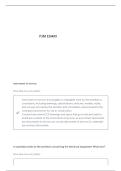
Instrument of service
Give this one a try later!
Instrument of service: Any tangible or intangible work by the architect or
consultants, including drawings, specifications, sketches, models, notes,
and surveys..Owned by the architect and consultants, and licensed to the
contractor and owner for use in construction
Contract documents (CD drawings and specs that go to bid and used to
build) are a subset of the instruments of service, so all contract documents
are instruments of service, but not all instruments of service (i.e. sketches)
are contract documents.
A submittal comes to the architect concerning the electrical equipment. What now?
Give this one a try later!
, The architect checks with the consultant-in this case, the MEP engineer-
before offering clarifications on submittals, change orders, and
construction change directives.
Want more review of
Warranties
Standard of Care
Indemnity
Certificate of substantial completion,
roof detailing,
told through a compelling story of a building collapse?
Give this one a try later!
Click here for the 1.25-hour video. https://www.youtube.com/watch?
v=HhzUHnvxV7w
When negotiating a contract in each of these roles, what is the single most important
priority (or single most significant goof) for
Owner
Architect
Contractor
.....
How does the architect's role in the contractor's application for payment differ in a
cost-plus-fixed-fee owner-contractor contract?
Give this one a try later!
Owner's number one problem: Insufficient insurance and insufficient
indemnity from third parties (like if the contractor injures someone walking
by the site)
Architect's number one problem: Over-involvement in means and methods
of construction
Contractor's number one problem: Cloudiness in payment processes
, See below
http://flashcards.amber-book.com/wp-content/uploads/2021/05/PjM-137-
210513-04-Schiff-Hardin-Lectures-Live-FC-055.mp4?_=1
On this project (as is often the case) applications for payment are made monthly. The
architect must walk the site and confirm that the contractor is billing for what was
actually purchased or built.
Approximately what percentage of the total bricks and mortar that will be needed for
this project were purchased and installed last month?
Give this one a try later!
A: 42%
From the schedule of values, the total cost of materials for
the bricks will be $300,000. $75,000 was purchased and
installed before, another $125,000 was purchased and
installed last month and $45,000 worth was purchased and
is stored on the site. . . so 81.67% of the total number of
bricks + mortar + scaffolding rental, etc. that will be
purchased has already been purchased. But the amount of
installed and completed materials just last month was
$125,000/$300,000 = 42%
Accessory space
Give this one a try later!
, A small space that might otherwise require classification as a different
occupancy group, but doesn't because it is less than 10% of a story's floor
area. For instance a small office in the corner of a factory floor doesn't
need to be classified as B (which might trigger a fire-rated wall
requirement), but can instead be classified the same as the rest of the
factory (F-1).
Joint venture
Give this one a try later!
When two companies make a temporary third company to win a
commission and build a project, with profits and risks shared between the
two parent companies.
What makes an effective work plan
Give this one a try later!
The project manager organizes the firm's efforts for the new
project: who will work on what, and when will they work on
it? She will record this in a "work plan," a short document
(two-ish pages), that includes a project description, the
deliverables, the team organization, a responsibility matrix,
a project schedule, a list of staffing needs, an internal
project budget and a profit plan.
What makes an effective work plan? From a quality
management (QM) point-of-view, work plans offer an
opportunity for continuous improvement, and you need to
have a structure-there's always a structure when following
QM practices. The four stages of an effective work plan
follow the "PDCA cycle" format, something that MBA
students learn, but I'm frankly not sure that adults need to
be taught this.
Give this one a try later!
Instrument of service: Any tangible or intangible work by the architect or
consultants, including drawings, specifications, sketches, models, notes,
and surveys..Owned by the architect and consultants, and licensed to the
contractor and owner for use in construction
Contract documents (CD drawings and specs that go to bid and used to
build) are a subset of the instruments of service, so all contract documents
are instruments of service, but not all instruments of service (i.e. sketches)
are contract documents.
A submittal comes to the architect concerning the electrical equipment. What now?
Give this one a try later!
, The architect checks with the consultant-in this case, the MEP engineer-
before offering clarifications on submittals, change orders, and
construction change directives.
Want more review of
Warranties
Standard of Care
Indemnity
Certificate of substantial completion,
roof detailing,
told through a compelling story of a building collapse?
Give this one a try later!
Click here for the 1.25-hour video. https://www.youtube.com/watch?
v=HhzUHnvxV7w
When negotiating a contract in each of these roles, what is the single most important
priority (or single most significant goof) for
Owner
Architect
Contractor
.....
How does the architect's role in the contractor's application for payment differ in a
cost-plus-fixed-fee owner-contractor contract?
Give this one a try later!
Owner's number one problem: Insufficient insurance and insufficient
indemnity from third parties (like if the contractor injures someone walking
by the site)
Architect's number one problem: Over-involvement in means and methods
of construction
Contractor's number one problem: Cloudiness in payment processes
, See below
http://flashcards.amber-book.com/wp-content/uploads/2021/05/PjM-137-
210513-04-Schiff-Hardin-Lectures-Live-FC-055.mp4?_=1
On this project (as is often the case) applications for payment are made monthly. The
architect must walk the site and confirm that the contractor is billing for what was
actually purchased or built.
Approximately what percentage of the total bricks and mortar that will be needed for
this project were purchased and installed last month?
Give this one a try later!
A: 42%
From the schedule of values, the total cost of materials for
the bricks will be $300,000. $75,000 was purchased and
installed before, another $125,000 was purchased and
installed last month and $45,000 worth was purchased and
is stored on the site. . . so 81.67% of the total number of
bricks + mortar + scaffolding rental, etc. that will be
purchased has already been purchased. But the amount of
installed and completed materials just last month was
$125,000/$300,000 = 42%
Accessory space
Give this one a try later!
, A small space that might otherwise require classification as a different
occupancy group, but doesn't because it is less than 10% of a story's floor
area. For instance a small office in the corner of a factory floor doesn't
need to be classified as B (which might trigger a fire-rated wall
requirement), but can instead be classified the same as the rest of the
factory (F-1).
Joint venture
Give this one a try later!
When two companies make a temporary third company to win a
commission and build a project, with profits and risks shared between the
two parent companies.
What makes an effective work plan
Give this one a try later!
The project manager organizes the firm's efforts for the new
project: who will work on what, and when will they work on
it? She will record this in a "work plan," a short document
(two-ish pages), that includes a project description, the
deliverables, the team organization, a responsibility matrix,
a project schedule, a list of staffing needs, an internal
project budget and a profit plan.
What makes an effective work plan? From a quality
management (QM) point-of-view, work plans offer an
opportunity for continuous improvement, and you need to
have a structure-there's always a structure when following
QM practices. The four stages of an effective work plan
follow the "PDCA cycle" format, something that MBA
students learn, but I'm frankly not sure that adults need to
be taught this.