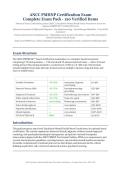
ANCC PMHNP Certification Exam
Complete Exam Pack · 120 Verified Items
American Nurses Credentialing Center (ANCC) | Psychiatric-Mental Health Nurse Practitioner Across the
Lifespan (PMHNP-BC™) | 2026/2027 Cycle
Advanced Assessment & Differential Diagnosis · Psychopharmacology · Psychotherapy Modalities · Crisis & Risk
Assessment
Trauma-Informed Care & Substance Use · Child/Adolescent & Geriatric Psychiatry · Legal-Ethical Standards ·
Cultural Humility & Health Equity
Entry-Level APRN Focus | Clinical Vignette, Application and Analysis Format | Guidelines Verified July 2026
Exam Structure
The ANCC PMHNP-BC™ board certification examination is a computer-based assessment
comprising 175 total questions — 150 scored and 25 unscored pretest items — with a 3.5-hour
testing period. The passing standard is a scaled score of 350 on a 0–500 scale. Item formats
include multiple-choice plus alternate formats such as multiple-response, drag-and-drop, and
chart or exhibit items.
ANCC Content Domain Blueprint Focus This Pack
Scientific Foundation ~20–22% Assessment, diagnosis, Q1–Q24
neurobiology
Advanced Practice Skills ~25–27% Psychopharmacology, Q25–Q46
prescribing
Diagnosis & Treatment ~22–25% Psychotherapy, interventions Q47–Q64
Ethics, Legal & Cultural Care ~15–17% Scope, law, equity Q65–Q80
Evaluation & Outcomes cross-cutting Monitoring, measurement Q81–Q92
Select-all-that-apply set — cross-domain Q93–Q100
Algorithm identification — cross-domain Q101–Q106
Clinical vignettes — cross-domain Q107–Q120
TOTAL IN THIS PACK 100% 120 items Q1–Q120
Introduction
This guide prepares entry-level Psychiatric-Mental Health Nurse Practitioners for national board
certification. The content emphasizes advanced clinical judgment, evidence-based diagnostic
reasoning, safe psychopharmacological management, and patient-centered therapeutic
interventions aligned with the ANCC PMHNP Test Content Outline, APNA core competencies, and
current clinical practice guidelines, ensuring learners can prioritize mental health assessments,
formulate comprehensive treatment plans across the lifespan, and demonstrate the critical
thinking required for safe, entry-level advanced practice psychiatric nursing.
ANCC Psychiatric-Mental Health Nurse Practitioner Certification · Complete Exam Pack · 2026–2027
,Domain 1 · Advanced Assessment & Differential Diagnosis
(Q1–Q24)
Question 1 (1 point · Multiple Choice)
A 24-year-old presents with 3 weeks of depressed mood, anhedonia, insomnia, and poor
concentration. Before initiating an antidepressant, which screening question is MOST essential?
A. Family history of hypertension
B. Any prior period of decreased need for sleep with elevated or irritable mood and
increased goal-directed activity ✓
C. Current caffeine intake
D. Preferred pharmacy
Correct Answer: B. Any prior period of decreased need for sleep with elevated or
irritable mood and increased goal-directed activity
Rationale: Screening for a past manic or hypomanic episode is mandatory before prescribing an
antidepressant, because unopposed antidepressant monotherapy in bipolar disorder can precipitate a manic
switch, mixed states, or cycle acceleration. Decreased need for sleep — feeling rested on very little sleep, as
distinct from insomnia with fatigue — is the most discriminating single symptom. Bipolar disorder is
frequently misdiagnosed as unipolar depression because patients present during depressive episodes and
rarely volunteer hypomanic history.
References: DSM-5-TR diagnostic criteria; CANMAT/ISBD guidelines; ANCC PMHNP Test Content Outline (2024/2026)
Domain 1.
Question 2 (1 point · Multiple Choice)
Which finding on mental status examination BEST distinguishes delirium from major
neurocognitive disorder (dementia)?
A. Impaired short-term memory
B. Acute onset with fluctuating level of attention ✓
C. Difficulty naming objects
D. Impaired executive function
Correct Answer: B. Acute onset with fluctuating level of attention
Rationale: Inattention with acute onset and a fluctuating course is the cardinal feature of delirium and the
key discriminator from dementia, which develops insidiously with attention preserved until late stages.
Delirium is always secondary to an underlying medical cause — infection, medication, metabolic derangement,
hypoxia, or withdrawal — and carries substantially increased mortality. The other options occur in both
conditions and do not discriminate.
References: DSM-5-TR diagnostic criteria; APA Practice Guidelines; ANCC PMHNP Test Content Outline (2024/2026)
Domain 1.
Question 3 (1 point · Multiple Choice)
A patient reports hearing voices commenting on their actions. Which additional assessment
element is MOST important for immediate safety?
A. Family history of schizophrenia
B. Whether the voices are command hallucinations and whether the patient feels
compelled to act on them ✓
ANCC Psychiatric-Mental Health Nurse Practitioner Certification · Complete Exam Pack · 2026–2027
, C. Age of symptom onset
D. Educational attainment
Correct Answer: B. Whether the voices are command hallucinations and whether the
patient feels compelled to act on them
Rationale: Command hallucinations directing self-harm or harm to others substantially elevate acute risk,
particularly when the patient perceives the voice as powerful, believes they must comply, or has complied
previously. The clinician must ask explicitly what the voices say, whether the patient intends to obey, and
whether means are available. The other items are diagnostically relevant but do not address immediate
danger.
References: APA Practice Guidelines schizophrenia guideline; ANCC PMHNP Test Content Outline (2024/2026) Domain
1.
Question 4 (1 point · Multiple Choice)
Which laboratory evaluation is MOST important before initiating lithium?
A. Liver function tests only
B. Renal function, thyroid function, electrolytes, pregnancy test, and baseline ECG in
patients with cardiac risk ✓
C. Serum lipid panel only
D. No baseline testing is required
Correct Answer: B. Renal function, thyroid function, electrolytes, pregnancy test, and
baseline ECG in patients with cardiac risk
Rationale: Lithium is renally cleared and both nephrotoxic and thyrotoxic over time, so baseline creatinine,
eGFR, TSH, and electrolytes are essential, along with a pregnancy test given the association with Ebstein
anomaly on first-trimester exposure. Because lithium can cause conduction abnormalities, an ECG is obtained
in patients over 40 or with cardiac risk factors. Valproate rather than lithium is the agent primarily requiring
baseline hepatic testing.
References: Lexicomp / Micromedex prescribing information; CANMAT/ISBD guidelines; ANCC PMHNP Test Content
Outline (2024/2026) Domain 1.
Question 5 (1 point · Multiple Choice)
A 7-year-old is referred for inattention. Which assessment element is REQUIRED before
diagnosing ADHD?
A. A single teacher report
B. Documentation of symptoms in two or more settings with onset before age 12 and
functional impairment ✓
C. Neuroimaging
D. A trial of stimulant medication
Correct Answer: B. Documentation of symptoms in two or more settings with onset
before age 12 and functional impairment
Rationale: DSM-5-TR requires that several symptoms be present before age 12, occur in two or more
settings such as home and school, and produce clear functional impairment. Multi-informant rating scales
from parents and teachers are standard. Neuroimaging has no role in routine diagnosis, and a medication trial
is never a diagnostic test — response to stimulants does not confirm ADHD, since stimulants improve attention
in people without the disorder.
References: DSM-5-TR diagnostic criteria; AACAP practice parameters ADHD parameter; ANCC PMHNP Test Content
Outline (2024/2026) Domain 1.
ANCC Psychiatric-Mental Health Nurse Practitioner Certification · Complete Exam Pack · 2026–2027
, Question 6 (1 point · Multiple Choice)
A patient presents with 6 months of excessive worry about multiple domains, muscle tension,
irritability, and sleep disturbance. The MOST likely diagnosis is:
A. Panic disorder
B. Generalized anxiety disorder ✓
C. Specific phobia
D. Obsessive-compulsive disorder
Correct Answer: B. Generalized anxiety disorder
Rationale: GAD requires excessive, difficult-to-control worry about multiple domains occurring more days
than not for at least 6 months, with at least three associated symptoms in adults — restlessness, fatigue, poor
concentration, irritability, muscle tension, or sleep disturbance. Panic disorder centers on discrete unexpected
panic attacks with anticipatory fear of recurrence, and OCD involves intrusive obsessions with compulsions
performed to reduce distress.
References: DSM-5-TR diagnostic criteria; APA Practice Guidelines; ANCC PMHNP Test Content Outline (2024/2026)
Domain 1.
Question 7 (1 point · Multiple Choice)
Which tool is MOST appropriate for standardized assessment of medication-induced abnormal
movements?
A. PHQ-9
B. AIMS (Abnormal Involuntary Movement Scale) ✓
C. GAD-7
D. MoCA
Correct Answer: B. AIMS (Abnormal Involuntary Movement Scale)
Rationale: The AIMS is the standard instrument for detecting and tracking tardive dyskinesia and other
involuntary movements, and should be performed at baseline and at least every 6 to 12 months for patients on
antipsychotics, more often for higher-risk patients. Early detection matters because tardive dyskinesia may
become irreversible. The PHQ-9 screens depression, GAD-7 anxiety, and MoCA cognition.
References: APA Practice Guidelines; ANCC PMHNP Test Content Outline (2024/2026) Domain 1.
Question 8 (1 point · Multiple Choice)
A patient with alcohol use disorder presents 12 hours after their last drink with tremor,
tachycardia, and diaphoresis. Which assessment instrument guides management?
A. AUDIT-C
B. CIWA-Ar ✓
C. CAGE
D. PHQ-9
Correct Answer: B. CIWA-Ar
Rationale: The Clinical Institute Withdrawal Assessment for Alcohol, revised, quantifies withdrawal severity
across ten domains and drives symptom-triggered benzodiazepine dosing, which reduces total medication
exposure and treatment duration compared with fixed schedules. AUDIT-C and CAGE are screening tools for
identifying problem drinking, not for managing active withdrawal. The clinician must also anticipate seizures
and delirium tremens, which typically emerge later, at 48 to 96 hours.
References: ASAM National Practice Guideline; ANCC PMHNP Test Content Outline (2024/2026) Domain 1.
ANCC Psychiatric-Mental Health Nurse Practitioner Certification · Complete Exam Pack · 2026–2027
Complete Exam Pack · 120 Verified Items
American Nurses Credentialing Center (ANCC) | Psychiatric-Mental Health Nurse Practitioner Across the
Lifespan (PMHNP-BC™) | 2026/2027 Cycle
Advanced Assessment & Differential Diagnosis · Psychopharmacology · Psychotherapy Modalities · Crisis & Risk
Assessment
Trauma-Informed Care & Substance Use · Child/Adolescent & Geriatric Psychiatry · Legal-Ethical Standards ·
Cultural Humility & Health Equity
Entry-Level APRN Focus | Clinical Vignette, Application and Analysis Format | Guidelines Verified July 2026
Exam Structure
The ANCC PMHNP-BC™ board certification examination is a computer-based assessment
comprising 175 total questions — 150 scored and 25 unscored pretest items — with a 3.5-hour
testing period. The passing standard is a scaled score of 350 on a 0–500 scale. Item formats
include multiple-choice plus alternate formats such as multiple-response, drag-and-drop, and
chart or exhibit items.
ANCC Content Domain Blueprint Focus This Pack
Scientific Foundation ~20–22% Assessment, diagnosis, Q1–Q24
neurobiology
Advanced Practice Skills ~25–27% Psychopharmacology, Q25–Q46
prescribing
Diagnosis & Treatment ~22–25% Psychotherapy, interventions Q47–Q64
Ethics, Legal & Cultural Care ~15–17% Scope, law, equity Q65–Q80
Evaluation & Outcomes cross-cutting Monitoring, measurement Q81–Q92
Select-all-that-apply set — cross-domain Q93–Q100
Algorithm identification — cross-domain Q101–Q106
Clinical vignettes — cross-domain Q107–Q120
TOTAL IN THIS PACK 100% 120 items Q1–Q120
Introduction
This guide prepares entry-level Psychiatric-Mental Health Nurse Practitioners for national board
certification. The content emphasizes advanced clinical judgment, evidence-based diagnostic
reasoning, safe psychopharmacological management, and patient-centered therapeutic
interventions aligned with the ANCC PMHNP Test Content Outline, APNA core competencies, and
current clinical practice guidelines, ensuring learners can prioritize mental health assessments,
formulate comprehensive treatment plans across the lifespan, and demonstrate the critical
thinking required for safe, entry-level advanced practice psychiatric nursing.
ANCC Psychiatric-Mental Health Nurse Practitioner Certification · Complete Exam Pack · 2026–2027
,Domain 1 · Advanced Assessment & Differential Diagnosis
(Q1–Q24)
Question 1 (1 point · Multiple Choice)
A 24-year-old presents with 3 weeks of depressed mood, anhedonia, insomnia, and poor
concentration. Before initiating an antidepressant, which screening question is MOST essential?
A. Family history of hypertension
B. Any prior period of decreased need for sleep with elevated or irritable mood and
increased goal-directed activity ✓
C. Current caffeine intake
D. Preferred pharmacy
Correct Answer: B. Any prior period of decreased need for sleep with elevated or
irritable mood and increased goal-directed activity
Rationale: Screening for a past manic or hypomanic episode is mandatory before prescribing an
antidepressant, because unopposed antidepressant monotherapy in bipolar disorder can precipitate a manic
switch, mixed states, or cycle acceleration. Decreased need for sleep — feeling rested on very little sleep, as
distinct from insomnia with fatigue — is the most discriminating single symptom. Bipolar disorder is
frequently misdiagnosed as unipolar depression because patients present during depressive episodes and
rarely volunteer hypomanic history.
References: DSM-5-TR diagnostic criteria; CANMAT/ISBD guidelines; ANCC PMHNP Test Content Outline (2024/2026)
Domain 1.
Question 2 (1 point · Multiple Choice)
Which finding on mental status examination BEST distinguishes delirium from major
neurocognitive disorder (dementia)?
A. Impaired short-term memory
B. Acute onset with fluctuating level of attention ✓
C. Difficulty naming objects
D. Impaired executive function
Correct Answer: B. Acute onset with fluctuating level of attention
Rationale: Inattention with acute onset and a fluctuating course is the cardinal feature of delirium and the
key discriminator from dementia, which develops insidiously with attention preserved until late stages.
Delirium is always secondary to an underlying medical cause — infection, medication, metabolic derangement,
hypoxia, or withdrawal — and carries substantially increased mortality. The other options occur in both
conditions and do not discriminate.
References: DSM-5-TR diagnostic criteria; APA Practice Guidelines; ANCC PMHNP Test Content Outline (2024/2026)
Domain 1.
Question 3 (1 point · Multiple Choice)
A patient reports hearing voices commenting on their actions. Which additional assessment
element is MOST important for immediate safety?
A. Family history of schizophrenia
B. Whether the voices are command hallucinations and whether the patient feels
compelled to act on them ✓
ANCC Psychiatric-Mental Health Nurse Practitioner Certification · Complete Exam Pack · 2026–2027
, C. Age of symptom onset
D. Educational attainment
Correct Answer: B. Whether the voices are command hallucinations and whether the
patient feels compelled to act on them
Rationale: Command hallucinations directing self-harm or harm to others substantially elevate acute risk,
particularly when the patient perceives the voice as powerful, believes they must comply, or has complied
previously. The clinician must ask explicitly what the voices say, whether the patient intends to obey, and
whether means are available. The other items are diagnostically relevant but do not address immediate
danger.
References: APA Practice Guidelines schizophrenia guideline; ANCC PMHNP Test Content Outline (2024/2026) Domain
1.
Question 4 (1 point · Multiple Choice)
Which laboratory evaluation is MOST important before initiating lithium?
A. Liver function tests only
B. Renal function, thyroid function, electrolytes, pregnancy test, and baseline ECG in
patients with cardiac risk ✓
C. Serum lipid panel only
D. No baseline testing is required
Correct Answer: B. Renal function, thyroid function, electrolytes, pregnancy test, and
baseline ECG in patients with cardiac risk
Rationale: Lithium is renally cleared and both nephrotoxic and thyrotoxic over time, so baseline creatinine,
eGFR, TSH, and electrolytes are essential, along with a pregnancy test given the association with Ebstein
anomaly on first-trimester exposure. Because lithium can cause conduction abnormalities, an ECG is obtained
in patients over 40 or with cardiac risk factors. Valproate rather than lithium is the agent primarily requiring
baseline hepatic testing.
References: Lexicomp / Micromedex prescribing information; CANMAT/ISBD guidelines; ANCC PMHNP Test Content
Outline (2024/2026) Domain 1.
Question 5 (1 point · Multiple Choice)
A 7-year-old is referred for inattention. Which assessment element is REQUIRED before
diagnosing ADHD?
A. A single teacher report
B. Documentation of symptoms in two or more settings with onset before age 12 and
functional impairment ✓
C. Neuroimaging
D. A trial of stimulant medication
Correct Answer: B. Documentation of symptoms in two or more settings with onset
before age 12 and functional impairment
Rationale: DSM-5-TR requires that several symptoms be present before age 12, occur in two or more
settings such as home and school, and produce clear functional impairment. Multi-informant rating scales
from parents and teachers are standard. Neuroimaging has no role in routine diagnosis, and a medication trial
is never a diagnostic test — response to stimulants does not confirm ADHD, since stimulants improve attention
in people without the disorder.
References: DSM-5-TR diagnostic criteria; AACAP practice parameters ADHD parameter; ANCC PMHNP Test Content
Outline (2024/2026) Domain 1.
ANCC Psychiatric-Mental Health Nurse Practitioner Certification · Complete Exam Pack · 2026–2027
, Question 6 (1 point · Multiple Choice)
A patient presents with 6 months of excessive worry about multiple domains, muscle tension,
irritability, and sleep disturbance. The MOST likely diagnosis is:
A. Panic disorder
B. Generalized anxiety disorder ✓
C. Specific phobia
D. Obsessive-compulsive disorder
Correct Answer: B. Generalized anxiety disorder
Rationale: GAD requires excessive, difficult-to-control worry about multiple domains occurring more days
than not for at least 6 months, with at least three associated symptoms in adults — restlessness, fatigue, poor
concentration, irritability, muscle tension, or sleep disturbance. Panic disorder centers on discrete unexpected
panic attacks with anticipatory fear of recurrence, and OCD involves intrusive obsessions with compulsions
performed to reduce distress.
References: DSM-5-TR diagnostic criteria; APA Practice Guidelines; ANCC PMHNP Test Content Outline (2024/2026)
Domain 1.
Question 7 (1 point · Multiple Choice)
Which tool is MOST appropriate for standardized assessment of medication-induced abnormal
movements?
A. PHQ-9
B. AIMS (Abnormal Involuntary Movement Scale) ✓
C. GAD-7
D. MoCA
Correct Answer: B. AIMS (Abnormal Involuntary Movement Scale)
Rationale: The AIMS is the standard instrument for detecting and tracking tardive dyskinesia and other
involuntary movements, and should be performed at baseline and at least every 6 to 12 months for patients on
antipsychotics, more often for higher-risk patients. Early detection matters because tardive dyskinesia may
become irreversible. The PHQ-9 screens depression, GAD-7 anxiety, and MoCA cognition.
References: APA Practice Guidelines; ANCC PMHNP Test Content Outline (2024/2026) Domain 1.
Question 8 (1 point · Multiple Choice)
A patient with alcohol use disorder presents 12 hours after their last drink with tremor,
tachycardia, and diaphoresis. Which assessment instrument guides management?
A. AUDIT-C
B. CIWA-Ar ✓
C. CAGE
D. PHQ-9
Correct Answer: B. CIWA-Ar
Rationale: The Clinical Institute Withdrawal Assessment for Alcohol, revised, quantifies withdrawal severity
across ten domains and drives symptom-triggered benzodiazepine dosing, which reduces total medication
exposure and treatment duration compared with fixed schedules. AUDIT-C and CAGE are screening tools for
identifying problem drinking, not for managing active withdrawal. The clinician must also anticipate seizures
and delirium tremens, which typically emerge later, at 48 to 96 hours.
References: ASAM National Practice Guideline; ANCC PMHNP Test Content Outline (2024/2026) Domain 1.
ANCC Psychiatric-Mental Health Nurse Practitioner Certification · Complete Exam Pack · 2026–2027