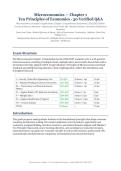
Microeconomics — Chapter 1
Ten Principles of Economics · 50 Verified Q&A
Microeconomics: Principles & Applications | Chapter 1 Comprehensive Assessment | 2026/2027 Edition
Scarcity & Resource Allocation · Opportunity Cost & Trade-offs · Marginal Analysis · Incentives & Behavioral
Responses
Gains from Trade · Market Efficiency & Equity · Role of Government · Productivity · Inflation · Short-Run
Phillips Curve
Undergraduate Business & Economics | Multiple-Choice, Scenario Analysis & Concept Application | 50
Questions · 60 Minutes
Exam Structure
The Microeconomics Chapter 1 Examination for the 2026/2027 academic cycle is a 50-question
timed assessment consisting of multiple-choice, multiple-select, and scenario-based items with a
60-minute time limit, aligned with N. Gregory Mankiw's Principles of Microeconomics test bank
standards and AACSB learning objectives. Item weighting below reflects the distribution used
throughout this pack.
Section Items Weighting Points
I — Scarcity, Trade-offs & Opportunity Cost Q1–Q10 10 items × 1 pt 10 pts
II — Marginal Thinking, Incentives & Interaction Q11–Q20 10 items × 1 pt 10 pts
III — The Economy as a Whole & Economic Q21–Q30 10 items × 1 pt 10 pts
Method
IV — Applied Models: PPF, Markets & Institutions Q31–Q38 8 items × 1 pt 8 pts
V — Multiple Select Q39–Q41 3 items × 2 pts 6 pts
VI — Diagram Identification (7 figures) Q42–Q48 7 items, 3–4 pts 25 pts
VII — Scenario Analysis Q49–Q50 2 items × 5 pts 10 pts
TOTAL 50 items — 79 pts
Introduction
This guide prepares undergraduate students on the foundational principles that shape economic
reasoning and decision-making. The content emphasizes scarcity analysis, opportunity cost
evaluation, marginal thinking, incentive structures, and market dynamics aligned with Mankiw's
Ten Principles framework, course learning objectives, and contemporary economic literature,
ensuring learners can apply core economic concepts to real-world scenarios, analyze trade-offs
systematically, and demonstrate competency in foundational microeconomic theory.
Microeconomics · Chapter 1: Ten Principles of Economics · Verified Q&A Pack · 2026–2027
,Section I · Scarcity, Trade-offs & Opportunity Cost (Q1–Q10)
Question 1 (1 point · Multiple Choice)
Economics is BEST defined as the study of:
A. How to make money in business
B. How society manages its scarce resources ✓
C. The behavior of the stock market
D. Government taxation and spending
Correct Answer: B. How society manages its scarce resources
Rationale: Mankiw defines economics as the study of how society manages its scarce resources — how
people decide what to buy, how much to work, and how much to save, and how firms and societies allocate
what they have. Finance, business management, and public finance are applications within or adjacent to
economics, but none captures the discipline's defining concern with allocation under scarcity.
References: Mankiw, Principles of Microeconomics, 10th/11th ed., Ch. 1; Course lecture materials, Chapter 1 unit.
Question 2 (1 point · Multiple Choice)
Scarcity exists because:
A. Governments restrict the supply of goods
B. Society has limited resources but essentially unlimited wants ✓
C. Some people are poor while others are wealthy
D. Firms deliberately restrict output to raise prices
Correct Answer: B. Society has limited resources but essentially unlimited wants
Rationale: Scarcity is the fundamental economic problem: resources — land, labor, capital,
entrepreneurship — are finite while human wants are effectively unlimited. It is a universal condition, not a
consequence of poverty, policy, or corporate behavior. Because scarcity forces choice, and every choice forgoes
an alternative, scarcity is what makes economics necessary at all.
References: Mankiw, Principles of Microeconomics, 10th/11th ed., Ch. 1; Course lecture materials, Chapter 1 unit.
Question 3 (1 point · Multiple Choice)
'There is no such thing as a free lunch' most directly illustrates which principle?
A. Trade can make everyone better off
B. People face trade-offs ✓
C. Markets are usually a good way to organize activity
D. People respond to incentives
Correct Answer: B. People face trade-offs
Rationale: The phrase captures Principle 1: to get one thing we usually have to give up another. Even a
lunch provided at no charge to the recipient consumes real resources — food, labor, time — that could have
been used elsewhere. Recognizing trade-offs does not by itself tell us what to decide, but no sound decision is
possible without acknowledging them.
References: Mankiw, Principles of Microeconomics, 10th/11th ed., Ch. 1; Course lecture materials, Chapter 1 unit.
Microeconomics · Chapter 1: Ten Principles of Economics · Verified Q&A Pack · 2026–2027
,Question 4 (1 point · Multiple Choice)
The classic trade-off between 'guns and butter' illustrates that:
A. Military spending always reduces economic growth
B. Resources devoted to national defense cannot simultaneously be used to produce
consumer goods ✓
C. Governments should not produce weapons
D. Consumer goods are more valuable than defense
Correct Answer: B. Resources devoted to national defense cannot simultaneously be used
to produce consumer goods
Rationale: The guns-and-butter example illustrates trade-offs at the societal level: with fixed resources,
more of one output necessarily means less of another. This is a positive statement about constraint, not a
normative claim about which choice is better — options C and D smuggle in value judgments the principle
itself does not make.
References: Mankiw, Principles of Microeconomics, 10th/11th ed., Ch. 1; Mankiw, Principles of Microeconomics,
10th/11th ed., Ch. 2.
Question 5 (1 point · Multiple Choice)
Society faces a trade-off between efficiency and equity. Equity means:
A. Getting the maximum output from scarce resources
B. Distributing economic prosperity fairly among members of society ✓
C. Equalizing all incomes exactly
D. Eliminating all taxation
Correct Answer: B. Distributing economic prosperity fairly among members of society
Rationale: Efficiency concerns the size of the economic pie; equity concerns how fairly it is divided. Note
that equity means fair distribution, not identical distribution — option C states a much stronger claim. Policies
such as progressive taxation and welfare transfers pursue equity but may blunt work incentives, which is
precisely why the two goals often conflict.
References: Mankiw, Principles of Microeconomics, 10th/11th ed., Ch. 1; Journal of Economic Perspectives research on
redistribution and incentives.
Question 6 (1 point · Multiple Choice)
The opportunity cost of an item is:
A. Its market price in dollars
B. What you give up to obtain it ✓
C. The cost of producing it
D. The sum of all money spent on it
Correct Answer: B. What you give up to obtain it
Rationale: Opportunity cost is the value of the best alternative forgone, which includes both explicit
monetary outlays and implicit costs such as time and forgone earnings. Because decision-makers rarely see
implicit costs on an invoice, they are routinely underweighted — and that omission is one of the most common
errors economic reasoning is designed to correct.
References: Mankiw, Principles of Microeconomics, 10th/11th ed., Ch. 1; Course lecture materials, Chapter 1 unit.
Microeconomics · Chapter 1: Ten Principles of Economics · Verified Q&A Pack · 2026–2027
, Question 7 (1 point · Multiple Choice)
A student pays $30,000 per year in tuition and forgoes a $40,000 salary to attend college full time.
The annual opportunity cost of attending is:
A. $30,000
B. $40,000
C. $70,000 ✓
D. $10,000
Correct Answer: C. $70,000
Rationale: Opportunity cost sums explicit and implicit costs: $30,000 of tuition plus $40,000 of forgone
earnings equals $70,000. Note what is deliberately excluded — room and board are generally not counted,
because the student would incur living expenses whether or not they attended college. Only costs that change
with the decision belong in the calculation.
References: Mankiw, Principles of Microeconomics, 10th/11th ed., Ch. 1; Course lecture materials, Chapter 1 unit.
Question 8 (1 point · Multiple Choice)
A sunk cost is BEST described as a cost that:
A. Will be incurred in the future if a project continues
B. Has already been incurred and cannot be recovered ✓
C. Varies directly with the level of output
D. Is shared between two parties
Correct Answer: B. Has already been incurred and cannot be recovered
Rationale: Because a sunk cost cannot be recovered regardless of what happens next, it should not influence
forward-looking decisions; only marginal costs and benefits are relevant. The persistent human tendency to
'throw good money after bad' — the sunk-cost fallacy — is a well-documented departure from this
prescription and a staple of behavioral economics.
References: Mankiw, Principles of Microeconomics, 10th/11th ed., Ch. 1; Journal of Economic Perspectives behavioral
economics literature.
Question 9 (1 point · Multiple Choice)
You have already paid $60 for a concert ticket that cannot be resold or refunded. On the night of
the concert you feel unwell. Economic reasoning says you should:
A. Attend anyway, because you already paid $60
B. Decide based only on whether attending now yields greater benefit than staying
home, ignoring the $60 ✓
C. Attend, since not attending wastes money
D. Attend only if you can sell the ticket
Correct Answer: B. Decide based only on whether attending now yields greater benefit
than staying home, ignoring the $60
Rationale: The $60 is sunk — it is gone whether you attend or not, so it cannot differ between the options
and must drop out of the comparison. The relevant question is purely marginal: given how you feel now, does
attending or resting deliver more benefit? Options A and C are textbook statements of the sunk-cost fallacy.
References: Mankiw, Principles of Microeconomics, 10th/11th ed., Ch. 1; Course lecture materials, Chapter 1 unit.
Microeconomics · Chapter 1: Ten Principles of Economics · Verified Q&A Pack · 2026–2027
Ten Principles of Economics · 50 Verified Q&A
Microeconomics: Principles & Applications | Chapter 1 Comprehensive Assessment | 2026/2027 Edition
Scarcity & Resource Allocation · Opportunity Cost & Trade-offs · Marginal Analysis · Incentives & Behavioral
Responses
Gains from Trade · Market Efficiency & Equity · Role of Government · Productivity · Inflation · Short-Run
Phillips Curve
Undergraduate Business & Economics | Multiple-Choice, Scenario Analysis & Concept Application | 50
Questions · 60 Minutes
Exam Structure
The Microeconomics Chapter 1 Examination for the 2026/2027 academic cycle is a 50-question
timed assessment consisting of multiple-choice, multiple-select, and scenario-based items with a
60-minute time limit, aligned with N. Gregory Mankiw's Principles of Microeconomics test bank
standards and AACSB learning objectives. Item weighting below reflects the distribution used
throughout this pack.
Section Items Weighting Points
I — Scarcity, Trade-offs & Opportunity Cost Q1–Q10 10 items × 1 pt 10 pts
II — Marginal Thinking, Incentives & Interaction Q11–Q20 10 items × 1 pt 10 pts
III — The Economy as a Whole & Economic Q21–Q30 10 items × 1 pt 10 pts
Method
IV — Applied Models: PPF, Markets & Institutions Q31–Q38 8 items × 1 pt 8 pts
V — Multiple Select Q39–Q41 3 items × 2 pts 6 pts
VI — Diagram Identification (7 figures) Q42–Q48 7 items, 3–4 pts 25 pts
VII — Scenario Analysis Q49–Q50 2 items × 5 pts 10 pts
TOTAL 50 items — 79 pts
Introduction
This guide prepares undergraduate students on the foundational principles that shape economic
reasoning and decision-making. The content emphasizes scarcity analysis, opportunity cost
evaluation, marginal thinking, incentive structures, and market dynamics aligned with Mankiw's
Ten Principles framework, course learning objectives, and contemporary economic literature,
ensuring learners can apply core economic concepts to real-world scenarios, analyze trade-offs
systematically, and demonstrate competency in foundational microeconomic theory.
Microeconomics · Chapter 1: Ten Principles of Economics · Verified Q&A Pack · 2026–2027
,Section I · Scarcity, Trade-offs & Opportunity Cost (Q1–Q10)
Question 1 (1 point · Multiple Choice)
Economics is BEST defined as the study of:
A. How to make money in business
B. How society manages its scarce resources ✓
C. The behavior of the stock market
D. Government taxation and spending
Correct Answer: B. How society manages its scarce resources
Rationale: Mankiw defines economics as the study of how society manages its scarce resources — how
people decide what to buy, how much to work, and how much to save, and how firms and societies allocate
what they have. Finance, business management, and public finance are applications within or adjacent to
economics, but none captures the discipline's defining concern with allocation under scarcity.
References: Mankiw, Principles of Microeconomics, 10th/11th ed., Ch. 1; Course lecture materials, Chapter 1 unit.
Question 2 (1 point · Multiple Choice)
Scarcity exists because:
A. Governments restrict the supply of goods
B. Society has limited resources but essentially unlimited wants ✓
C. Some people are poor while others are wealthy
D. Firms deliberately restrict output to raise prices
Correct Answer: B. Society has limited resources but essentially unlimited wants
Rationale: Scarcity is the fundamental economic problem: resources — land, labor, capital,
entrepreneurship — are finite while human wants are effectively unlimited. It is a universal condition, not a
consequence of poverty, policy, or corporate behavior. Because scarcity forces choice, and every choice forgoes
an alternative, scarcity is what makes economics necessary at all.
References: Mankiw, Principles of Microeconomics, 10th/11th ed., Ch. 1; Course lecture materials, Chapter 1 unit.
Question 3 (1 point · Multiple Choice)
'There is no such thing as a free lunch' most directly illustrates which principle?
A. Trade can make everyone better off
B. People face trade-offs ✓
C. Markets are usually a good way to organize activity
D. People respond to incentives
Correct Answer: B. People face trade-offs
Rationale: The phrase captures Principle 1: to get one thing we usually have to give up another. Even a
lunch provided at no charge to the recipient consumes real resources — food, labor, time — that could have
been used elsewhere. Recognizing trade-offs does not by itself tell us what to decide, but no sound decision is
possible without acknowledging them.
References: Mankiw, Principles of Microeconomics, 10th/11th ed., Ch. 1; Course lecture materials, Chapter 1 unit.
Microeconomics · Chapter 1: Ten Principles of Economics · Verified Q&A Pack · 2026–2027
,Question 4 (1 point · Multiple Choice)
The classic trade-off between 'guns and butter' illustrates that:
A. Military spending always reduces economic growth
B. Resources devoted to national defense cannot simultaneously be used to produce
consumer goods ✓
C. Governments should not produce weapons
D. Consumer goods are more valuable than defense
Correct Answer: B. Resources devoted to national defense cannot simultaneously be used
to produce consumer goods
Rationale: The guns-and-butter example illustrates trade-offs at the societal level: with fixed resources,
more of one output necessarily means less of another. This is a positive statement about constraint, not a
normative claim about which choice is better — options C and D smuggle in value judgments the principle
itself does not make.
References: Mankiw, Principles of Microeconomics, 10th/11th ed., Ch. 1; Mankiw, Principles of Microeconomics,
10th/11th ed., Ch. 2.
Question 5 (1 point · Multiple Choice)
Society faces a trade-off between efficiency and equity. Equity means:
A. Getting the maximum output from scarce resources
B. Distributing economic prosperity fairly among members of society ✓
C. Equalizing all incomes exactly
D. Eliminating all taxation
Correct Answer: B. Distributing economic prosperity fairly among members of society
Rationale: Efficiency concerns the size of the economic pie; equity concerns how fairly it is divided. Note
that equity means fair distribution, not identical distribution — option C states a much stronger claim. Policies
such as progressive taxation and welfare transfers pursue equity but may blunt work incentives, which is
precisely why the two goals often conflict.
References: Mankiw, Principles of Microeconomics, 10th/11th ed., Ch. 1; Journal of Economic Perspectives research on
redistribution and incentives.
Question 6 (1 point · Multiple Choice)
The opportunity cost of an item is:
A. Its market price in dollars
B. What you give up to obtain it ✓
C. The cost of producing it
D. The sum of all money spent on it
Correct Answer: B. What you give up to obtain it
Rationale: Opportunity cost is the value of the best alternative forgone, which includes both explicit
monetary outlays and implicit costs such as time and forgone earnings. Because decision-makers rarely see
implicit costs on an invoice, they are routinely underweighted — and that omission is one of the most common
errors economic reasoning is designed to correct.
References: Mankiw, Principles of Microeconomics, 10th/11th ed., Ch. 1; Course lecture materials, Chapter 1 unit.
Microeconomics · Chapter 1: Ten Principles of Economics · Verified Q&A Pack · 2026–2027
, Question 7 (1 point · Multiple Choice)
A student pays $30,000 per year in tuition and forgoes a $40,000 salary to attend college full time.
The annual opportunity cost of attending is:
A. $30,000
B. $40,000
C. $70,000 ✓
D. $10,000
Correct Answer: C. $70,000
Rationale: Opportunity cost sums explicit and implicit costs: $30,000 of tuition plus $40,000 of forgone
earnings equals $70,000. Note what is deliberately excluded — room and board are generally not counted,
because the student would incur living expenses whether or not they attended college. Only costs that change
with the decision belong in the calculation.
References: Mankiw, Principles of Microeconomics, 10th/11th ed., Ch. 1; Course lecture materials, Chapter 1 unit.
Question 8 (1 point · Multiple Choice)
A sunk cost is BEST described as a cost that:
A. Will be incurred in the future if a project continues
B. Has already been incurred and cannot be recovered ✓
C. Varies directly with the level of output
D. Is shared between two parties
Correct Answer: B. Has already been incurred and cannot be recovered
Rationale: Because a sunk cost cannot be recovered regardless of what happens next, it should not influence
forward-looking decisions; only marginal costs and benefits are relevant. The persistent human tendency to
'throw good money after bad' — the sunk-cost fallacy — is a well-documented departure from this
prescription and a staple of behavioral economics.
References: Mankiw, Principles of Microeconomics, 10th/11th ed., Ch. 1; Journal of Economic Perspectives behavioral
economics literature.
Question 9 (1 point · Multiple Choice)
You have already paid $60 for a concert ticket that cannot be resold or refunded. On the night of
the concert you feel unwell. Economic reasoning says you should:
A. Attend anyway, because you already paid $60
B. Decide based only on whether attending now yields greater benefit than staying
home, ignoring the $60 ✓
C. Attend, since not attending wastes money
D. Attend only if you can sell the ticket
Correct Answer: B. Decide based only on whether attending now yields greater benefit
than staying home, ignoring the $60
Rationale: The $60 is sunk — it is gone whether you attend or not, so it cannot differ between the options
and must drop out of the comparison. The relevant question is purely marginal: given how you feel now, does
attending or resting deliver more benefit? Options A and C are textbook statements of the sunk-cost fallacy.
References: Mankiw, Principles of Microeconomics, 10th/11th ed., Ch. 1; Course lecture materials, Chapter 1 unit.
Microeconomics · Chapter 1: Ten Principles of Economics · Verified Q&A Pack · 2026–2027