Portage Learning Anatomy & Physiology II
Module 6 Exam · Complete Exam Pack
BIOD 152 — Essential Human Anatomy & Physiology II with Lab | Module 6 Examination | Updated 2026–
2027
Male & Female Reproductive Anatomy · Gametogenesis & Hormonal Regulation · Menstrual & Ovarian Cycles
Fertilization & Early Development · Pregnancy & Placental Function · Parturition & Lactation · Reproductive
Endocrinology
Undergraduate Health Sciences | Respondus LockDown Browser Secure Exam Format | 23 Questions · 100
Points · 60 Minutes
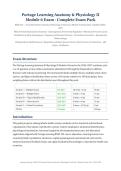
Exam Structure
The Portage Learning Anatomy & Physiology II Module 6 Exam for the 2026–2027 academic cycle
is a 23-question secure online examination administered through the Respondus LockDown
Browser with webcam monitoring. The instrument blends multiple-choice, multiple-select, short-
answer, and figure-identification items across a 60-minute window for 100 total points. Item
weighting below reflects the distribution used throughout this pack.
Section Items Weighting Points
Section I — Multiple Choice Q1–Q10 10 items × 4 pts 40 pts
Section II — Multiple Select Q11–Q13 3 items × 5 pts 15 pts
Section III — Figure Identification Q14–Q17 4 items × 6 pts 24 pts
Section IV — Short Answer Q18–Q21 4 items × 4 pts 16 pts
Section V — Clinical Correlation Q22–Q23 2 items × (3/2) pts 5 pts
TOTAL 23 items — 100 pts
Introduction
This guide prepares undergraduate health sciences students on the structural and functional
organization of the human reproductive system. Content emphasizes anatomical identification,
physiological mechanisms, hormonal regulation, developmental processes, and laboratory
applications aligned with Portage Learning BIOD 152 course objectives, ensuring learners can
accurately label reproductive structures, explain gametogenesis and menstrual cycle events,
interpret hormonal feedback loops, and apply foundational knowledge to reproductive health case
scenarios.
Portage Learning · BIOD 152 Essential Human Anatomy & Physiology II with Lab · Module 6 Exam Pack · 2025–2026
,Section I · Multiple-Choice Items (Q1–Q10 · 4 points each)
Question 1 (4 points · Multiple Choice)
All of the following are functions of the ovaries EXCEPT:
A. Production of eggs (oocytes)
B. Maintaining the development of a fetus ✓
C. Production of estrogen
D. Development of the corpus luteum
Correct Answer: B. Maintaining the development of a fetus
Rationale: The ovaries are the female gonads: they produce oocytes through oogenesis, secrete estrogen
and progesterone, and house the follicle that becomes the corpus luteum after ovulation. Maintaining fetal
development is the role of the uterus, which provides the implantation site, and of the placenta, which takes
over nutritive, respiratory, excretory, and endocrine support once established. The ovary contributes indirectly
by secreting progesterone from the corpus luteum during the first trimester, but it does not house or maintain
the fetus itself.
References: Portage Learning BIOD 152 Module 6, 'The Ovaries'; Marieb & Hoehn, Human Anatomy & Physiology, 11th
ed., Ch. 27; Saladin, Anatomy & Physiology, 9th ed., Ch. 28.
Question 2 (4 points · Multiple Choice)
Which of the following statements is TRUE concerning oogenesis?
A. It begins at the time of puberty.
B. The primary oocyte divides to produce a secondary oocyte. ✓
C. Each primary oocyte produces two to three mature ova.
D. The first polar body retains all of the cytoplasm.
Correct Answer: B. The primary oocyte divides to produce a secondary oocyte.
Rationale: In meiosis I the primary oocyte divides unequally to yield one secondary oocyte, which retains
nearly all of the cytoplasm, and one small first polar body. Option A is false because oogenesis begins during
fetal development, with primary oocytes arrested in prophase I until puberty. Option C is false because a single
primary oocyte yields only one functional ovum plus polar bodies — the key contrast with spermatogenesis,
where all four products are viable. Option D inverts the cytoplasmic distribution: the polar body receives
almost none, ensuring the ovum retains the nutrient reserves an early embryo requires.
References: Portage Learning BIOD 152 Module 6, 'Oogenesis'; Marieb & Hoehn, 11th ed., Ch. 27; Saladin, 9th ed., Ch.
28.
Question 3 (4 points · Multiple Choice)
Which of the following is TRUE concerning spermatogenesis?
A. Production of a mature sperm takes approximately 20 days.
Portage Learning · BIOD 152 Essential Human Anatomy & Physiology II with Lab · Module 6 Exam Pack · 2025–2026
, B. Spermatogenesis is complete at the time of birth.
C. Males possess at birth all the sperm they will ever produce.
D. Each primary spermatocyte produces four viable gametes. ✓
E. Each mature gamete contains a total of 46 chromosomes.
Correct Answer: D. Each primary spermatocyte produces four viable gametes.
Rationale: Meiosis of one primary spermatocyte yields four haploid spermatids, and all four go on to
become functional sperm after spermiogenesis strips away excess cytoplasm. This is the defining contrast with
oogenesis. Options B and C are false because spermatogonia remain mitotically active stem cells and sperm
production begins only at puberty and continues throughout life. Option E is false because gametes are haploid
with 23 chromosomes. Option A confuses total spermatogenesis with the roughly 20-day maturation period
sperm spend in the epididymis acquiring motility.
References: Portage Learning BIOD 152 Module 6, 'Spermatogenesis'; Marieb & Hoehn, 11th ed., Ch. 27; Martini,
Fundamentals of Anatomy & Physiology, 11th ed., Ch. 28.
Question 4 (4 points · Multiple Choice)
Blood tests indicate that both progesterone and estrogen levels are elevated. Your patient is most
likely in which phase of the uterine (menstrual) cycle?
A. Menstrual phase
B. Proliferative phase
C. Secretory phase ✓
D. Luteal phase
E. Follicular phase
Correct Answer: C. Secretory phase
Rationale: During the secretory phase (days 15–28) the corpus luteum secretes progesterone while estrogen
remains elevated, increasing endometrial blood supply and glandular secretion in preparation for
implantation. The distractor to watch is option D: luteal and follicular are phases of the ovarian cycle, not the
uterine cycle, so they cannot answer a question that specifies the uterine cycle even though the luteal phase is
concurrent. The menstrual and proliferative phases are characterized by low and rising-estrogen-with-low-
progesterone profiles respectively.
References: Portage Learning BIOD 152 Module 6, 'The Menstrual Cycle'; Marieb & Hoehn, 11th ed., Ch. 27; Saladin, 9th
ed., Ch. 28.
Question 5 (4 points · Multiple Choice)
Which layer of the uterus contracts during labor?
A. Endometrium
B. Mucosal coat
C. Perimetrium
Portage Learning · BIOD 152 Essential Human Anatomy & Physiology II with Lab · Module 6 Exam Pack · 2025–2026
Module 6 Exam · Complete Exam Pack
BIOD 152 — Essential Human Anatomy & Physiology II with Lab | Module 6 Examination | Updated 2026–
2027
Male & Female Reproductive Anatomy · Gametogenesis & Hormonal Regulation · Menstrual & Ovarian Cycles
Fertilization & Early Development · Pregnancy & Placental Function · Parturition & Lactation · Reproductive
Endocrinology
Undergraduate Health Sciences | Respondus LockDown Browser Secure Exam Format | 23 Questions · 100
Points · 60 Minutes
Exam Structure
The Portage Learning Anatomy & Physiology II Module 6 Exam for the 2026–2027 academic cycle
is a 23-question secure online examination administered through the Respondus LockDown
Browser with webcam monitoring. The instrument blends multiple-choice, multiple-select, short-
answer, and figure-identification items across a 60-minute window for 100 total points. Item
weighting below reflects the distribution used throughout this pack.
Section Items Weighting Points
Section I — Multiple Choice Q1–Q10 10 items × 4 pts 40 pts
Section II — Multiple Select Q11–Q13 3 items × 5 pts 15 pts
Section III — Figure Identification Q14–Q17 4 items × 6 pts 24 pts
Section IV — Short Answer Q18–Q21 4 items × 4 pts 16 pts
Section V — Clinical Correlation Q22–Q23 2 items × (3/2) pts 5 pts
TOTAL 23 items — 100 pts
Introduction
This guide prepares undergraduate health sciences students on the structural and functional
organization of the human reproductive system. Content emphasizes anatomical identification,
physiological mechanisms, hormonal regulation, developmental processes, and laboratory
applications aligned with Portage Learning BIOD 152 course objectives, ensuring learners can
accurately label reproductive structures, explain gametogenesis and menstrual cycle events,
interpret hormonal feedback loops, and apply foundational knowledge to reproductive health case
scenarios.
Portage Learning · BIOD 152 Essential Human Anatomy & Physiology II with Lab · Module 6 Exam Pack · 2025–2026
,Section I · Multiple-Choice Items (Q1–Q10 · 4 points each)
Question 1 (4 points · Multiple Choice)
All of the following are functions of the ovaries EXCEPT:
A. Production of eggs (oocytes)
B. Maintaining the development of a fetus ✓
C. Production of estrogen
D. Development of the corpus luteum
Correct Answer: B. Maintaining the development of a fetus
Rationale: The ovaries are the female gonads: they produce oocytes through oogenesis, secrete estrogen
and progesterone, and house the follicle that becomes the corpus luteum after ovulation. Maintaining fetal
development is the role of the uterus, which provides the implantation site, and of the placenta, which takes
over nutritive, respiratory, excretory, and endocrine support once established. The ovary contributes indirectly
by secreting progesterone from the corpus luteum during the first trimester, but it does not house or maintain
the fetus itself.
References: Portage Learning BIOD 152 Module 6, 'The Ovaries'; Marieb & Hoehn, Human Anatomy & Physiology, 11th
ed., Ch. 27; Saladin, Anatomy & Physiology, 9th ed., Ch. 28.
Question 2 (4 points · Multiple Choice)
Which of the following statements is TRUE concerning oogenesis?
A. It begins at the time of puberty.
B. The primary oocyte divides to produce a secondary oocyte. ✓
C. Each primary oocyte produces two to three mature ova.
D. The first polar body retains all of the cytoplasm.
Correct Answer: B. The primary oocyte divides to produce a secondary oocyte.
Rationale: In meiosis I the primary oocyte divides unequally to yield one secondary oocyte, which retains
nearly all of the cytoplasm, and one small first polar body. Option A is false because oogenesis begins during
fetal development, with primary oocytes arrested in prophase I until puberty. Option C is false because a single
primary oocyte yields only one functional ovum plus polar bodies — the key contrast with spermatogenesis,
where all four products are viable. Option D inverts the cytoplasmic distribution: the polar body receives
almost none, ensuring the ovum retains the nutrient reserves an early embryo requires.
References: Portage Learning BIOD 152 Module 6, 'Oogenesis'; Marieb & Hoehn, 11th ed., Ch. 27; Saladin, 9th ed., Ch.
28.
Question 3 (4 points · Multiple Choice)
Which of the following is TRUE concerning spermatogenesis?
A. Production of a mature sperm takes approximately 20 days.
Portage Learning · BIOD 152 Essential Human Anatomy & Physiology II with Lab · Module 6 Exam Pack · 2025–2026
, B. Spermatogenesis is complete at the time of birth.
C. Males possess at birth all the sperm they will ever produce.
D. Each primary spermatocyte produces four viable gametes. ✓
E. Each mature gamete contains a total of 46 chromosomes.
Correct Answer: D. Each primary spermatocyte produces four viable gametes.
Rationale: Meiosis of one primary spermatocyte yields four haploid spermatids, and all four go on to
become functional sperm after spermiogenesis strips away excess cytoplasm. This is the defining contrast with
oogenesis. Options B and C are false because spermatogonia remain mitotically active stem cells and sperm
production begins only at puberty and continues throughout life. Option E is false because gametes are haploid
with 23 chromosomes. Option A confuses total spermatogenesis with the roughly 20-day maturation period
sperm spend in the epididymis acquiring motility.
References: Portage Learning BIOD 152 Module 6, 'Spermatogenesis'; Marieb & Hoehn, 11th ed., Ch. 27; Martini,
Fundamentals of Anatomy & Physiology, 11th ed., Ch. 28.
Question 4 (4 points · Multiple Choice)
Blood tests indicate that both progesterone and estrogen levels are elevated. Your patient is most
likely in which phase of the uterine (menstrual) cycle?
A. Menstrual phase
B. Proliferative phase
C. Secretory phase ✓
D. Luteal phase
E. Follicular phase
Correct Answer: C. Secretory phase
Rationale: During the secretory phase (days 15–28) the corpus luteum secretes progesterone while estrogen
remains elevated, increasing endometrial blood supply and glandular secretion in preparation for
implantation. The distractor to watch is option D: luteal and follicular are phases of the ovarian cycle, not the
uterine cycle, so they cannot answer a question that specifies the uterine cycle even though the luteal phase is
concurrent. The menstrual and proliferative phases are characterized by low and rising-estrogen-with-low-
progesterone profiles respectively.
References: Portage Learning BIOD 152 Module 6, 'The Menstrual Cycle'; Marieb & Hoehn, 11th ed., Ch. 27; Saladin, 9th
ed., Ch. 28.
Question 5 (4 points · Multiple Choice)
Which layer of the uterus contracts during labor?
A. Endometrium
B. Mucosal coat
C. Perimetrium
Portage Learning · BIOD 152 Essential Human Anatomy & Physiology II with Lab · Module 6 Exam Pack · 2025–2026