
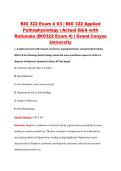
BIO 322 Exam 4 V3 | BIO 322 Applied
Pathophysiology | Actual Q&A with
Rationale (BIO322 Exam 4) | Grand Canyon
University
1. A patient presents with massive proteinuria, hypoalbuminemia, and generalized edema.
Which of the following clinical findings should the nurse practitioner expect to confirm a
diagnosis of Nephrotic Syndrome? (Select All That Apply)
A. Proteinuria greater than 3.5 g/day
B. Hyperlipidemia
C. Gross hematuria (cola-colored urine)
D. Hypovolemia due to fluid shifting
E. Vitamin D deficiency
F. Periorbital edema
Correct Answer: A, B, D, E, F
Rationale: Nephrotic syndrome is characterized by a glomerular permeability increase
leading to massive protein loss. The liver attempts to compensate for low albumin by
increasing synthesis of lipoproteins, leading to hyperlipidemia. Hematuria is more
characteristic of Nephritic syndrome, not Nephrotic syndrome, which focuses on non-
inflammatory protein loss.
,2. Which electrolyte imbalance is most commonly associated with the Syndrome of
Inappropriate Antidiuretic Hormone (SIADH)?
A. Hyperkalemia
B. Hypomagnesemia
C. Hypercalcemia
D. Hyponatremia
Correct Answer: D
Rationale: SIADH involves the excessive release of ADH, which leads to water retention
and expansion of extracellular fluid volume. This results in dilutional hyponatremia as the
kidneys reabsorb water without a corresponding reabsorption of sodium. Patients must be
monitored closely for neurological changes due to cerebral edema from low sodium levels.
3. A patient with Diabetes Insipidus (DI) is likely to exhibit which of the following clinical
manifestations?
A. High urine specific gravity and low serum osmolality
B. Low urine specific gravity and high serum osmolality
C. High urine specific gravity and high serum osmolality
D. Low urine specific gravity and low serum osmolality
Correct Answer: B
,Rationale: Diabetes Insipidus is caused by a deficiency of or resistance to ADH, leading to
the inability to concentrate urine. This results in the excretion of large volumes of dilute
urine (low specific gravity) and a subsequent increase in blood concentration (high serum
osmolality). Understanding the inverse relationship between urine and serum
concentration is vital for differentiating DI from other polyuric states.
4. Pathologically, what is the primary difference between Type 1 and Type 2 Diabetes
Mellitus?
A. Type 1 involves insulin resistance, while Type 2 involves an absolute insulin deficiency.
B. Type 1 is always associated with obesity, whereas Type 2 is associated with genetic
mutations only.
C. Type 2 only occurs in adults, whereas Type 1 only occurs in children.
D. Type 1 is characterized by autoimmune destruction of pancreatic beta cells, while Type
2 is characterized by insulin resistance and relative insulin deficiency.
Correct Answer: D
Rationale: Type 1 Diabetes Mellitus is an autoimmune disorder where the immune system
attacks and destroys the insulin-producing beta cells in the Islets of Langerhans. Type 2
Diabetes is more complex, involving peripheral tissue resistance to insulin action and a
progressive decline in beta-cell secretory function. Distinguishing these helps in
determining if the patient requires exogenous insulin for survival or if oral hypoglycemics
are appropriate.
, 5. A 45-year-old female presents with exophthalmos, heat intolerance, and a palpably
enlarged thyroid. Which laboratory result would confirm a diagnosis of Graves’ Disease?
A. Decreased TSH and Elevated T3/T4
B. Elevated TSH and Elevated T3/T4
C. Elevated TSH and Decreased T3/T4
D. Decreased TSH and Decreased T3/T4
Correct Answer: A
Rationale: Graves’ disease is an autoimmune form of hyperthyroidism where thyroid-
stimulating immunoglobulins (TSI) mimic TSH, causing overproduction of thyroid
hormones. The high levels of T3 and T4 provide negative feedback to the pituitary gland,
resulting in a suppressed (low) TSH level. Clinical symptoms like exophthalmos are specific
to Graves’ due to retro-orbital connective tissue inflammation.
6. What is the hallmark physiological change in Cushing’s Syndrome?
A. Chronic hypocortisolism
B. Excessive production of mineralocorticoids
C. Deficiency of ACTH from the pituitary
D. Chronic exposure to excessive circulating cortisol
Correct Answer: D
Pathophysiology | Actual Q&A with
Rationale (BIO322 Exam 4) | Grand Canyon
University
1. A patient presents with massive proteinuria, hypoalbuminemia, and generalized edema.
Which of the following clinical findings should the nurse practitioner expect to confirm a
diagnosis of Nephrotic Syndrome? (Select All That Apply)
A. Proteinuria greater than 3.5 g/day
B. Hyperlipidemia
C. Gross hematuria (cola-colored urine)
D. Hypovolemia due to fluid shifting
E. Vitamin D deficiency
F. Periorbital edema
Correct Answer: A, B, D, E, F
Rationale: Nephrotic syndrome is characterized by a glomerular permeability increase
leading to massive protein loss. The liver attempts to compensate for low albumin by
increasing synthesis of lipoproteins, leading to hyperlipidemia. Hematuria is more
characteristic of Nephritic syndrome, not Nephrotic syndrome, which focuses on non-
inflammatory protein loss.
,2. Which electrolyte imbalance is most commonly associated with the Syndrome of
Inappropriate Antidiuretic Hormone (SIADH)?
A. Hyperkalemia
B. Hypomagnesemia
C. Hypercalcemia
D. Hyponatremia
Correct Answer: D
Rationale: SIADH involves the excessive release of ADH, which leads to water retention
and expansion of extracellular fluid volume. This results in dilutional hyponatremia as the
kidneys reabsorb water without a corresponding reabsorption of sodium. Patients must be
monitored closely for neurological changes due to cerebral edema from low sodium levels.
3. A patient with Diabetes Insipidus (DI) is likely to exhibit which of the following clinical
manifestations?
A. High urine specific gravity and low serum osmolality
B. Low urine specific gravity and high serum osmolality
C. High urine specific gravity and high serum osmolality
D. Low urine specific gravity and low serum osmolality
Correct Answer: B
,Rationale: Diabetes Insipidus is caused by a deficiency of or resistance to ADH, leading to
the inability to concentrate urine. This results in the excretion of large volumes of dilute
urine (low specific gravity) and a subsequent increase in blood concentration (high serum
osmolality). Understanding the inverse relationship between urine and serum
concentration is vital for differentiating DI from other polyuric states.
4. Pathologically, what is the primary difference between Type 1 and Type 2 Diabetes
Mellitus?
A. Type 1 involves insulin resistance, while Type 2 involves an absolute insulin deficiency.
B. Type 1 is always associated with obesity, whereas Type 2 is associated with genetic
mutations only.
C. Type 2 only occurs in adults, whereas Type 1 only occurs in children.
D. Type 1 is characterized by autoimmune destruction of pancreatic beta cells, while Type
2 is characterized by insulin resistance and relative insulin deficiency.
Correct Answer: D
Rationale: Type 1 Diabetes Mellitus is an autoimmune disorder where the immune system
attacks and destroys the insulin-producing beta cells in the Islets of Langerhans. Type 2
Diabetes is more complex, involving peripheral tissue resistance to insulin action and a
progressive decline in beta-cell secretory function. Distinguishing these helps in
determining if the patient requires exogenous insulin for survival or if oral hypoglycemics
are appropriate.
, 5. A 45-year-old female presents with exophthalmos, heat intolerance, and a palpably
enlarged thyroid. Which laboratory result would confirm a diagnosis of Graves’ Disease?
A. Decreased TSH and Elevated T3/T4
B. Elevated TSH and Elevated T3/T4
C. Elevated TSH and Decreased T3/T4
D. Decreased TSH and Decreased T3/T4
Correct Answer: A
Rationale: Graves’ disease is an autoimmune form of hyperthyroidism where thyroid-
stimulating immunoglobulins (TSI) mimic TSH, causing overproduction of thyroid
hormones. The high levels of T3 and T4 provide negative feedback to the pituitary gland,
resulting in a suppressed (low) TSH level. Clinical symptoms like exophthalmos are specific
to Graves’ due to retro-orbital connective tissue inflammation.
6. What is the hallmark physiological change in Cushing’s Syndrome?
A. Chronic hypocortisolism
B. Excessive production of mineralocorticoids
C. Deficiency of ACTH from the pituitary
D. Chronic exposure to excessive circulating cortisol
Correct Answer: D


