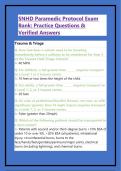
SNHD Paramedic Protocol Exam
Bank: Practice Questions &
Verified Answers
Trauma & Triage
Q: How fast does a vehicle need to be traveling
immediately before a collision to be considered for Step 3
of the Trauma Field Triage Criteria?
A: 40 MPH.
Q: For children, a fall greater than ______ requires transport
to a Level 1 or 2 trauma center.
A: 10 feet or two times the height of the child.
Q: For adults, a fall greater than ______ requires transport to
a Level 1, 2, or 3 trauma center.
A: 20 feet.
Q: An auto vs pedestrian/bicyclist thrown, run over, or with
significant (greater than 15 mph) impact requires transport
to a Level 1, 2, or 3 trauma center.
A: False (greater than 20mph).
Q: Which of the following patients should be transported to
a burn center?
A: Patients with second and/or third-degree burns >10% BSA (if
under 10 or over 50), >20% BSA (all patients), inhalational
injury, circumferential burns, burns to the
face/hands/feet/genitalia/perineum/major joints, electrical
burns (including lightning), and chemical burns.
,Q: What is the Parkland Burn Formula for Fluid
Replacement?
A: 4ml x (body weight in kg) x (% BSA burned) = total fluids for
24 hours. Give 1/2 in the first 8 hours; give the remainder over
the next 16 hours.
Q: A patient who was ejected from a motor vehicle requires
transport to a Level 1 and 2 trauma center only.
A: False (Level 1, 2, or 3).
Q: A patient with a GCS less than ______ must be transported
to a Level 1 or 2 trauma center.
A: 13.
Cardiac & Resuscitation
Q: When should defibrillation be attempted during a
witnessed cardiac arrest?
A: Immediately.
Q: When should defibrillation be attempted during an
unwitnessed cardiac arrest?
A: After 2 minutes of CPR.
Q: What is recommended if hypoxia is the cause of cardiac
arrest?
A: Early ventilation.
Q: What are possible causes of cardiogenic shock?
A: Myocardial contusion, heart failure, MI, toxins, and
cardiomyopathy.
Q: For a traumatic cardiac arrest, what interventions must
be performed prior to considering terminating
resuscitation efforts?
, A: Provide effective ventilation with 100% oxygenation for two
minutes, open the airway with basic life support measures, and
perform bilateral needle thoracentesis if a tension
pneumothorax is suspected.
Q: Which of the following are approved hypothermia (post-
resuscitation) centers?
A: Centennial Hills, Desert Springs, Mountain View Hospital, St.
Rose De Lima, St. Rose Siena, Southern Hills, Spring Valley,
Summerlin, Sunrise, UMC, Valley.
Medications & Dosages
Q: What is the dose of Naloxone (Narcan) in the setting of a
suspected overdose?
A: 2.0 mg IN/IM/IV; may be repeated to a max dose of 10mg.
Q: What is the dose of Nitroglycerin for a patient in
Pulmonary Edema/CHF who is hypertensive with a diastolic
BP > 100 mmHg?
A: 1.6 mg SL.
Q: What is the dose of Nitroglycerin for a patient in
Pulmonary Edema/CHF who is normotensive?
A: 0.4 mg SL.
Q: What is the dose of Midazolam (Versed) for a patient in
seizure?
A: 0.1 mg/kg IM/IN/IV up to a maximum of 5.0 mg.
Q: What is the dose of Aspirin for a patient with chest pain?
A: 324mg.
Pediatrics & Obstetrics
Bank: Practice Questions &
Verified Answers
Trauma & Triage
Q: How fast does a vehicle need to be traveling
immediately before a collision to be considered for Step 3
of the Trauma Field Triage Criteria?
A: 40 MPH.
Q: For children, a fall greater than ______ requires transport
to a Level 1 or 2 trauma center.
A: 10 feet or two times the height of the child.
Q: For adults, a fall greater than ______ requires transport to
a Level 1, 2, or 3 trauma center.
A: 20 feet.
Q: An auto vs pedestrian/bicyclist thrown, run over, or with
significant (greater than 15 mph) impact requires transport
to a Level 1, 2, or 3 trauma center.
A: False (greater than 20mph).
Q: Which of the following patients should be transported to
a burn center?
A: Patients with second and/or third-degree burns >10% BSA (if
under 10 or over 50), >20% BSA (all patients), inhalational
injury, circumferential burns, burns to the
face/hands/feet/genitalia/perineum/major joints, electrical
burns (including lightning), and chemical burns.
,Q: What is the Parkland Burn Formula for Fluid
Replacement?
A: 4ml x (body weight in kg) x (% BSA burned) = total fluids for
24 hours. Give 1/2 in the first 8 hours; give the remainder over
the next 16 hours.
Q: A patient who was ejected from a motor vehicle requires
transport to a Level 1 and 2 trauma center only.
A: False (Level 1, 2, or 3).
Q: A patient with a GCS less than ______ must be transported
to a Level 1 or 2 trauma center.
A: 13.
Cardiac & Resuscitation
Q: When should defibrillation be attempted during a
witnessed cardiac arrest?
A: Immediately.
Q: When should defibrillation be attempted during an
unwitnessed cardiac arrest?
A: After 2 minutes of CPR.
Q: What is recommended if hypoxia is the cause of cardiac
arrest?
A: Early ventilation.
Q: What are possible causes of cardiogenic shock?
A: Myocardial contusion, heart failure, MI, toxins, and
cardiomyopathy.
Q: For a traumatic cardiac arrest, what interventions must
be performed prior to considering terminating
resuscitation efforts?
, A: Provide effective ventilation with 100% oxygenation for two
minutes, open the airway with basic life support measures, and
perform bilateral needle thoracentesis if a tension
pneumothorax is suspected.
Q: Which of the following are approved hypothermia (post-
resuscitation) centers?
A: Centennial Hills, Desert Springs, Mountain View Hospital, St.
Rose De Lima, St. Rose Siena, Southern Hills, Spring Valley,
Summerlin, Sunrise, UMC, Valley.
Medications & Dosages
Q: What is the dose of Naloxone (Narcan) in the setting of a
suspected overdose?
A: 2.0 mg IN/IM/IV; may be repeated to a max dose of 10mg.
Q: What is the dose of Nitroglycerin for a patient in
Pulmonary Edema/CHF who is hypertensive with a diastolic
BP > 100 mmHg?
A: 1.6 mg SL.
Q: What is the dose of Nitroglycerin for a patient in
Pulmonary Edema/CHF who is normotensive?
A: 0.4 mg SL.
Q: What is the dose of Midazolam (Versed) for a patient in
seizure?
A: 0.1 mg/kg IM/IN/IV up to a maximum of 5.0 mg.
Q: What is the dose of Aspirin for a patient with chest pain?
A: 324mg.
Pediatrics & Obstetrics