

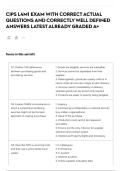
CIPS L4M1 EXAM WITH CORRECT ACTUAL
QUESTIONS AND CORRECTLY WELL DEFINED
ANSWERS LATEST ALREADY GRADED A+
Terms in this set (49)
O1. Outline FIVE differences 1. Goods are tangible, services are intangible:
between purchasing goods and 2. Services cannot be separated from their
purchasing services. supplier:
3. Heterogeneity: goods are usually uniform in
nature while services are unique at each delivery
4. Services 'perish' immediately on delivery
whereas goods can be stored until required
5. Products are easier to specify, being tangible
O2. Explain THREE circumstances in 1. Urgency
which a competitive tendering 2. Commercial confidentiality or national security
exercise might not be the best (e.g. military organisations):
approach to making a purchase. 3. Value of the purchase:
4. Production costs cannot be measured
accurately:
5. Price is not the only criterion for supplier
selection and contract award
6. Intellectual Property Rights and monopoly
O2. Describe TWO e-sourcing tools 1. E-Catalogues
and their use in procurement and 2. E-Tendering
supply. 3. E. Auction
4. Reverse Auctions
5. Online suppleir evaluation data
,O3. Explain the role of a shared SSUs reflect a desire to centralise and share
services unit (SSU). services
The shared service provider becomes a
dedicated provider of services such as; finance,
HR, IT and procurement which continue to be
provided internally
An SSU manages costs and quality SLAs to
demonstrate value for money.
An SSU's benefits may be summarised as:
• cost effective internal service;
• liaison with its customers;
• anticipating future demand;
• employing resources and providing higher
levels of service more cost effectively than if they
were provided by a department or an external
provider.
, O3. A manufacturer of electrically Centralisation' and 'decentralisation' refer to the
powered tools for the engineering degree to which responsibility and authority is
industry consists of four separate delegated. Arguments for centralisation can only
business units, each of which be evaluated in the context of specific
undertakes its own purchasing organisational environment and might include:
activities.
1. Policies & procedures
Discuss THREE benefits of 2. Consolidation of requirements
centralising all purchasing activities 3. Location
with those of retaining the present 4. Supply market structure
decentralised structure. (1 of 2) 5. Expertise required:
6. Customer demands
O3. A manufacturer of electrically The benefits of retaining the present de-
powered tools for the engineering centralised structure include:
industry consists of four separate 1. Local responsibility
business units, each of which 2. Knowledge of the local environment, culture
undertakes its own purchasing and customer needs
activities. 3. Skills development of buyers in each unit
4. Better communication and coordination
Discuss THREE benefits of between procurement and operating
centralising all purchasing activities departments,
with those of retaining the present 5. Customer focus: buyers are 'closer' to internal
decentralised structure. (2 of 2) and external customers developing
understanding of user needs and problems.
6. Quicker response to operational and user
needs,
7. Smaller purchase quantities:
8. Accountability: d
9. Freeing central procurement units to focus on
higher-level, value-adding tasks.
QUESTIONS AND CORRECTLY WELL DEFINED
ANSWERS LATEST ALREADY GRADED A+
Terms in this set (49)
O1. Outline FIVE differences 1. Goods are tangible, services are intangible:
between purchasing goods and 2. Services cannot be separated from their
purchasing services. supplier:
3. Heterogeneity: goods are usually uniform in
nature while services are unique at each delivery
4. Services 'perish' immediately on delivery
whereas goods can be stored until required
5. Products are easier to specify, being tangible
O2. Explain THREE circumstances in 1. Urgency
which a competitive tendering 2. Commercial confidentiality or national security
exercise might not be the best (e.g. military organisations):
approach to making a purchase. 3. Value of the purchase:
4. Production costs cannot be measured
accurately:
5. Price is not the only criterion for supplier
selection and contract award
6. Intellectual Property Rights and monopoly
O2. Describe TWO e-sourcing tools 1. E-Catalogues
and their use in procurement and 2. E-Tendering
supply. 3. E. Auction
4. Reverse Auctions
5. Online suppleir evaluation data
,O3. Explain the role of a shared SSUs reflect a desire to centralise and share
services unit (SSU). services
The shared service provider becomes a
dedicated provider of services such as; finance,
HR, IT and procurement which continue to be
provided internally
An SSU manages costs and quality SLAs to
demonstrate value for money.
An SSU's benefits may be summarised as:
• cost effective internal service;
• liaison with its customers;
• anticipating future demand;
• employing resources and providing higher
levels of service more cost effectively than if they
were provided by a department or an external
provider.
, O3. A manufacturer of electrically Centralisation' and 'decentralisation' refer to the
powered tools for the engineering degree to which responsibility and authority is
industry consists of four separate delegated. Arguments for centralisation can only
business units, each of which be evaluated in the context of specific
undertakes its own purchasing organisational environment and might include:
activities.
1. Policies & procedures
Discuss THREE benefits of 2. Consolidation of requirements
centralising all purchasing activities 3. Location
with those of retaining the present 4. Supply market structure
decentralised structure. (1 of 2) 5. Expertise required:
6. Customer demands
O3. A manufacturer of electrically The benefits of retaining the present de-
powered tools for the engineering centralised structure include:
industry consists of four separate 1. Local responsibility
business units, each of which 2. Knowledge of the local environment, culture
undertakes its own purchasing and customer needs
activities. 3. Skills development of buyers in each unit
4. Better communication and coordination
Discuss THREE benefits of between procurement and operating
centralising all purchasing activities departments,
with those of retaining the present 5. Customer focus: buyers are 'closer' to internal
decentralised structure. (2 of 2) and external customers developing
understanding of user needs and problems.
6. Quicker response to operational and user
needs,
7. Smaller purchase quantities:
8. Accountability: d
9. Freeing central procurement units to focus on
higher-level, value-adding tasks.


