

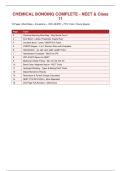
CHEMICAL BONDING COMPLETE - NEET & Class
11
15 Pages | Mind Maps + Exceptions + 100% NCERT + PYQ Tricks | Stuvia Special
Page Topic
2 Chemical Bonding Mind Map - Why Bonds Form?
3 Ionic Bond - Lattice, Properties, Fajans Rule
4 Covalent Bond - Lewis, VSEPR Full Table
5 VSEPR Shapes - 2 to 7 Electron Pairs with Examples
6 Hybridization - sp, sp2, sp3, sp3d, sp3d2 Tricks
7 Hybridization Examples - BeCl2 to SF6
8 VBT & MOT Basics for NEET
9 Molecular Orbital Theory - B2, C2, N2, O2, F2
10 Bond Order, Magnetic Nature - MOT Tricks
11 Hydrogen Bonding - Types & Boiling Point Tricks
12 Dipole Moment & Polarity
13 Resonance & Formal Charge Calculation
14 NEET PYQ 2019-2024 + Most Repeated
15 One Page Full Revision + Mnemonics
,Page 2 - Why Chemical Bonds Form?
Octet Rule: Atoms try to get 8 electrons in outermost shell (ns2 np6)
3 Reasons: 1) Lower energy 2) Stability 3) Noble gas config
Types: Ionic (transfer), Covalent (sharing), Coordinate (donation), Metallic, H-bonding (not real bond)
NEET Trick: Bond strength: Ionic > Covalent > H-bond > van der Waals
Kossel-Lewis Approach: Lewis dot - show valence electrons as dots
, Page 3 - Ionic Bond & Fajans Rule
Ionic Bond: Complete transfer of electron from metal (low IE) to non-metal (high EA)
Lattice Energy: Higher charge + smaller size = stronger ionic bond. Eg: MgO > NaCl
Properties: High MP/BP, soluble in water, conduct electricity in aqueous & molten, not solid
Fajans Rule - Covalent character in Ionic: Small cation + Large anion + High charge = more covalent
Order of covalent character: NaCl < MgCl2 < AlCl3 (same anion, cation charge increases)
NEET PYQ: AlCl3 is covalent while NaCl ionic due to Fajans
Compound Cation Size Covalent %
NaCl Large Na+ Least
MgCl2 Smaller Mg2+ Medium
AlCl3 Smallest Al3+ Most covalent - soluble in organic
11
15 Pages | Mind Maps + Exceptions + 100% NCERT + PYQ Tricks | Stuvia Special
Page Topic
2 Chemical Bonding Mind Map - Why Bonds Form?
3 Ionic Bond - Lattice, Properties, Fajans Rule
4 Covalent Bond - Lewis, VSEPR Full Table
5 VSEPR Shapes - 2 to 7 Electron Pairs with Examples
6 Hybridization - sp, sp2, sp3, sp3d, sp3d2 Tricks
7 Hybridization Examples - BeCl2 to SF6
8 VBT & MOT Basics for NEET
9 Molecular Orbital Theory - B2, C2, N2, O2, F2
10 Bond Order, Magnetic Nature - MOT Tricks
11 Hydrogen Bonding - Types & Boiling Point Tricks
12 Dipole Moment & Polarity
13 Resonance & Formal Charge Calculation
14 NEET PYQ 2019-2024 + Most Repeated
15 One Page Full Revision + Mnemonics
,Page 2 - Why Chemical Bonds Form?
Octet Rule: Atoms try to get 8 electrons in outermost shell (ns2 np6)
3 Reasons: 1) Lower energy 2) Stability 3) Noble gas config
Types: Ionic (transfer), Covalent (sharing), Coordinate (donation), Metallic, H-bonding (not real bond)
NEET Trick: Bond strength: Ionic > Covalent > H-bond > van der Waals
Kossel-Lewis Approach: Lewis dot - show valence electrons as dots
, Page 3 - Ionic Bond & Fajans Rule
Ionic Bond: Complete transfer of electron from metal (low IE) to non-metal (high EA)
Lattice Energy: Higher charge + smaller size = stronger ionic bond. Eg: MgO > NaCl
Properties: High MP/BP, soluble in water, conduct electricity in aqueous & molten, not solid
Fajans Rule - Covalent character in Ionic: Small cation + Large anion + High charge = more covalent
Order of covalent character: NaCl < MgCl2 < AlCl3 (same anion, cation charge increases)
NEET PYQ: AlCl3 is covalent while NaCl ionic due to Fajans
Compound Cation Size Covalent %
NaCl Large Na+ Least
MgCl2 Smaller Mg2+ Medium
AlCl3 Smallest Al3+ Most covalent - soluble in organic


