
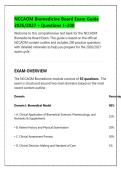
NCCAOM Biomedicine Board Exam Guide
2026/2027 – Questions 1–200
Welcome to this comprehensive test bank for the NCCAOM
Biomedicine Board Exam. This guide is based on the official
NCCAOM content outline and includes 200 practice questions
with detailed rationales to help you prepare for the 2026/2027
exam cycle .
EXAM OVERVIEW
The NCCAOM Biomedicine module consists of 50 questions . The
exam is structured around two main domains based on the most
recent content outline :
Domain Percentag
Domain I: Biomedical Model 80%
• A. Clinical Application of Biomedical Sciences, Pharmacology, and
25%
Nutrients & Supplements
• B. Patient History and Physical Examination 20%
• C. Clinical Assessment Process 30%
• D. Clinical Decision-Making and Standard of Care 5%
,Domain Percentag
Domain II: Safety and Professional Responsibilities 20%
Passing Score: 70% (35 of 50 correct)
DOMAIN I: BIOMEDICAL MODEL
Section A: Clinical Application, Pharmacology, and
Nutrients/Supplements
Question 1
A 60-year-old male patient with a 40-pack-year smoking
history presents with a chronic cough, hemoptysis, and
weight loss. He also complains of shoulder and chest pain.
The most likely primary site of malignancy is:
A) Prostate
B) Colon
C) Lung
D) Renal
Answer: C) Lung.
Rationale: Lung cancer is most common in patients over 60 with a
significant smoking history. Classic red flags include chronic cough,
hemoptysis, weight loss, and shoulder/chest pain .
,Question 2
A 55-year-old male complains of low back pain, frequent
urination, and difficulty starting urination. Which malignancy
should be suspected?
A) Lung cancer
B) Prostate cancer
C) Colon cancer
D) Renal cancer
Answer: B) Prostate cancer.
Rationale: Prostate cancer is most common in men over 50
presenting with lumbar/sacral pain, frequent urination, weak urine
stream, and difficulty starting urination .
Question 3
What are the most common primary sites of metastatic
tumors?
A) Lung, Prostate, Renal, Breast, Colon
B) Brain, Liver, Pancreas, Stomach
C) Bone, Skin, Thyroid, Adrenal
D) Heart, Spleen, Kidney, Bladder
Answer: A) Lung, Prostate, Renal, Breast, Colon.
, Rationale: The five most common primary sites for metastatic
tumors are lung, prostate, renal, breast, and colon .
Question 4
The "C" in the cancer alert mnemonic stands for:
A) Cough that persists
B) Changes in bowel or bladder
C) Chest pain
D) Color changes in skin
Answer: B) Changes in bowel or bladder.
Rationale: The cancer alert mnemonic CAUTION includes: C -
Changes in bowel or bladder, A - A sore throat that fails to heal in 6
weeks, U - Unusual bleeding or discharge, T - Thickening/lump, I -
Indigestion or difficulty swallowing, O - Obvious change in wart or
mole, N - Nagging cough or hoarseness .
Question 5
A patient presents with a mole that has asymmetric shape,
irregular borders, non-uniform pigmentation, and is larger
than 6mm. Which malignancy is most concerning?
A) Basal cell carcinoma
B) Squamous cell carcinoma
2026/2027 – Questions 1–200
Welcome to this comprehensive test bank for the NCCAOM
Biomedicine Board Exam. This guide is based on the official
NCCAOM content outline and includes 200 practice questions
with detailed rationales to help you prepare for the 2026/2027
exam cycle .
EXAM OVERVIEW
The NCCAOM Biomedicine module consists of 50 questions . The
exam is structured around two main domains based on the most
recent content outline :
Domain Percentag
Domain I: Biomedical Model 80%
• A. Clinical Application of Biomedical Sciences, Pharmacology, and
25%
Nutrients & Supplements
• B. Patient History and Physical Examination 20%
• C. Clinical Assessment Process 30%
• D. Clinical Decision-Making and Standard of Care 5%
,Domain Percentag
Domain II: Safety and Professional Responsibilities 20%
Passing Score: 70% (35 of 50 correct)
DOMAIN I: BIOMEDICAL MODEL
Section A: Clinical Application, Pharmacology, and
Nutrients/Supplements
Question 1
A 60-year-old male patient with a 40-pack-year smoking
history presents with a chronic cough, hemoptysis, and
weight loss. He also complains of shoulder and chest pain.
The most likely primary site of malignancy is:
A) Prostate
B) Colon
C) Lung
D) Renal
Answer: C) Lung.
Rationale: Lung cancer is most common in patients over 60 with a
significant smoking history. Classic red flags include chronic cough,
hemoptysis, weight loss, and shoulder/chest pain .
,Question 2
A 55-year-old male complains of low back pain, frequent
urination, and difficulty starting urination. Which malignancy
should be suspected?
A) Lung cancer
B) Prostate cancer
C) Colon cancer
D) Renal cancer
Answer: B) Prostate cancer.
Rationale: Prostate cancer is most common in men over 50
presenting with lumbar/sacral pain, frequent urination, weak urine
stream, and difficulty starting urination .
Question 3
What are the most common primary sites of metastatic
tumors?
A) Lung, Prostate, Renal, Breast, Colon
B) Brain, Liver, Pancreas, Stomach
C) Bone, Skin, Thyroid, Adrenal
D) Heart, Spleen, Kidney, Bladder
Answer: A) Lung, Prostate, Renal, Breast, Colon.
, Rationale: The five most common primary sites for metastatic
tumors are lung, prostate, renal, breast, and colon .
Question 4
The "C" in the cancer alert mnemonic stands for:
A) Cough that persists
B) Changes in bowel or bladder
C) Chest pain
D) Color changes in skin
Answer: B) Changes in bowel or bladder.
Rationale: The cancer alert mnemonic CAUTION includes: C -
Changes in bowel or bladder, A - A sore throat that fails to heal in 6
weeks, U - Unusual bleeding or discharge, T - Thickening/lump, I -
Indigestion or difficulty swallowing, O - Obvious change in wart or
mole, N - Nagging cough or hoarseness .
Question 5
A patient presents with a mole that has asymmetric shape,
irregular borders, non-uniform pigmentation, and is larger
than 6mm. Which malignancy is most concerning?
A) Basal cell carcinoma
B) Squamous cell carcinoma


