
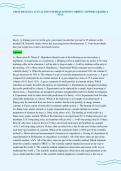
CHEM 104 EXAM 1 ACTUAL TEST PAPER QUESTIONS CORRECT ANSWERS GRADED A
PLUS
CHEM 104 Exam 1 Questions and Answers Verified
Solutions Latest Update 2026/2027
Question:
theory: A. During your visit to the gym, your trainer records that you ran for 25 minutes on the
treadmill. B. Scientific studies shows that exercising lowers blood pressure. C. Your doctor thinks
that your weight loss is due to increased exercise.
Answer:
A. Observation B. Theory C. Hypothesis Identify each of the following as an observation, a
hypothesis, an experiment, or a conclusion: a. Drinking coffee at night keeps me awake. b. If I stop
drinking coffee in the afternoon, I will be able to sleep at night. c. I will try drinking coffee only in
the morning -✓✓a. Observation b. Hypothesis c. Experiment Which statement most resembles a
scientific theory? a. When the pressure on a sample of oxygen gas is increased 10%, the volume of
the gas decreases by 10%. b. The volume of a gas is inversely proportional to its pressure. c. A gas is
composed of small particles in constant motion. d. A gas sample has a mass of 15.8 grams and a
volume of 10.5 liters. -✓✓c. A gas is composed of small particles in constant motion. Which
statement accurately describes the purpose of experiments? a. Experiments are designed to produce
the results predicted by a theory. b. Experiments can be replaced by a simple, logical reasoning of
known facts. c. Experiments are designed to produce unexplainable results for further investigation.
d. Experiments look for other observable predictions of a theory. -✓✓d. Experiments look for other
observable predictions of a theory. Which of the following is an example of an observation? a.
Energy may be converted from one form to another, but the total quantity of energy remains
constant. b. Gases consist of molecules in constant random motion. c. The burning of wood results
in a flame, heat, smoke, and ash. d. A pure compound always contains definite or constant
proportions of elements by mass. e. None of the above -✓✓c. The burning of wood results in a
flame, heat, smoke, and ash. Which of the following is an experiment (E)? a. Eating salsa gives me
heartburn. b. If I stop eating salsa, my heartburn will go away. c. I will stop eating salsa for 10 days,
then eat salsa twice a day for the next 10 days and record each time I get heartburn in a journal.
-✓✓c. I will stop eating salsa for 10 days, then eat salsa twice a day for the next 10 days and record
each time I get heartburn in a journal. Which of the statements below is NOT part of the scientific
method? a. Observation and measurement b. Formation of a hypothesis c. Testing of a hypothesis by
experimentation d. Refinement of a hypothesis as needed e. All of the above steps are part of the
scientific method. -✓✓e. All of the above steps are part of the scientific method. Which statement
about the scientific method is TRUE? a. The scientific method emphasizes reason as the way to
understand the world. b. The scientific method emphasizes observation and reason as the way to
understand the world. c. The scientific method emphasizes observation and experimentation as the
way to understand the world. d. The scientific method emphasizes scientific laws as the way to
PLUS
CHEM 104 Exam 1 Questions and Answers Verified
Solutions Latest Update 2026/2027
Question:
theory: A. During your visit to the gym, your trainer records that you ran for 25 minutes on the
treadmill. B. Scientific studies shows that exercising lowers blood pressure. C. Your doctor thinks
that your weight loss is due to increased exercise.
Answer:
A. Observation B. Theory C. Hypothesis Identify each of the following as an observation, a
hypothesis, an experiment, or a conclusion: a. Drinking coffee at night keeps me awake. b. If I stop
drinking coffee in the afternoon, I will be able to sleep at night. c. I will try drinking coffee only in
the morning -✓✓a. Observation b. Hypothesis c. Experiment Which statement most resembles a
scientific theory? a. When the pressure on a sample of oxygen gas is increased 10%, the volume of
the gas decreases by 10%. b. The volume of a gas is inversely proportional to its pressure. c. A gas is
composed of small particles in constant motion. d. A gas sample has a mass of 15.8 grams and a
volume of 10.5 liters. -✓✓c. A gas is composed of small particles in constant motion. Which
statement accurately describes the purpose of experiments? a. Experiments are designed to produce
the results predicted by a theory. b. Experiments can be replaced by a simple, logical reasoning of
known facts. c. Experiments are designed to produce unexplainable results for further investigation.
d. Experiments look for other observable predictions of a theory. -✓✓d. Experiments look for other
observable predictions of a theory. Which of the following is an example of an observation? a.
Energy may be converted from one form to another, but the total quantity of energy remains
constant. b. Gases consist of molecules in constant random motion. c. The burning of wood results
in a flame, heat, smoke, and ash. d. A pure compound always contains definite or constant
proportions of elements by mass. e. None of the above -✓✓c. The burning of wood results in a
flame, heat, smoke, and ash. Which of the following is an experiment (E)? a. Eating salsa gives me
heartburn. b. If I stop eating salsa, my heartburn will go away. c. I will stop eating salsa for 10 days,
then eat salsa twice a day for the next 10 days and record each time I get heartburn in a journal.
-✓✓c. I will stop eating salsa for 10 days, then eat salsa twice a day for the next 10 days and record
each time I get heartburn in a journal. Which of the statements below is NOT part of the scientific
method? a. Observation and measurement b. Formation of a hypothesis c. Testing of a hypothesis by
experimentation d. Refinement of a hypothesis as needed e. All of the above steps are part of the
scientific method. -✓✓e. All of the above steps are part of the scientific method. Which statement
about the scientific method is TRUE? a. The scientific method emphasizes reason as the way to
understand the world. b. The scientific method emphasizes observation and reason as the way to
understand the world. c. The scientific method emphasizes observation and experimentation as the
way to understand the world. d. The scientific method emphasizes scientific laws as the way to


